
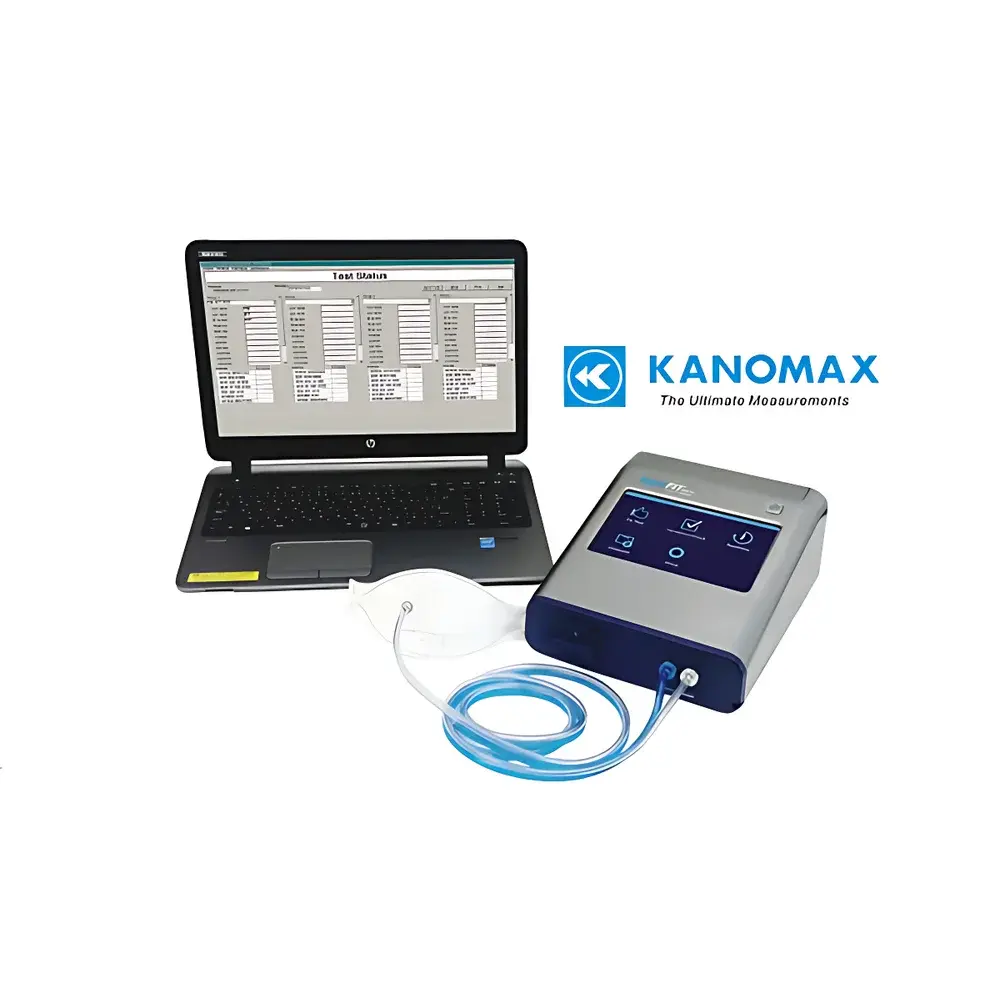
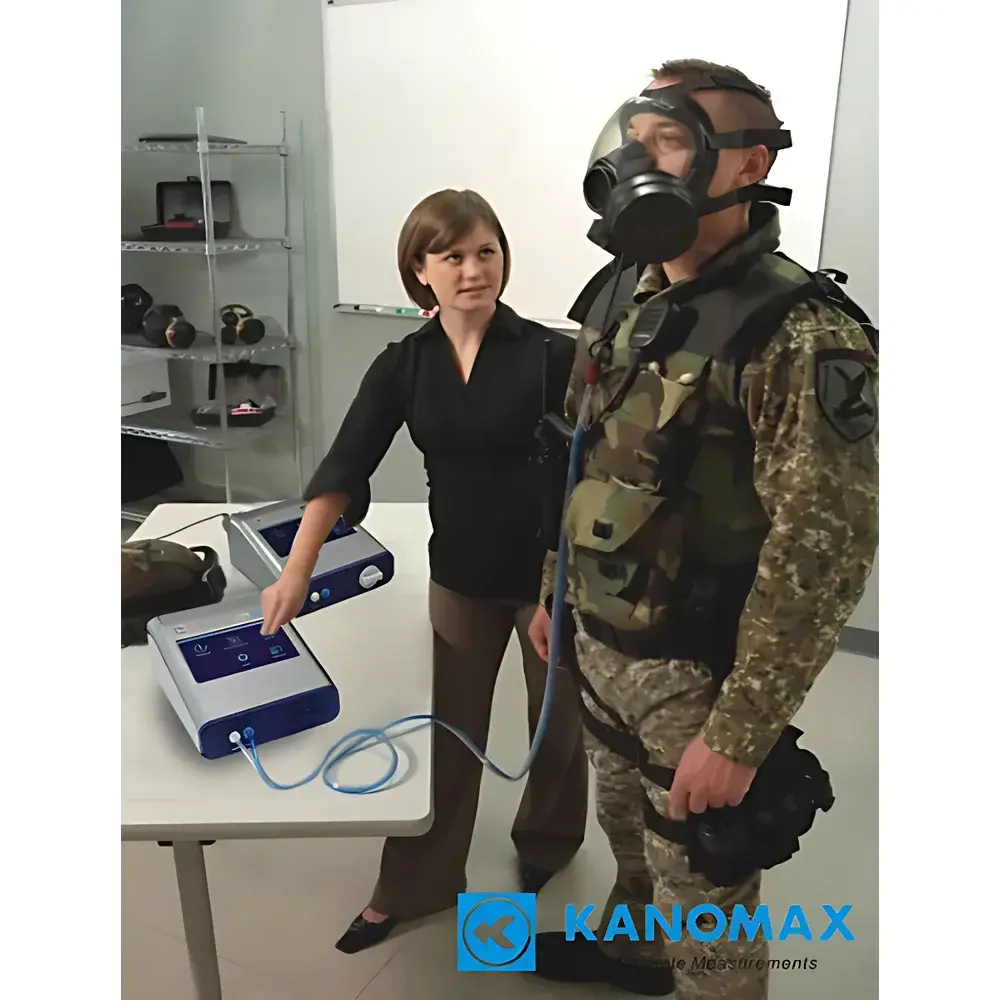
Kanomax AccuFIT 9000 Quantitative Respirator Fit Testing System
| Brand | Kanomax |
|---|---|
| Origin | Japan |
| Model | AccuFIT 9000 |
| Particle Concentration Range | 0–100,000 particles/cm³ |
| Particle Size Range | 0.02–1.0 µm |
| Sampling Flow Rate | 100 cm³/min |
| Total Flow Rate | 700 cm³/min |
| Fit Factor Measurement Method | Direct (Cout/Cin) |
| Test Aerosol | 99.5% ethanol + analytical-grade isopropanol |
| Display | 7-inch full-color touchscreen |
| Communication Interfaces | USB (Host ×2, Device ×1), Ethernet ×1, Wi-Fi enabled |
| Operating Temperature | 15–35 °C |
| Power Supply | AC 110–240 V, 50/60 Hz |
| Dimensions | 208 × 117 × 262 mm |
| Weight | 2.1 kg |
| Language Support | English, French, Spanish, Portuguese, Chinese |
| Multi-unit Control | Up to 4 units controlled simultaneously via single PC |
| Data Export Format | Microsoft Excel (.xlsx) |
| Compliance | GB 2626–2019, GB 19083–2010, OSHA 29 CFR 1910.134, CSA Z94.4–18 |
Overview
The Kanomax AccuFIT 9000 is a quantitative respirator fit testing system engineered for precision, repeatability, and regulatory compliance in occupational health and clinical safety environments. It employs the ambient aerosol condensation nuclei counter (CNC) method—based on real-time particle counting—to quantitatively assess the fit of filtering facepiece respirators (FFRs), half-masks, full-face respirators, and powered air-purifying respirators (PAPRs). Unlike qualitative methods that rely on subjective sensory detection, the AccuFIT 9000 delivers objective, numerical fit factors (FF) by comparing ambient particle concentration outside the respirator (Cout) with the concentration inside the facepiece (Cin) during standardized test exercises. This ratio (Cout/Cin) constitutes the quantitative fit factor, enabling rigorous pass/fail evaluation against internationally recognized thresholds—including ≥100 for N95/KN95 respirators per OSHA 29 CFR 1910.134 and GB 2626–2019.
Key Features
- Real-time CNC-based particle counting across a validated size range of 0.02–1.0 µm, optimized for detecting ultrafine challenge aerosols generated from ethanol/isopropanol vapor condensation.
- Integrated dual-flow architecture: precise 100 cm³/min sampling flow through the respirator’s interior, plus 700 cm³/min total system flow ensuring stable aerosol generation and consistent chamber dynamics.
- 7-inch high-resolution resistive touchscreen interface with five-language support (English, French, Spanish, Portuguese, Chinese), enabling seamless operation across multinational facilities.
- Flexible connectivity: three USB ports (two Host, one Device), Gigabit Ethernet, and optional Wi-Fi—supporting remote diagnostics, firmware updates, and centralized data aggregation.
- Multi-instrument control architecture: a single Windows-based PC can concurrently manage up to four AccuFIT 9000 units, streamlining high-volume fit testing programs in hospitals, manufacturing plants, and research laboratories.
- Robust mechanical design: compact footprint (208 × 117 × 262 mm), lightweight aluminum chassis (2.1 kg), and integrated thermal management ensure stable performance across ambient temperatures of 15–35 °C.
Sample Compatibility & Compliance
The AccuFIT 9000 is validated for use with all major classes of particulate-filtering respiratory protection devices, including disposable FFRs (N95, KN95, KP95, N99, P3, HEPA), elastomeric half-masks and full-facepieces, and reusable respirators equipped with P100 or equivalent filters. Its test protocol aligns with the exercise sequences and pass criteria defined in ISO 16900–1:2019 (Respiratory protective devices — Methods of test and test equipment — Part 1: Determination of inward leakage), ASTM F1885–22 (Standard Practice for Conducting Quantitative Fit Tests of Negative Pressure Respirators), and China’s GB 2626–2019 (Respiratory Protective Devices – Self-Contained Filtering Devices Against Particles). For medical-grade respirators, it satisfies the total inward leakage (TIL) requirements of GB 19083–2010, where ≥8 of 10 subjects must achieve TIL ≤8% for KN95/KP95 and ≤2% for KN100/KP100. The system supports audit-ready documentation compliant with GLP and GMP frameworks, including timestamped test logs, operator ID tagging, and tamper-evident data export.
Software & Data Management
The AccuFIT 9000 operates standalone or integrates with Kanomax’s dedicated FitTest Manager software (Windows 10/11 compatible), which provides full test lifecycle control—from subject registration and test sequence assignment to automated pass/fail adjudication and statistical reporting. All raw particle count data, time-stamped exercise phase markers (e.g., normal breathing, deep breathing, head movement), and calculated fit factors are stored locally and exported in native Microsoft Excel (.xlsx) format. Audit trails include user login history, calibration event timestamps, and instrument configuration changes—supporting FDA 21 CFR Part 11 readiness when deployed in regulated pharmaceutical or biotech settings. Data encryption and role-based access control are enforced at the application layer.
Applications
- Occupational Health & Safety Programs: Mandatory annual or pre-deployment fit testing for healthcare workers, first responders, industrial maintenance personnel, and cleanroom operators.
- Hospital Infection Control Units: Validation of surgical N95 respirators under pandemic response protocols per CDC/NIOSH guidelines and WHO interim guidance on respiratory protection.
- Respirator Certification Laboratories: Third-party verification of manufacturer-submitted fit data for GB 2626–2019, EN 149:2001+A1:2009, and ASTM F2299–07 conformance.
- Academic & Clinical Research: Human factors studies evaluating facial anthropometry impacts on respirator performance, comparative analysis of novel mask designs, and validation of decontamination protocols.
- Regulatory Audits & Accreditation: Evidence generation for Joint Commission, CAP, or CNAS assessments requiring documented respirator suitability verification.
FAQ
What aerosol agent does the AccuFIT 9000 use, and why is it preferred over sodium chloride or corn oil?
The system uses ethanol and analytical-grade isopropanol as the condensable vapor source. Upon rapid expansion and cooling, these vapors form a stable, monodisperse ultrafine aerosol (geometric mean diameter ~0.05 µm), ideal for probing micro-leak pathways at the face seal. This approach eliminates handling hazards, avoids filter clogging, and ensures reproducible particle generation without external aerosol generators.
Can the AccuFIT 9000 be used for qualitative fit testing?
No—it is exclusively a quantitative system. Qualitative testing requires separate instrumentation (e.g., saccharin or Bitrex™ challenge agents) and relies on human sensory perception, which the AccuFIT 9000 does not support.
Is calibration traceable to national standards?
Yes. Kanomax provides factory calibration certificates traceable to JCSS (Japan Calibration Service System) and NIST-traceable reference instruments. Field verification kits—including zero-count filters and certified aerosol generators—are available as optional accessories.
Does the system meet FDA or EU MDR requirements for medical device testing?
While not a medical device itself, the AccuFIT 9000 generates data used in conformity assessments for Class I/IIa respiratory protective devices under EU MDR Annex II and FDA 510(k) submissions. Its software supports 21 CFR Part 11-compliant electronic records when configured with appropriate IT infrastructure.
How frequently should the instrument undergo preventive maintenance?
Kanomax recommends quarterly inspection of flow sensors, optical windows, and aerosol delivery tubing, with full recalibration every 12 months or after 500 test cycles—whichever occurs first. Maintenance logs are automatically embedded in exported Excel reports.







