
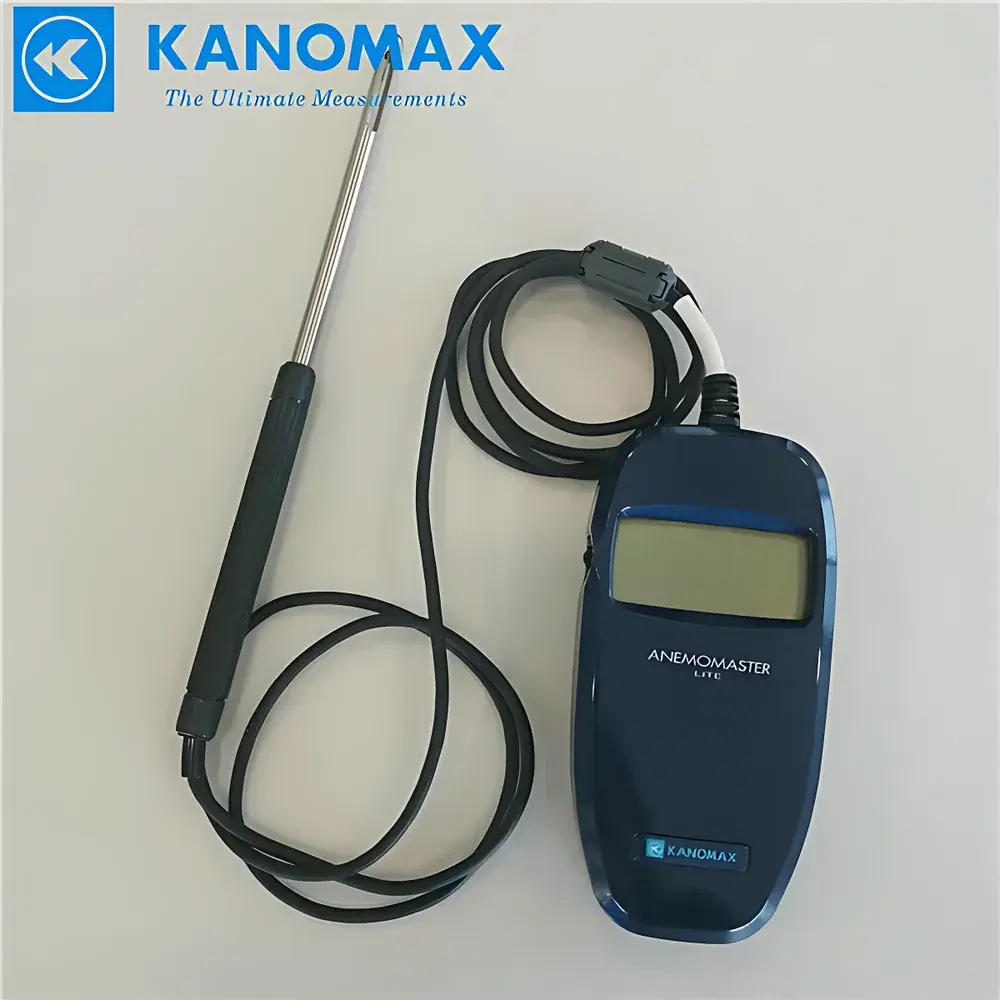
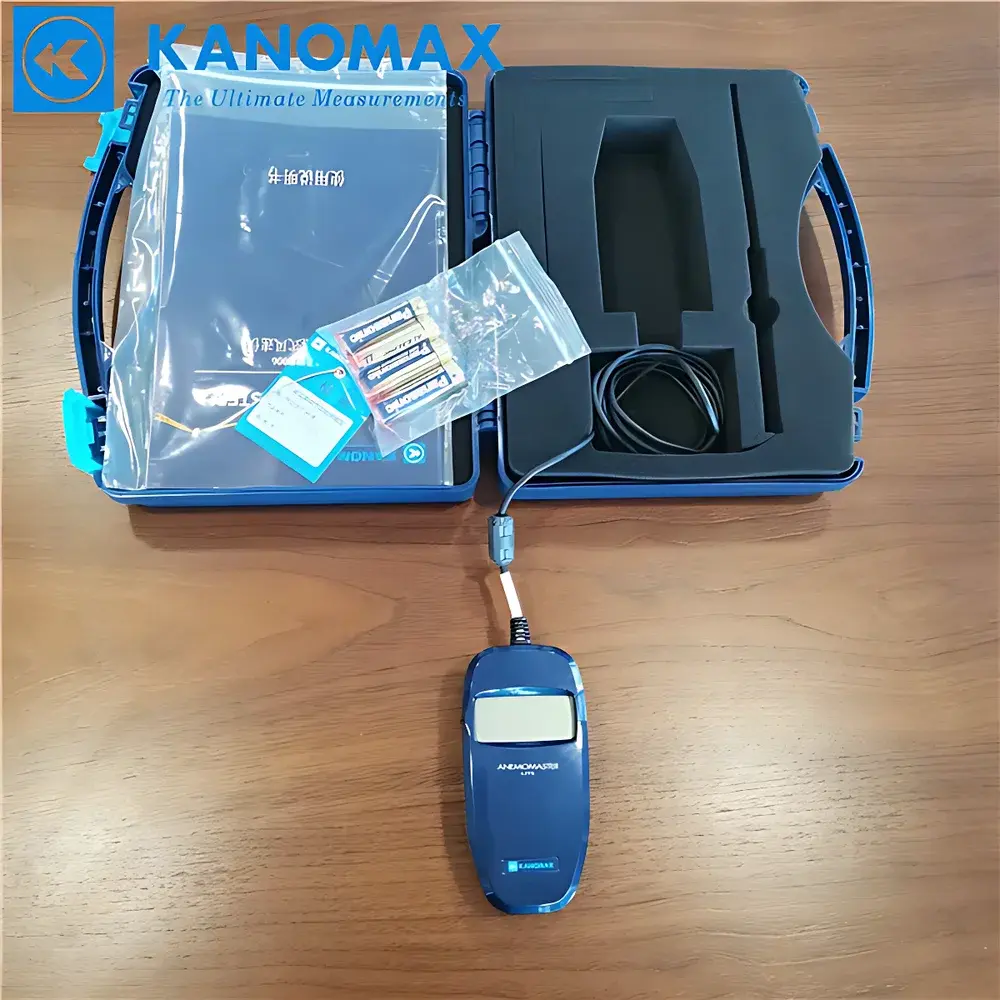
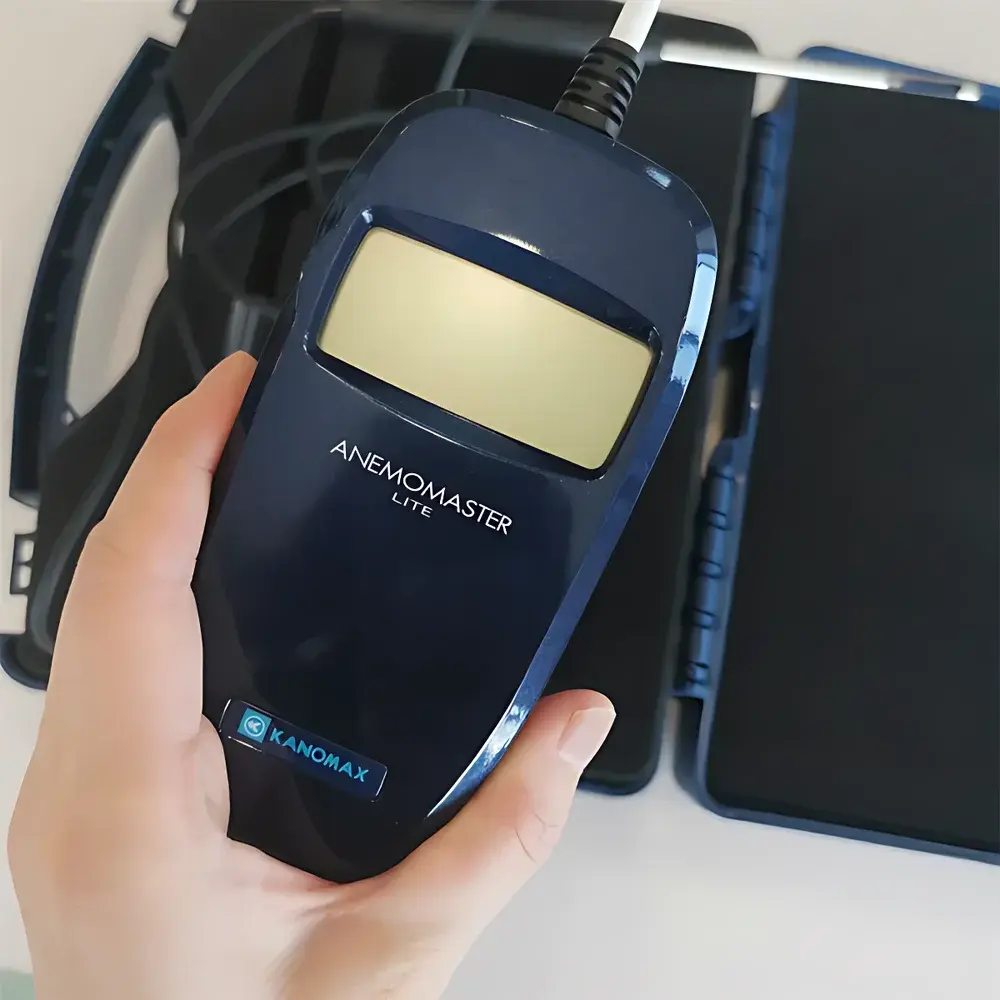
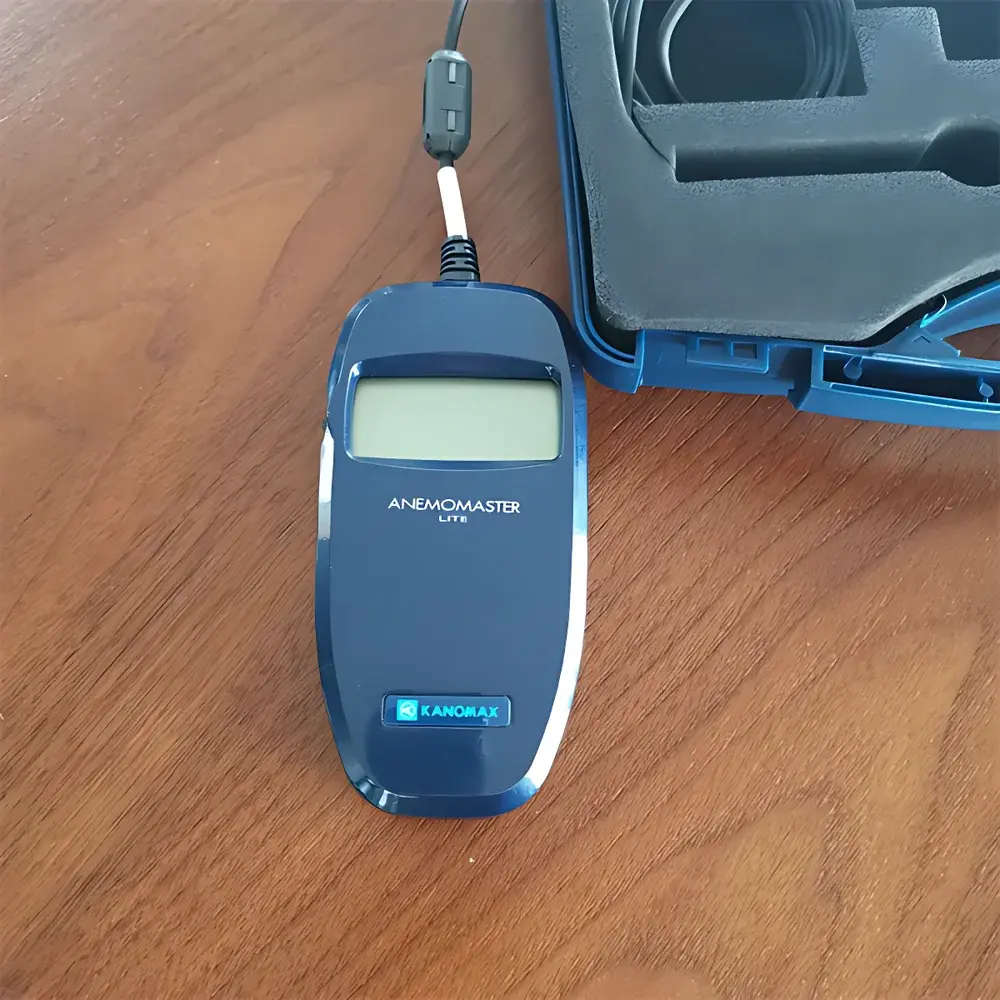
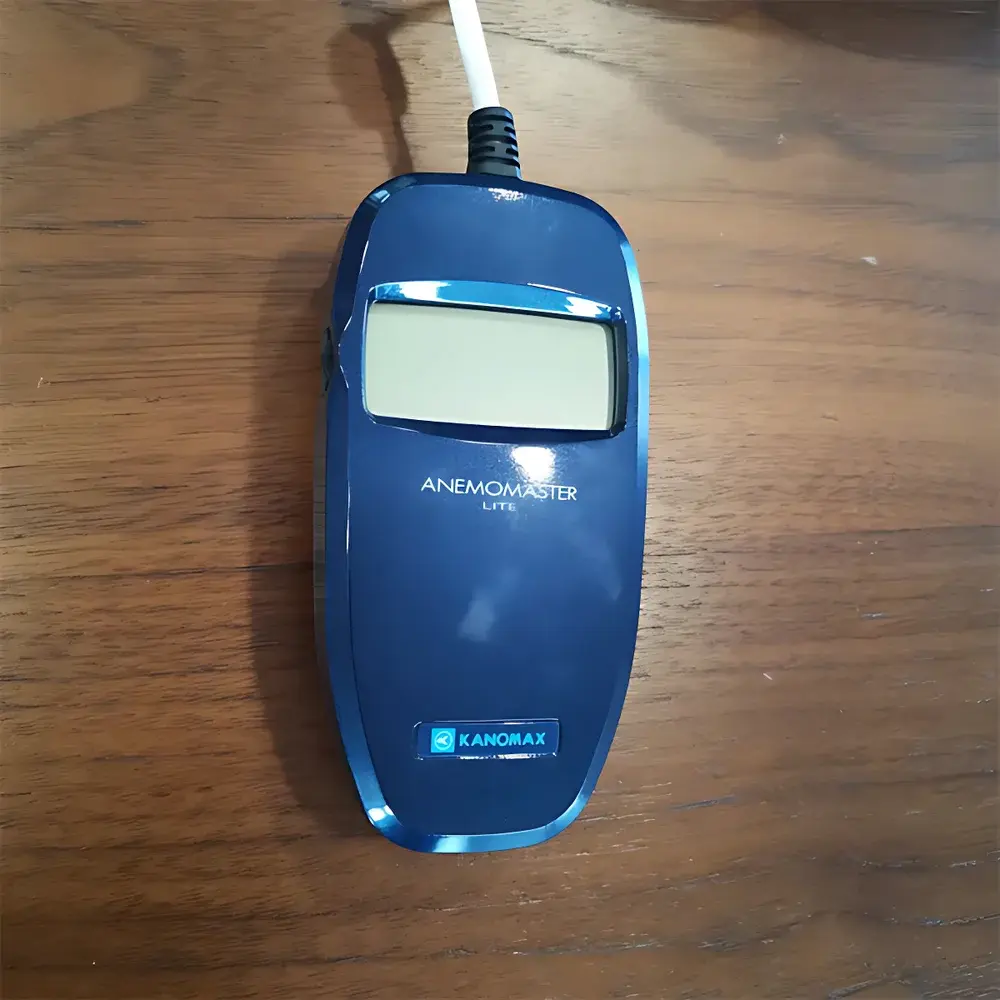
KANOMAX Model 6006 Hot-Wire Anemometer
| Brand | KANOMAX |
|---|---|
| Origin | Japan |
| Model | 6006 |
| Instrument Type | Hot-Wire Anemometer |
| Measurement Range | 0.01–20.0 m/s |
| Resolution | 0.01 m/s (0–9.99 m/s), 0.1 m/s (10.0–20.0 m/s) |
| Accuracy | ±5% of reading (wind speed), ±1°C (temperature) |
| Operating Temperature | −20–70°C (probe), 5–40°C (main unit) |
| Operating Humidity | 20–85% RH |
| Response Time | <1 s (90% for wind speed at 1 m/s), <30 s (90% for temperature) |
| Display | Dual-parameter (wind speed + temperature), selectable units (m/s/°C or fpm/°F), FAST/SLOW averaging, battery level indicator (4-segment), hold function |
| Probe Dimensions | Ø6.1 mm (Ø10.6 mm at tip) × 205 mm |
| Cable | Ø3.3 mm × ~1.5 m |
| Main Unit Dimensions | 60 × 120 × 30 mm |
| Weight | ~180 g (including batteries) |
| Compliance | Designed per JIS B 7554 and IEC 61260-1 Class 2 requirements for environmental air velocity instrumentation |
Overview
The KANOMAX Model 6006 is a precision-engineered handheld hot-wire anemometer designed for reliable, real-time measurement of low-to-moderate air velocity and ambient temperature in industrial, HVAC, cleanroom, laboratory, and field-based environmental monitoring applications. Based on constant-temperature anemometry (CTA), the instrument maintains a heated sensing element at a fixed differential above ambient temperature; convective cooling by airflow modulates the electrical power required to sustain that delta-T, which is linearly correlated to volumetric flow velocity. This principle enables high sensitivity down to 0.01 m/s—critical for laminar flow validation, duct traverse surveys, and ventilation system commissioning where traditional cup or vane anemometers lack resolution. Unlike thermal mass flow sensors, the 6006’s micro-thin platinum wire probe provides rapid thermal response (<1 s at 1 m/s) and minimal flow disturbance, making it suitable for confined spaces, filter integrity testing, and localized airflow profiling.
Key Features
- Single-button intuitive operation with tactile feedback—no menu navigation required for basic measurements.
- Interchangeable, calibrated probe assembly ensuring traceable accuracy across multiple units without recalibration dependency.
- Integrated temperature compensation circuitry optimized for stability across the full operational range (−20–70°C probe environment), with highest accuracy maintained between 10–40°C per JIS B 7554 calibration reference conditions.
- Dual-parameter simultaneous display: wind speed and ambient temperature, with user-selectable units (m/s & °C / fpm & °F) via DIP switch.
- Configurable averaging modes: FAST (1-second moving average) for dynamic flow assessment; SLOW (5-second moving average) for stable baseline recording.
- Low-power design with 4-segment battery-level indicator and automatic sleep mode—enables extended field use on standard AA alkaline cells.
- Compact, ergonomic main unit (60 × 120 × 30 mm) and lightweight construction (~180 g with batteries) support one-handed operation during prolonged surveys.
Sample Compatibility & Compliance
The Model 6006 is validated for use in ambient air under standard atmospheric pressure (86–106 kPa). It is not rated for corrosive, explosive, or particulate-laden gas streams without optional protective filters or probe housings. The probe’s stainless-steel sheath and ceramic insulation ensure mechanical durability and resistance to moderate humidity (20–85% RH non-condensing). Compliance is aligned with Japanese Industrial Standard JIS B 7554 “Anemometers – Methods of Testing” and conforms to IEC 61260-1:2014 Class 2 specifications for octave-band sound and airflow instrumentation performance criteria. While not intrinsically safe, the device meets CE marking requirements for electromagnetic compatibility (EMC Directive 2014/30/EU) and low-voltage safety (LVD Directive 2014/35/EU). For GLP/GMP environments, data logging via optional PC interface (RS-232) supports audit-ready timestamped records.
Software & Data Management
The Model 6006 operates as a standalone instrument with no embedded memory or onboard logging. However, when connected to a host PC using the optional RS-232 interface cable and KANOMAX-supplied terminal software (compatible with Windows 7–11), users can capture real-time serial output at 1 Hz sampling rate. The ASCII-formatted data stream includes wind speed, temperature, timestamp, and unit identifiers—enabling direct import into Excel, MATLAB, or LIMS platforms. The software supports configurable logging intervals, CSV export, and basic statistical functions (min/max/avg/std dev). No FDA 21 CFR Part 11 compliance features (e.g., electronic signatures, audit trails) are built-in; such functionality must be implemented at the enterprise software layer.
Applications
- HVAC system balancing and duct static pressure verification in commercial buildings and hospitals.
- Cleanroom ISO 14644-3 air velocity mapping—particularly for unidirectional airflow hoods and laminar flow benches.
- Industrial exhaust hood face velocity validation per OSHA 1910.145 and ANSI/AIHA Z9.5 standards.
- Environmental chamber airflow uniformity testing during qualification (IQ/OQ).
- Academic aerodynamics labs for boundary layer studies and low-velocity wind tunnel calibration.
- Field-based indoor air quality (IAQ) assessments supporting ASHRAE Standard 62.1 ventilation rate procedures.
FAQ
Is the Model 6006 suitable for measuring airflow in ducts with high turbulence or swirling flow?
Yes—its directional independence and fast response time allow accurate spot measurements even in non-uniform flows; however, ISO 12599-compliant duct traverse protocols require ≥12 measurement points per cross-section.
Can the probe be used outdoors in rain or freezing conditions?
The probe is rated for −20–70°C operating temperature but is not waterproof (IP rating not specified); condensation or direct precipitation may affect sensor stability and should be avoided.
Does the instrument require annual recalibration?
KANOMAX recommends recalibration every 12 months or after physical impact to the probe; accredited calibration certificates traceable to NMIJ (Japan) are available through authorized service centers.
What is the expected probe lifetime under normal use?
With proper handling and avoidance of mechanical shock or oil contamination, the platinum wire sensor typically exceeds 5 years of continuous service in controlled environments.
Is there a version with data logging capability built-in?
No—the Model 6006 is a real-time readout-only instrument; for autonomous logging, consider the KANOMAX Model 6162 or 6501 series with internal memory and USB interface.
Related Products







