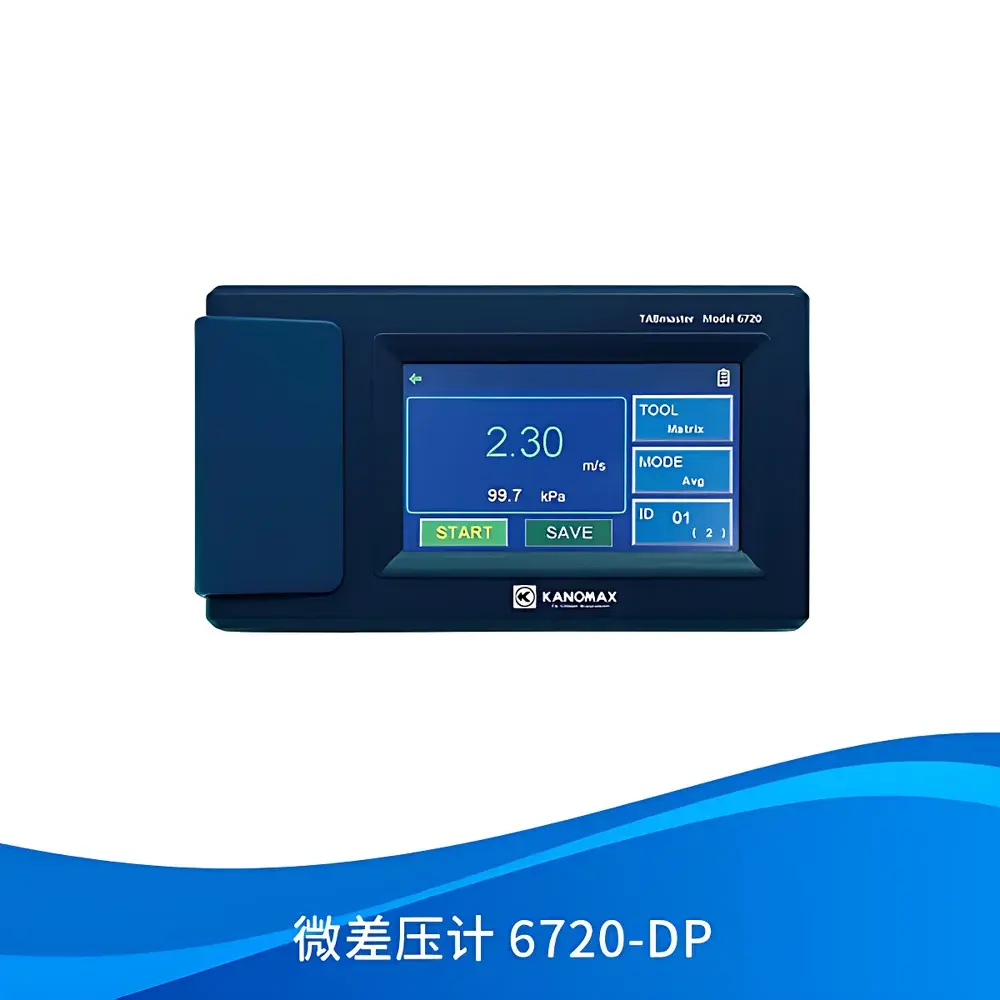
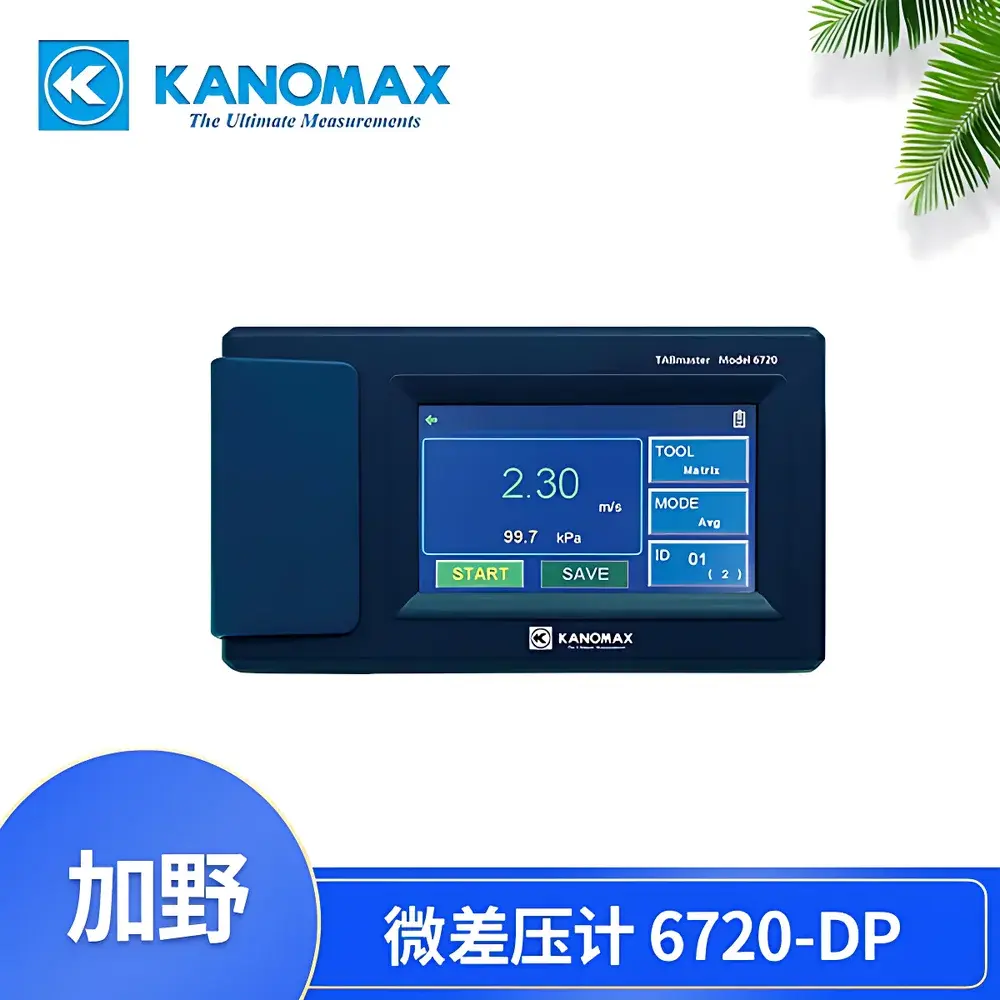
KANOMAX Model 6720-DP Digital Differential Pressure Meter
| Brand | KANOMAX |
|---|---|
| Origin | Liaoning, China |
| Manufacturer Type | Authorized Distributor |
| Country of Origin | China |
| Model | 6720-DP |
| Measurement Range | ±2500 Pa |
| Accuracy Class | 0.01 |
| Medium | Gas |
| Operating Temperature | 0–60 °C (non-condensing) |
| Differential Pressure Resolution | 0.001 Pa |
| Differential Pressure Accuracy | ±1.5% of reading ±0.25 Pa |
| Air Velocity Range (with Pitot Tube) | 0.15–40 m/s |
| Air Velocity Range (with Air Velocity Matrix) | 0.15–15 m/s |
| Air Velocity Accuracy | ±3% of reading ±0.05 m/s (>0.25 m/s) |
| Air Velocity Resolution | 0.01 m/s |
| Display | 4.3-inch full-color touchscreen |
| Data Storage | 8,000 readings (instrument), 10,000 readings (mobile app) |
| Power | 4 × AA batteries (~14 h continuous operation), DC 5 V input |
| Weight | ~390 g |
| Communication | Bluetooth 4.2, USB data export |
Overview
The KANOMAX Model 6720-DP is a high-precision digital differential pressure meter engineered for quantitative airflow and static pressure differential measurement in controlled environments. It operates on the principle of piezoresistive pressure transduction, delivering stable, low-drift measurements across its full ±2500 Pa range with 0.001 Pa resolution. Designed for compliance-critical applications—including ISO 14644-3 cleanroom certification, NSF/ANSI 49 biosafety cabinet face velocity validation, and ASHRAE 110 fume hood performance testing—the instrument meets the metrological requirements for GLP-aligned environmental monitoring workflows. Its dual-mode sensing architecture supports both direct differential pressure measurement via flexible tubing and integrated air velocity profiling using interchangeable probes (Pitot tube or Air Velocity Matrix), enabling traceable, repeatable characterization of HVAC system dynamics, filter integrity, and containment barrier performance.
Key Features
- 4.3-inch full-color capacitive touchscreen interface with intuitive icon-driven navigation and multi-language support (English, Japanese, Chinese, Korean, Spanish)
- Bluetooth 4.2 wireless connectivity for real-time bidirectional communication with iOS/Android mobile devices running the official KANOMAX FieldLink™ app
- On-device data logging capacity of 8,000 measurement records; mobile app extends storage to 10,000 entries with timestamp, location tagging, and customizable metadata fields
- Low-power architecture: 4 × AA alkaline batteries provide up to 14 hours of continuous operation; automatic sleep mode activates after 5 minutes of inactivity
- K-factor calibration adjustment for probe-specific compensation—essential for maintaining accuracy when using third-party or legacy Pitot tubes
- Integrated statistical processing engine: real-time calculation of min/max/average/cumulative values during live measurement sessions
- USB-C port for firmware updates, bulk data export (CSV format), and connection to external power (DC 5 V)
Sample Compatibility & Compliance
The Model 6720-DP is validated exclusively for clean, dry, non-corrosive gases (e.g., ambient air, nitrogen, compressed air). It is not rated for liquid media, explosive atmospheres, or particulate-laden streams exceeding ISO 8573-1 Class 4. For regulatory alignment, the instrument supports audit-ready documentation per ISO/IEC 17025 clause 7.7 (results reporting) and facilitates traceability through embedded clock synchronization, unique device ID, and tamper-evident data logs. When used with NIST-traceable calibration certificates (available upon request), it satisfies preconditions for FDA 21 CFR Part 11-compliant environments where electronic records require authentication, integrity, and retention controls.
Software & Data Management
The KANOMAX FieldLink™ mobile application serves as the primary interface for configuration, visualization, and post-processing. It enables remote parameter setup (unit selection, averaging time, alarm thresholds), synchronized data streaming, and one-touch generation of PDF test reports compliant with ISO 14644-3 Annex B templates. All exported CSV files include column headers specifying measurement type (ΔP or v), probe ID, K-factor, ambient temperature/humidity (if connected via optional sensor module), and GPS coordinates. Instrument firmware supports over-the-air updates via the app, ensuring long-term compatibility with evolving validation protocols and cybersecurity standards.
Applications
- Biosafety cabinet (BSC) and laminar flow hood face velocity mapping per NSF/ANSI 49 Section 6.3.1.1
- Cleanroom differential pressure monitoring across classified zones (ISO 14644-1 Class 5–8)
- HVAC duct static pressure balancing and fan performance verification (ASHRAE Guideline 12-2020)
- Fume hood containment testing using tracer gas or smoke visualization paired with quantitative velocity profiles
- Filter leak detection via upstream/downstream pressure drop trending in HEPA/ULPA systems
- Building envelope infiltration/exfiltration assessment using blower door methodology (ASTM E779)
FAQ
What calibration standards does the Model 6720-DP support?
It accepts factory calibration against NIST-traceable reference manometers (e.g., Fluke 754, Druck DPI 620) and supports user-initiated zero and span adjustments via the touchscreen interface.
Can the device operate in high-humidity environments?
Operation is permitted only under non-condensing conditions (0–60 °C, RH ≤ 80%). Prolonged exposure to condensation may compromise sensor stability and void warranty coverage.
Is the Bluetooth interface compatible with enterprise MDM platforms?
Yes—the FieldLink™ app supports standard iOS Mobile Device Management (MDM) and Android Enterprise policies for secure deployment across laboratory fleets.
How is data integrity ensured during USB transfer?
All CSV exports include SHA-256 checksums embedded in file metadata, enabling cryptographic verification of data authenticity and completeness.
Does the instrument meet IEC 61000-4 electromagnetic immunity requirements?
It complies with IEC 61000-4-2 (ESD), -4-3 (radiated RF), and -4-4 (electrical fast transient) at Level 3 severity, validated per EN 61326-1:2013 for laboratory equipment.