
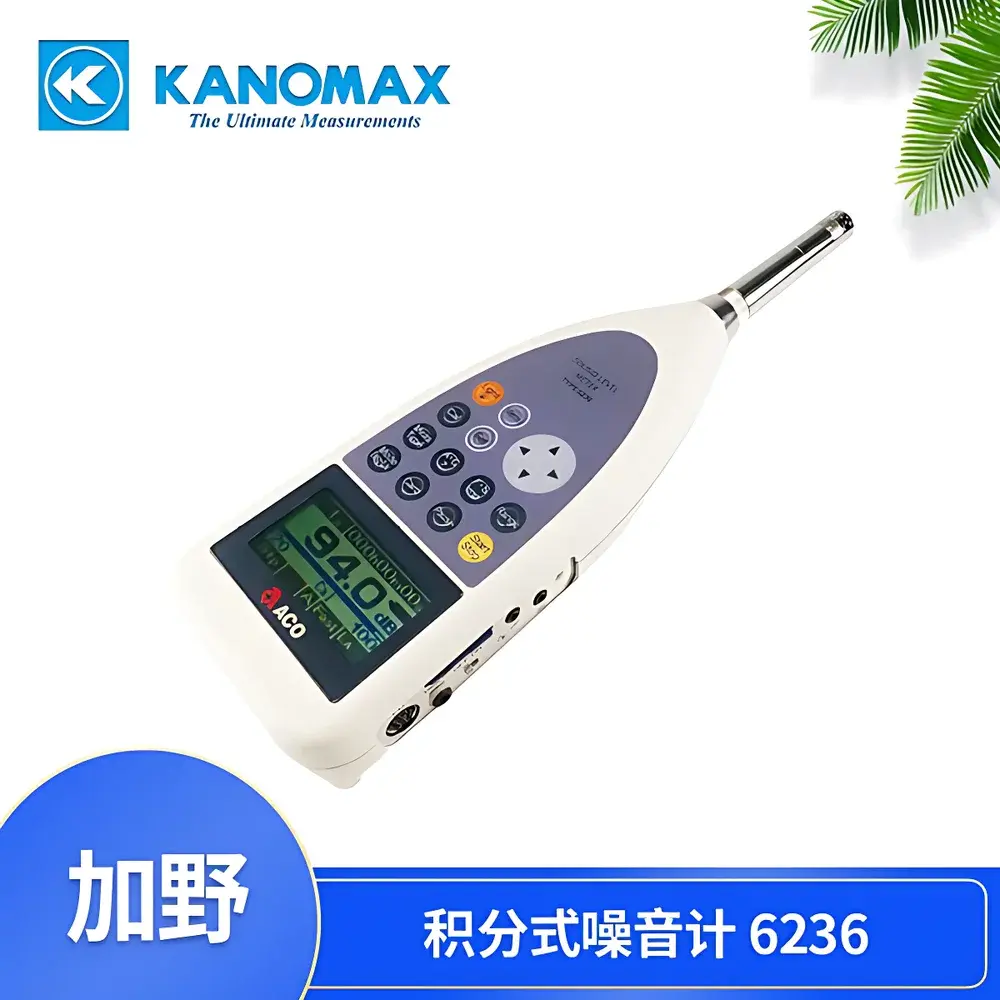
Kanomax Model 6236 High-Capacity Integrating Sound Level Meter
| Brand | Kanomax |
|---|---|
| Origin | Japan |
| Model | 6236 |
| Instrument Type | Handheld Integrating Sound Level Meter |
| Frequency Range | 20–8,000 Hz |
| Measurement Ranges | 28–130 dB(A), 30–130 dB(C), 38–130 dB(Z) |
| Self-Noise | 0.1 dB |
| Accuracy | ±0.1 dB |
| Maximum Measurement Duration | 199 h 59 min 59 s |
| Microphone | Type 7146NL (Sensitivity: −28 dB re 1 V/Pa |
| Standalone calibration | −23 dB) |
| Compliance | IEC 61672-1:2013 Class 1, ANSI S1.4-1983 Type 1 |
| Time Weighting | Fast / Slow |
| Display | Backlit LCD with Analog Bar Graph |
| Power Supply | 4 × AA batteries (≈9 h operation) or AC adapter |
| Dimensions & Weight | 86 × 285 × 46 mm, ≈450 g |
Overview
The Kanomax Model 6236 is a high-capacity, Class 1 integrating sound level meter engineered for precision environmental and occupational noise assessment in compliance with international electroacoustic standards. It operates on the principle of time-integrated sound pressure level measurement, converting acoustic energy into electrical signals via a pre-polarized electret condenser microphone (Type 7146NL), whose stable sensitivity and low self-noise (0.1 dB) ensure metrological integrity across extended monitoring periods. Designed for field-deployable reliability, the instrument supports simultaneous A-, C-, and Z-frequency weightings—enabling evaluation of human hearing response (A-weighting), peak-level assessment (C-weighting), and flat-response broadband analysis (Z-weighting). Its 20–8,000 Hz frequency range meets the full audible spectrum requirements specified in IEC 61672-1:2013 for Class 1 instruments, while its extended dynamic range (28–130 dB) accommodates both low-level ambient surveys and high-intensity industrial noise sources without range switching artifacts.
Key Features
- Class 1 performance per IEC 61672-1:2013 and ANSI S1.4-1983, validated for legal metrology and regulatory reporting
- True integrating functionality supporting Leq (equivalent continuous sound level), Lmax/Lmin, Lpeak, SEL (sound exposure level), and time-history logging
- Backlit LCD display with real-time analog bar graph for rapid visual trend interpretation under variable lighting conditions
- Programmable measurement modes: instantaneous SPL, time-weighted averaging (Fast/Slow), single-event capture, and percentile-based statistical analysis (L10, L50, L90)
- Internal memory capable of storing up to 199 hours, 59 minutes, and 59 seconds of continuous time-stamped data at user-selectable intervals (100 ms–1 s resolution)
- Rugged handheld ergonomics: 450 g mass, compact form factor (86 × 285 × 46 mm), and IP54-rated enclosure for dust and splash resistance during outdoor deployment
Sample Compatibility & Compliance
The Model 6236 is compatible with standard 1/2-inch free-field microphones conforming to IEC 61094-4, including the supplied Type 7146NL transducer. It satisfies mandatory requirements for noise mapping, workplace exposure assessment (OSHA 29 CFR 1910.95, EU Directive 2003/10/EC), and environmental impact studies governed by ISO 1996-1 and ISO 1996-2. Calibration traceability is maintained via built-in acoustic calibrator compatibility (e.g., Kanomax CA-100) and adherence to ISO 7196:1995 for periodic verification. All measurements are fully compliant with GLP documentation practices when paired with Kanomax’s optional PC interface software and audit-trail-enabled data export.
Software & Data Management
Data retrieval is facilitated through a USB 2.0 interface supporting direct connection to Windows-based PCs. The bundled Kanomax Sound Analysis Software (v3.x) enables post-processing of raw time-series datasets, spectral analysis (1/1-octave band), report generation in PDF/CSV formats, and alignment with ISO 532-1 (Zwicker loudness) and ISO 532-2 (Moore-Glasberg model) metrics. The software enforces 21 CFR Part 11-compliant user authentication, electronic signatures, and immutable audit trails—critical for QA/QC laboratories operating under FDA, EPA, or ISO/IEC 17025 accreditation frameworks.
Applications
- Ongoing occupational noise exposure monitoring in manufacturing, construction, and transportation sectors
- Environmental noise compliance testing near airports, highways, and industrial perimeters per ISO 1996 and national noise ordinances
- Acoustic validation of building envelope performance (e.g., façade insulation, HVAC system emissions)
- Product noise certification for consumer electronics, power tools, and household appliances against IEC 60704 and ISO 3744
- Research-grade temporal noise pattern analysis in urban soundscapes and ecological bioacoustics studies
FAQ
What calibration standards does the Model 6236 support?
It complies with IEC 61672-1:2013 Class 1 and ANSI S1.4-1983 Type 1 specifications, and supports periodic verification using accredited acoustic calibrators traceable to NIST or JCSS.
Can the device perform octave-band analysis?
No—octave or 1/3-octave spectral analysis requires external signal conditioning and FFT processing; however, time-domain data exported via USB can be imported into third-party acoustics software for spectral decomposition.
Is battery life affected by backlight or data logging?
Yes—continuous backlight use reduces runtime by ~25%; enabling high-frequency logging (>1 Hz) decreases battery life to approximately 6–7 hours. AC adapter operation bypasses this limitation.
Does the instrument meet EU CE marking requirements for noise emission testing?
Yes—the Model 6236 carries CE marking under the Measuring Instruments Directive (MID) 2014/32/EU and fulfills essential requirements for sound level meters used in conformity assessment of machinery noise per Directive 2006/42/EC.
How is data integrity ensured during long-term unattended measurements?
Internal non-volatile memory retains all logged data even during power interruption; timestamp synchronization uses an integrated real-time clock with ±2 sec/month accuracy, and file corruption protection is implemented via cyclic redundancy checksums.







