
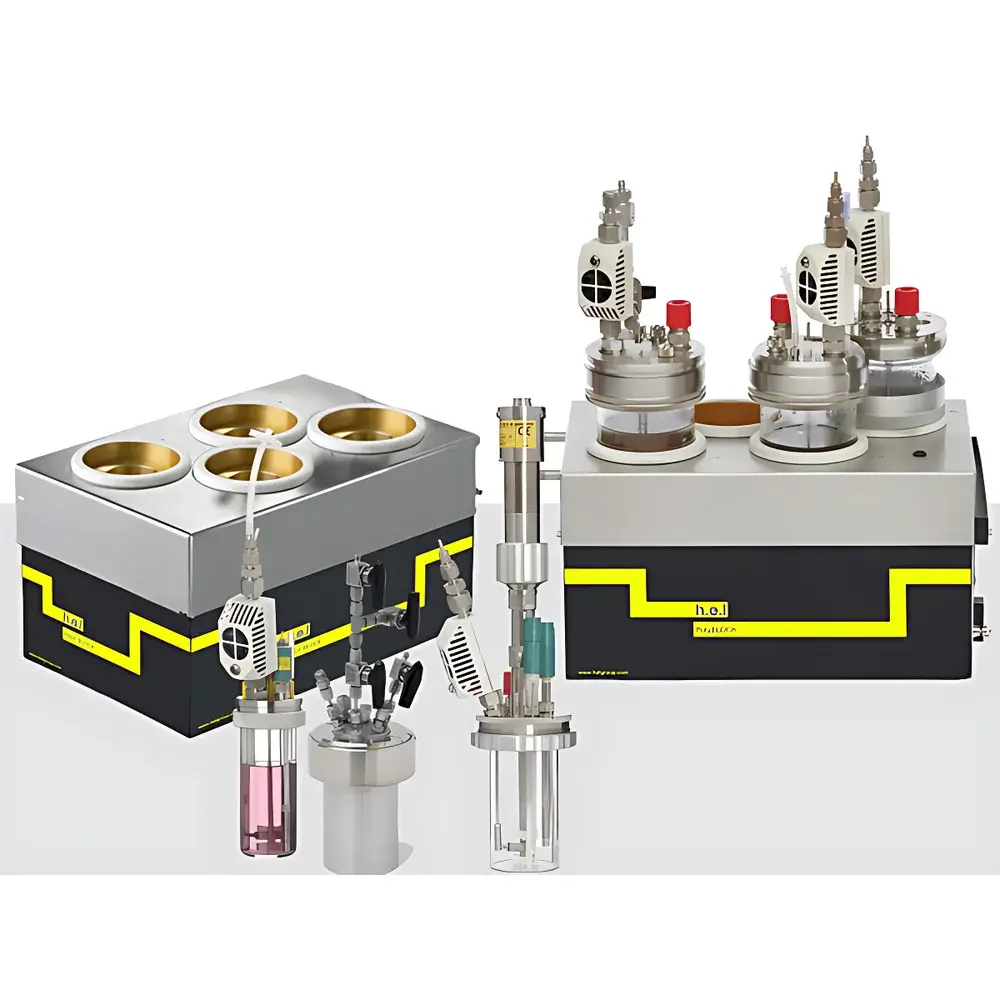
HEL PolyBLOCK 4 High-Throughput Automated Parallel Synthesis Reactor
| Brand | HEL |
|---|---|
| Origin | United Kingdom |
| Model | PolyBLOCK 4 |
| Reactor Type | Modular Parallel Reaction System |
| Number of Independent Reaction Zones | 4 |
| Temperature Range | –60 °C to +230 °C (per zone) |
| Max. Temperature Differential Between Zones | 100 °C |
| Vessel Capacity | 1 mL to 500 mL (standard), up to 1000 mL (with optional adapters) |
| Construction Material | Stainless Steel (316 SS) |
| Pressure Rating | High-Pressure Compatible (up to 100 bar, dependent on vessel configuration) |
| Stirring | Hovering Mechanical Stirring (standard), with torque and speed monitoring |
| Dimensions (Platform) | 350 × 200 × 200 mm |
| Software | WinISO v8.x (Windows-based, FDA 21 CFR Part 11 compliant audit trail option) |
Overview
The HEL PolyBLOCK 4 is a modular, computer-controlled parallel synthesis reactor engineered for high-throughput screening and process optimization in synthetic chemistry, catalysis, crystallization, and hydrogenation research. It operates on the principle of independent thermal and mechanical control across four physically isolated reaction zones—each capable of simultaneous yet distinct reaction execution under precisely defined temperature, stirring, pressure, and dosing conditions. Unlike conventional batch reactors or single-zone heating blocks, the PolyBLOCK 4 implements a Couette-type mechanical stirring architecture with hovering impeller design, ensuring reproducible mixing even in heterogeneous, viscous, or precipitating systems. Its integrated cryo-heating capability (–60 °C to +230 °C) and high-pressure compatibility (via certified stainless-steel vessels) enable rigorous exploration of kinetic and thermodynamic parameters across diverse chemical spaces—critical for early-stage route scouting, DoE-driven process development, and scale-up risk mitigation.
Key Features
- Four fully independent reaction zones with individual PID-controlled heating/cooling, real-time temperature monitoring (±0.2 °C accuracy), and dynamic power regulation.
- Hovering mechanical stirring system with continuous torque and rotational speed feedback—optimized for suspension polymerization, crystallization studies, and catalyst slurry handling.
- Modular liquid dispensing module: dual-channel fast-fill syringe pumps with multi-position distribution valves, enabling programmable, timed addition of up to two reagents per zone—traceable and repeatable within ±1% volumetric precision.
- Integrated online reaction calorimetry (optional): self-calibrating heat flow measurement without external calibration; delivers real-time enthalpy profiles synchronized with temperature, pressure, and stirrer torque data.
- Standardized gas and condensate interfaces per zone: quick-connect fittings for inert gas purging (N₂, Ar), reflux condensation (dry ice/acetone or circulating chiller), and automatic vapor seal activation when condenser is disengaged.
- Compact footprint (350 × 200 × 200 mm) designed for benchtop deployment in fume hoods or controlled-environment labs—no external chillers or compressors required for low-temperature operation.
Sample Compatibility & Compliance
The PolyBLOCK 4 accommodates a wide range of vessel formats—including standard glass tubes (1–25 mL), borosilicate round-bottom flasks (50–250 mL), and custom-engineered high-pressure reactors (75–500 mL, 316 stainless steel, ASME-certified). All vessels mount via standardized 85 mm diameter × 65 mm depth bayonet interface, ensuring mechanical stability during vigorous agitation. The system complies with IEC 61010-1 (electrical safety), EN 61326-1 (EMC), and supports GLP/GMP workflows through optional WinISO software modules featuring electronic signatures, full audit trails, and 21 CFR Part 11 compliance for data integrity and regulatory submission readiness. Vessel-specific pressure ratings and material certifications are documented per ISO 15143 and ASTM E2915 standards.
Software & Data Management
WinISO v8.x serves as the unified control and analysis environment—deployable on Windows 10/11 workstations or optional touchscreen HMI terminals. It enables method creation via intuitive drag-and-drop sequencing, real-time overlay of up to 16 parameters (e.g., Tblock, Tinternal, P, RPM, torque, pH, turbidity), and synchronized logging at user-defined intervals (100 ms to 5 min resolution). All datasets export natively to CSV or Excel-compatible XLSX format, preserving metadata (operator ID, timestamp, versioned method ID). Batch comparison tools support statistical evaluation of reaction outcomes (e.g., conversion yield variance, nucleation onset time dispersion), while automated report generation conforms to internal SOP templates or external regulatory frameworks (e.g., USP , ISO/IEC 17025).
Applications
- High-throughput reaction condition screening: ligand–metal ratio optimization, solvent effects, base/acid screening under ambient or elevated pressure.
- Catalytic reaction profiling: turnover frequency (TOF) mapping, deactivation kinetics, and induction period quantification across temperature gradients.
- Crystallization process development: supersaturation control, polymorph screening, and seeding protocol validation using in-situ turbidity and temperature ramping.
- Hydrogenation and gas–liquid reactions: precise H₂ dosing control, mass transfer coefficient estimation (kLa), and pressure-dependent selectivity analysis.
- Process safety evaluation: adiabatic temperature rise (ΔTad) determination, accumulation rate profiling, and criticality classification per CCPS guidelines.
FAQ
Can the PolyBLOCK 4 operate under inert atmosphere without manual intervention?
Yes—each zone includes dedicated gas inlet/outlet ports with solenoid-valve control; WinISO can automate purge cycles, pressure ramping, and continuous blanketing based on user-defined logic.
Is it possible to integrate third-party sensors (e.g., FTIR probe, Raman cell)?
Yes—the system provides analog/digital I/O expansion ports and Modbus TCP support for synchronization with external analytical devices; sensor data streams are time-aligned and logged alongside native parameters.
What validation documentation is supplied with the instrument?
Factory-issued IQ/OQ protocols, material certificates for wetted parts (316 SS), temperature uniformity maps per zone, and software verification reports (including 21 CFR Part 11 configuration assessment) are included.
How is maintenance performed on the stirring mechanism?
The hovering stirrer assembly is tool-free removable; wear components (seals, bearings) are field-replaceable with calibrated torque settings—no recalibration required post-service.
Does the system support unattended overnight operation?
Yes—full hardware watchdog logic, thermal runaway protection, emergency power-off interlocks, and email/SMS alerting (via optional network gateway) ensure safe autonomous execution of multi-step methods lasting >72 hours.



