
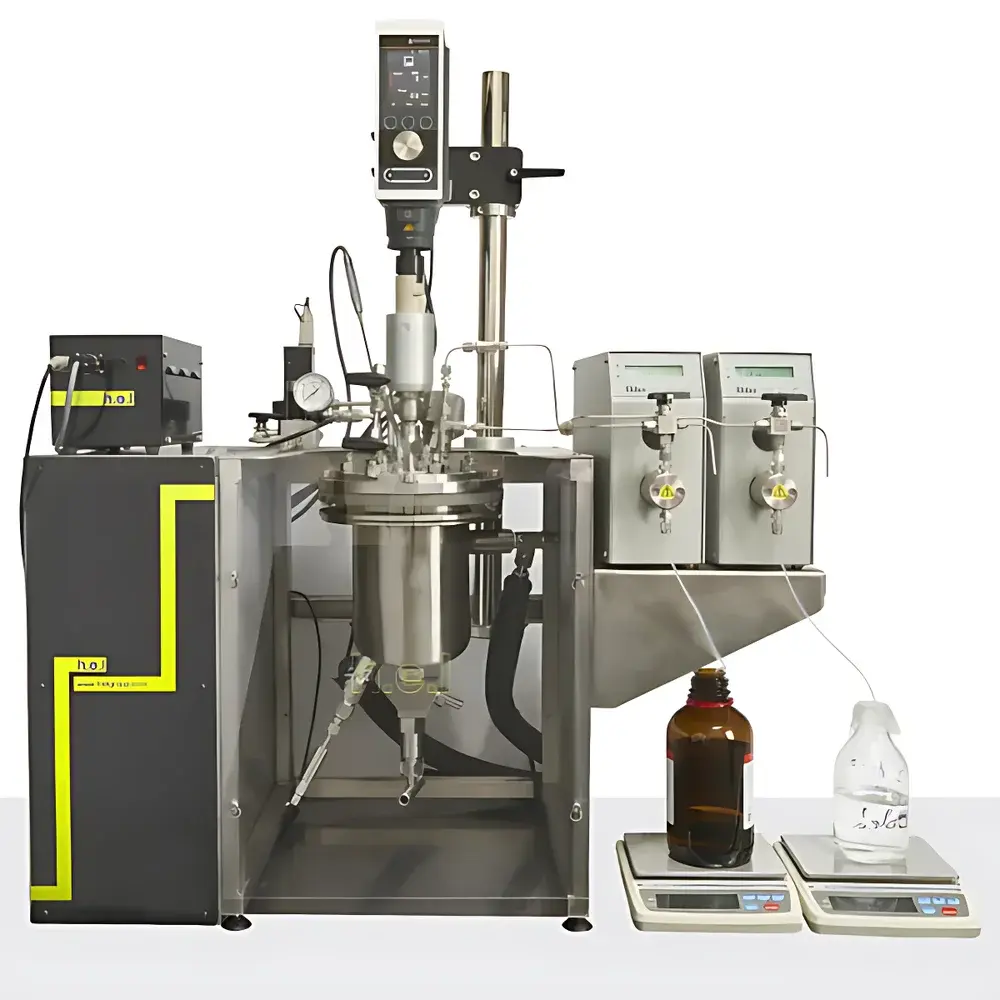
HEL HP Simular High-Pressure Metal Reaction Calorimeter
| Brand | HEL (UK) |
|---|---|
| Origin | United Kingdom |
| Model | HP Simular |
| Measurement Mode | Adiabatic Calorimetry |
| Instrument Type | Reaction Calorimeter |
| Automation | Fully Automated |
| Temperature Range | −30 °C to 210 °C |
| Temperature Resolution | 0.2 mK |
| Temperature Precision | ±0.1 K |
| Heat Capacity Range | ±750 J/K |
| Maximum Pressure | 100 bar (upgradable to 200 bar) |
| Vessel Volume Options | 0.5 L, 1 L, 2 L |
| Vessel Materials | 316 Stainless Steel or Hastelloy C-276 |
| Stirring System | PTFE-coated shaft with 4-blade PTFE impeller (45–60° pitch) |
| Pressure Relief | Swagelok 316SS PRV + dial pressure gauge |
| Integrated Sensors | Temperature, pressure, optional in situ FTIR/Raman/turbidity/particle size |
| Calibration Heater | 150 W power-compensation heater |
| Control Software | HEL ChemScan™ with PAT integration, audit trail, and 21 CFR Part 11 compliance support |
Overview
The HEL HP Simular High-Pressure Metal Reaction Calorimeter is an engineered platform for quantitative thermal hazard assessment and kinetic process understanding under industrially relevant reaction conditions. It operates on the principle of adiabatic calorimetry—minimizing heat loss to the environment through active temperature control of the reactor jacket—to deliver high-fidelity measurement of heat flow, heat capacity, and thermal accumulation during exothermic chemical transformations. Designed for early-stage process safety evaluation, the system enables direct characterization of decomposition onset, runaway initiation, and unstable intermediate behavior under controlled pressure (up to 100 bar, upgradeable to 200 bar) and temperature (−30 °C to 210 °C). Its modular metal reactor architecture—fabricated from 316 stainless steel or corrosion-resistant Hastelloy C-276—ensures mechanical integrity and chemical compatibility across diverse synthetic chemistries, including hydrogenations, nitration, oxidation, and catalytic coupling reactions.
Key Features
- Adiabatic and isothermal calorimetry modes: supports both power-compensation (with integrated 150 W calibration heater) and heat-flow methodologies, as well as non-isothermal ramped-rate calorimetry for decomposition kinetics.
- High-pressure reaction vessel: rated to 100 bar standard (200 bar optional), equipped with nine standardized ports for sensor integration, gas/liquid feed, and sampling; includes Swagelok 316SS pressure relief valve and calibrated dial pressure gauge.
- Precision temperature control and measurement: ±0.1 K accuracy with 0.2 mK resolution via calibrated Pt100 thermistors embedded in vessel wall and reaction mass.
- Automated liquid and gas dosing: integrated high-pressure metering pump and mass flow controller (MFC)-regulated gas addition enable reproducible reagent addition under closed-loop feedback.
- Modular PAT-ready design: supports seamless integration of in situ analytical probes—including FTIR, Raman, turbidity, and particle size sensors—via standardized optical and electrical interfaces.
- Robust stirring configuration: PTFE-coated 4-blade impeller (45–60° pitch) ensures uniform mixing; Hastelloy C-276 shaft and impeller available for aggressive media.
Sample Compatibility & Compliance
The HP Simular accommodates a broad range of sample types—from homogeneous catalytic solutions and slurries to heterogeneous gas–liquid–solid systems—within its 0.5 L, 1 L, or 2 L vessels. Material compatibility extends to strongly acidic, alkaline, halogenated, and hydride-containing chemistries when configured with Hastelloy C-276. The system meets essential requirements for laboratory-scale process safety testing per ASTM E1981 (Standard Guide for Evaluating Thermal Stability), ISO 8064 (Reaction Calorimetry Terminology), and EU REACH Annex VII guidelines. Data acquisition and reporting comply with GLP principles; software audit trails, electronic signatures, and configurable user access levels align with FDA 21 CFR Part 11 expectations for regulated environments.
Software & Data Management
Control and analysis are executed via HEL ChemScan™—a validated, Windows-based platform designed for both novice and expert users. The interface provides real-time visualization of temperature, pressure, heat flow, stirrer torque, and auxiliary sensor data, with fully customizable dashboards and automated alarm thresholds. Users define experiment protocols using hierarchical scripting—ranging from simple temperature ramps to multistep sequences involving timed dosing, pressure modulation, and conditional logic triggers. All raw and processed data are stored in a structured, timestamped format with metadata tagging (operator, vessel ID, calibration history). Export options include CSV, PDF reports, and native ChemScan™ project files. Optional data archiving modules support long-term retention with SHA-256 hash verification and periodic integrity checks.
Applications
- Process safety screening: determination of adiabatic temperature rise (ΔTad), time-to-maximum-rate (TMRad), and self-heating rates for RC1-style hazard ranking.
- Reaction kinetics modeling: extraction of activation energy, enthalpy of reaction, and heat generation profiles under varying pressure and concentration conditions.
- Scale-up risk mitigation: identification of critical process parameters (CPPs) that influence thermal accumulation during transition from lab to pilot plant.
- Catalyst performance evaluation: quantification of heat release profiles during catalyst activation, deactivation, or poisoning events.
- Thermodynamic characterization: measurement of heat capacity (Cp) and phase transition behavior in pressurized solvent systems.
- Regulatory dossier preparation: generation of auditable calorimetric data packages for FDA, EMA, and Health Canada submissions.
FAQ
What calorimetric methods does the HP Simular support?
It supports adiabatic, isothermal (power-compensation and heat-flow), and non-isothermal (ramped-rate) calorimetry—enabling comprehensive thermal profiling across multiple experimental paradigms.
Can the system operate under inert or reactive gas atmospheres?
Yes—integrated MFC-controlled gas dosing allows precise regulation of headspace composition (e.g., N2, H2, O2, CO) up to 100 bar, with optional gas-phase sampling loops.
Is the software compliant with 21 CFR Part 11?
ChemScan™ supports Part 11 compliance through electronic signatures, role-based access control, audit trail logging, and data integrity safeguards—configurable per site validation requirements.
What is the minimum detectable heat flow resolution?
System sensitivity is optimized for industrial reaction scales; typical heat flow resolution is ≤0.1 W, dependent on vessel size, thermal mass, and calibration stability.
Are third-party sensors supported?
Yes—standardized analog/digital I/O and optical feedthroughs allow integration of vendor-agnostic FTIR, Raman, turbidity, and particle sizing probes with synchronized data acquisition.



