
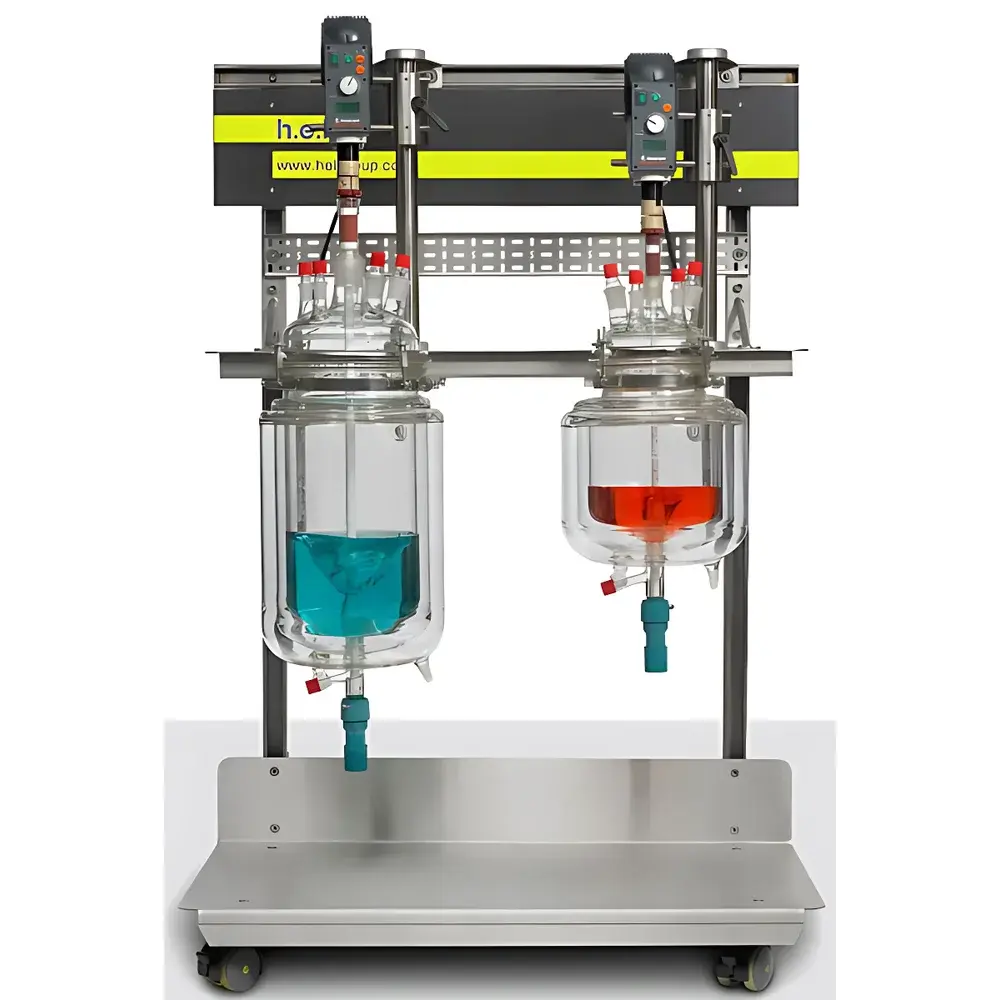
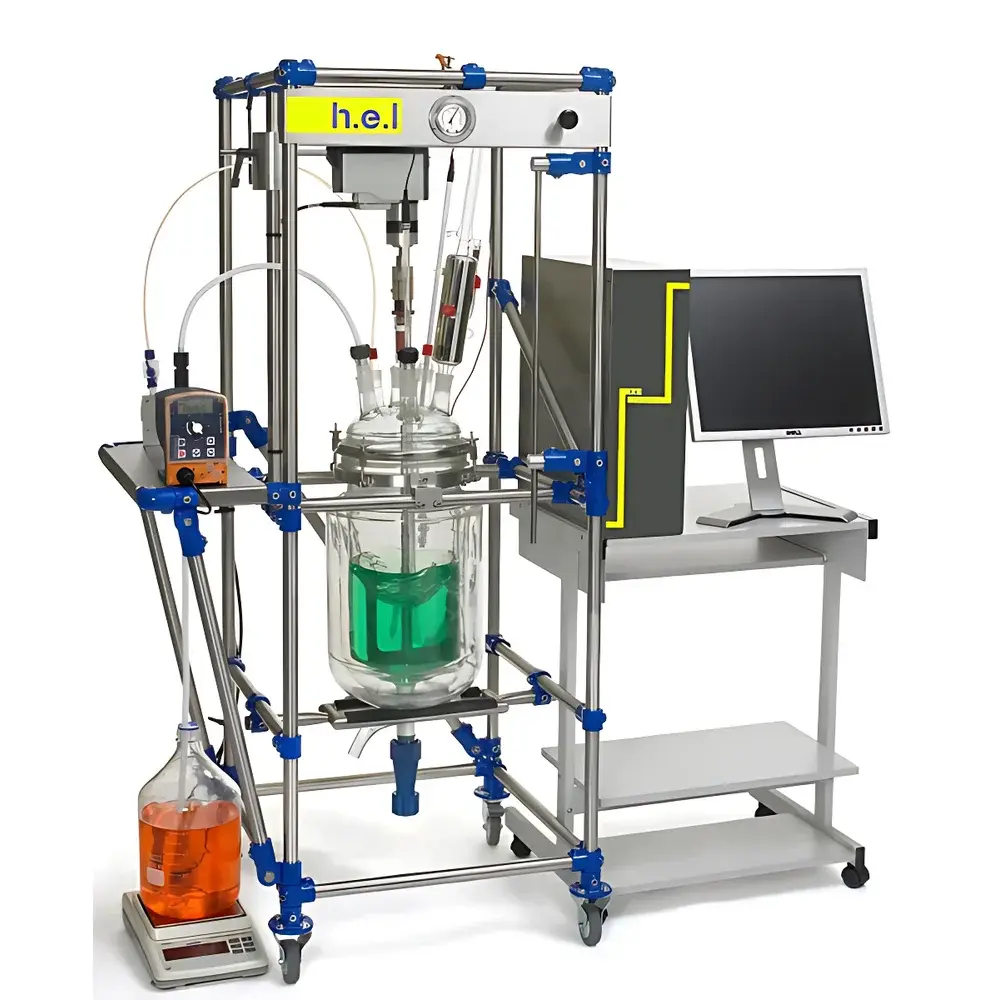
HEL AutoLAB & AutoLAB Custom Automated Chemical Synthesis System
| Brand | HEL (UK) |
|---|---|
| Origin | United Kingdom |
| Model | AutoLAB & AutoLAB Custom |
| Reactor Volume | 500 mL – 5 L |
| Material | Borosilicate Glass (Pyrex®), Stainless Steel, Corrosion-Resistant Alloys |
| Operating Pressure | Up to 200 bar (customizable) |
| Configuration | 1–8 parallel reactors |
| Modular PAT Integration | Yes |
| Software | WinISO v6.x (FDA 21 CFR Part 11 compliant, audit trail enabled) |
| Temperature Control Range | −80 °C to +250 °C (dependent on jacketed reactor & circulator) |
| Stirring | Independent digital torque-controlled overhead stirring per reactor |
| Automation Level | Fully programmable multi-parameter sequence control (T, P, agitation, dosing, sampling, pH, spectroscopy) |
Overview
The HEL AutoLAB and AutoLAB Custom are fully automated, modular parallel chemical synthesis systems engineered for precise, reproducible, and scalable reaction development under controlled laboratory conditions. Based on Couette-type temperature-controlled jacketed reactor architecture and integrated process analytical technology (PAT), the system implements real-time, closed-loop control of critical reaction parameters—including temperature, pressure, agitation rate, dosing profiles, pH, and in situ spectroscopic signatures. Designed by HEL’s in-house team of process chemists and reaction engineers over two decades, AutoLAB supports both fundamental mechanistic studies and applied process optimization—spanning catalyst screening, kinetic profiling, thermal hazard assessment (e.g., RC1/RC2 equivalence), crystallization pathway mapping, and continuous-flow hybrid operation. Its architecture conforms to ISO 17025-compliant laboratory practice and is routinely deployed in GLP/GMP-regulated environments where traceability, parameter integrity, and electronic record retention are mandatory.
Key Features
- Modular 1–8 parallel reactor configuration with independent control of temperature, pressure, agitation, and dosing per vessel
- Reactor volumes scalable from 500 mL to 5 L standard; custom configurations up to 20 L available with reinforced Pyrex® glass, 316 stainless steel, or Hastelloy® C-276 construction
- Pressure rating up to 200 bar (standard); vacuum-compatible design enables negative-pressure operations and solvent stripping
- WinISO software platform with intuitive graphical workflow editor, event-driven scripting, and full 21 CFR Part 11 compliance—including electronic signatures, role-based access control, and immutable audit trails
- Digital torque-sensing overhead stirrers with real-time power monitoring and adaptive speed regulation
- Integrated multi-modal dosing: liquid (peristaltic, HPLC, high-pressure piston, volatile solvent-capable pumps), gas (mass flow controller or rotameter-based), and solid (HEL’s proprietary helical feeder with gravimetric feedback)
- Expandable PAT interface supporting FTIR, Raman, FBRM, turbidity, calorimetry, and pH modules via standardized analog/digital I/O and Ethernet protocols
Sample Compatibility & Compliance
AutoLAB accommodates a broad range of chemistries—including organometallic catalysis, hydrogenations, nitrations, Grignard formations, polymerizations, and crystallization processes—across solvents ranging from water and alcohols to chlorinated hydrocarbons and supercritical CO₂. All wetted materials comply with USP Class VI and ASTM F519 standards for biocompatibility and corrosion resistance. Reactor vessels meet PED 2014/68/EU requirements when configured for >0.5 bar gauge pressure. The system supports validation documentation packages aligned with ASTM E2500-13 (Good Automated Manufacturing Practice) and is routinely qualified per IQ/OQ/PQ protocols in pharmaceutical R&D and fine chemical manufacturing facilities.
Software & Data Management
WinISO serves as the central orchestration engine, enabling synchronized execution of complex multi-step reaction sequences across all reactors. Each experiment generates timestamped, structured data files (.csv, .xlsx, .tdms) containing all sensor readings, actuator states, and user-defined metadata. Raw spectral data from FTIR/Raman modules are stored in vendor-neutral .spc or .jdx formats. Data export supports direct integration with ELN platforms (e.g., LabArchives, Benchling) via RESTful API. All software updates are version-controlled and documented per ISO 13485 Annex A.2; no runtime dependencies require manual installation—updates deploy seamlessly without interrupting active experiments.
Applications
- Reaction condition screening (DoE implementation with automated matrix generation)
- Catalyst performance benchmarking across metal loadings, ligand ratios, and temperature gradients
- Kinetic modeling using in situ concentration tracking (via FTIR peak integration or Raman band deconvolution)
- Thermal runaway prediction through reaction calorimetry coupling (RC1-style heat flow quantification)
- Crystallization endpoint detection using real-time FBRM chord length distribution analysis
- pH-controlled addition strategies for exothermic enolate formations or acid-catalyzed condensations
- Process safety evaluation including MTSR (Maximum Temperature of Synthesis Reaction) and adiabatic temperature rise calculations
FAQ
Can AutoLAB operate under inert atmosphere or vacuum?
Yes—standard configurations include gas purging ports and vacuum-rated seals; optional glovebox integration kits enable Schlenk-line compatibility.
Is remote monitoring supported?
Yes—WinISO includes secure web-based dashboard access (HTTPS/TLS 1.2) with live parameter visualization and alarm notification via SMTP/SMS gateways.
What level of validation support does HEL provide?
HEL delivers comprehensive IQ/OQ documentation templates, URS alignment checklists, and on-site PQ assistance for GxP environments.
Can existing non-HEL reactors be retrofitted into AutoLAB?
Only HEL-certified reactor vessels with calibrated RTD/pressure transducer mounting interfaces may be integrated; third-party vessels require full mechanical and electrical requalification.
How is calibration traceability maintained?
All sensors ship with UKAS-accredited calibration certificates (ISO/IEC 17025); field recalibration intervals are configurable within WinISO and logged automatically.



