
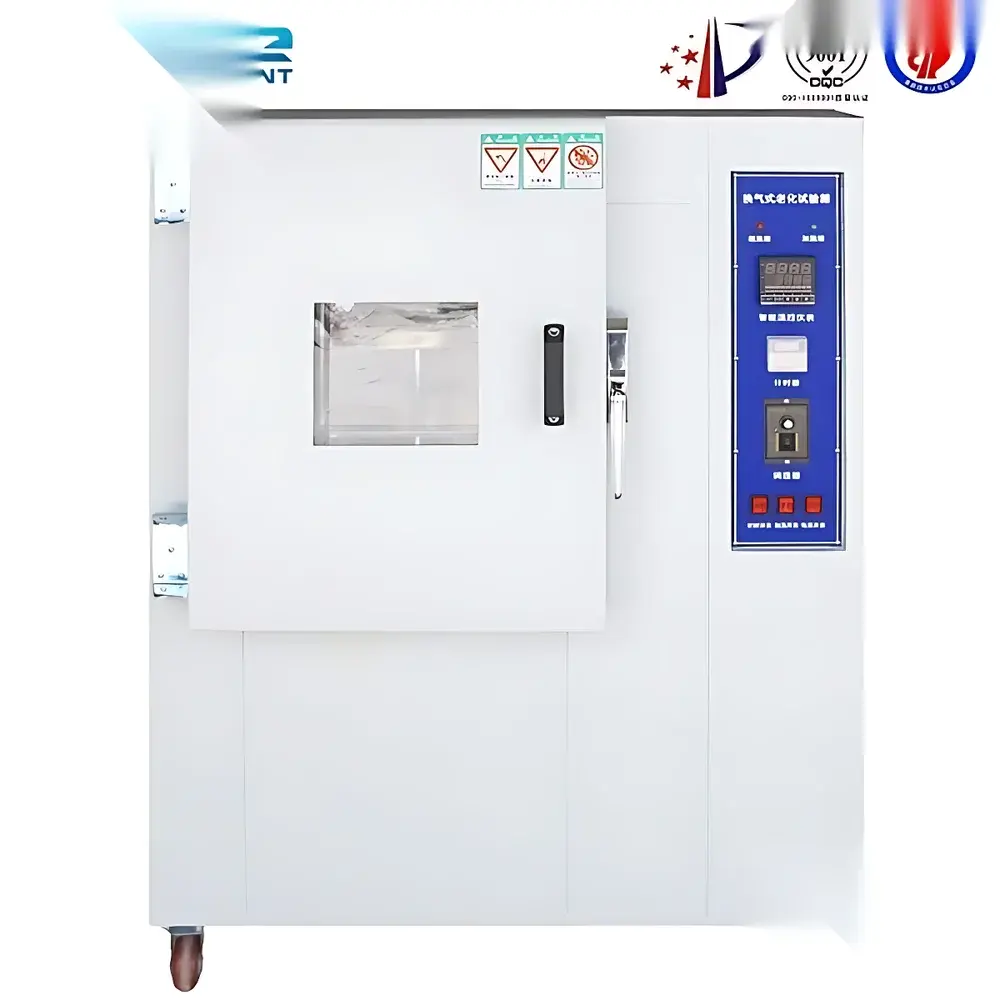
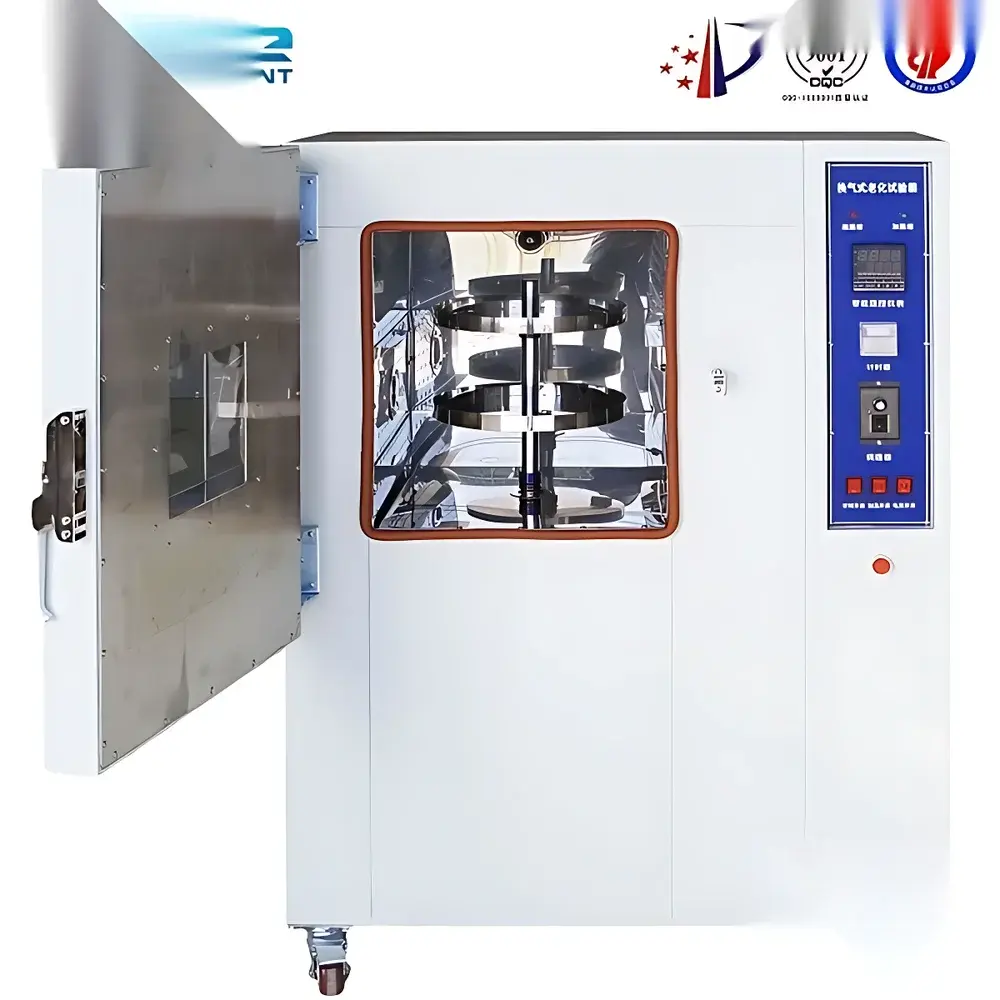
OK-HQ Series Forced-Air Thermal Aging Test Chamber
| Brand | OK Instruments |
|---|---|
| Origin | Imported |
| Manufacturer Type | Authorized Distributor |
| Temperature Range | RT+10°C to 200°C / 300°C |
| Temperature Uniformity | ±2°C |
| Temperature Stability | ±0.5°C |
| Air Exchange Rate | 2–100 cycles/hour |
| Adjustable Air Exchange Time | 1 min – 99 h |
| Internal Dimensions (L×W×H, mm) | 450×450×500 to 800×1000×1000 |
| Power Rating | 4.0–9.0 kW |
| Controller | PID + SSR Microprocessor-Based Digital Controller |
| Display Resolution | 0.1°C (Set & Actual) |
| Timer Range | 1–9999 min |
| Rotating Turntable Diameter | Φ250–Φ700 mm |
| Test Port | Ø50 mm (Left Side) |
| Insulation | High-Density Glass Fiber Mat |
| Compliance | ASTM D5423-09 (Type II), ASTM D5374-93 (2005), UL 1581, GB/T 2951, IEC 60811, VDE 0472, JIS C 3005 |
Overview
The OK-HQ Series Forced-Air Thermal Aging Test Chamber is an engineered environmental test system designed for accelerated thermal aging evaluation of polymeric and elastomeric materials under controlled, ventilated high-temperature conditions. Based on the principle of forced convection with precisely regulated air exchange, it replicates long-term thermal degradation mechanisms—such as oxidative chain scission, crosslinking, and volatilization—within shortened test durations. Unlike static oven environments, this chamber maintains a continuous supply of fresh ambient air into the working chamber at programmable rates, ensuring consistent oxygen partial pressure and preventing localized depletion or contaminant accumulation. This dynamic airflow architecture is essential for evaluating material stability in real-world applications where ventilation is inherent—e.g., insulated wiring harnesses in automotive engine bays, outdoor cable sheaths exposed to solar heating and wind flow, or textile components in HVAC duct systems. The chamber complies with standardized test protocols requiring defined air exchange parameters, including ASTM D5423-09 (Type II laboratory ovens), ASTM D5374-93(2005), UL 1581 Section 1060, and multiple national standards (GB/T 2951, IEC 60811-501).
Key Features
- Precision-engineered forced-air circulation system featuring high-temperature-resistant centrifugal blower and optimized baffle-guided airflow path for uniform temperature distribution (±2°C across full working volume).
- Digital PID + SSR microprocessor controller with 0.1°C resolution for both setpoint and display; integrated timer (1–9999 minutes) and programmable air exchange scheduling (1 minute to 99 hours per cycle).
- Stainless steel (SUS304) interior chamber with argon arc welding construction; exterior A3 steel cabinet with electrostatic powder coating for corrosion resistance and cleanroom-compatible surface integrity.
- High-efficiency thermal insulation using ultra-fine glass fiber mat (≥100 mm thickness), minimizing heat loss and improving energy efficiency during prolonged high-temperature operation.
- Front-mounted observation window with tempered glass and built-in LED illumination enables real-time visual monitoring without thermal disturbance or safety compromise.
- Optional rotating turntable (Φ250–Φ700 mm) ensures uniform exposure of asymmetric or multi-layer specimens to thermal gradients and airflow patterns.
- Standardized Ø50 mm test port on left side wall allows seamless integration with external power supplies, data loggers, or sensor feedthroughs for in-situ electrical or mechanical property tracking.
Sample Compatibility & Compliance
The OK-HQ chamber accommodates a broad spectrum of non-metallic specimens—including insulated wires and cables, rubber hoses, PVC and PE sheathing, synthetic leather, woven fabrics, silicone elastomers, and thermoset composites. Its design supports standardized specimen mounting configurations per ASTM D5423 and UL 1581: horizontal suspension on ceramic rods, vertical hanging, or flat placement on perforated stainless trays. All models meet structural and performance requirements for Type II forced-ventilation ovens per ASTM D5423-09, including minimum air exchange verification capability (2–100 cycles/hour), temperature stability (±0.5°C), and chamber uniformity (±2°C). Regulatory alignment extends to IEC 60811-501 (electrical insulating materials), GB/T 2951.12 (Chinese standard for cable aging), VDE 0472 Part 813, and JIS C 3005. For GLP/GMP-regulated laboratories, optional audit-trail-enabled controllers support 21 CFR Part 11-compliant data recording when paired with validated software.
Software & Data Management
While the base configuration features a standalone LED digital controller, optional RS485/Modbus RTU interface enables integration with centralized laboratory data acquisition platforms (e.g., LabVIEW, SCADA, or LIMS). Third-party compliant software packages provide real-time temperature logging, air exchange cycle verification reports, deviation alerts, and exportable CSV/PDF test records traceable to NIST-calibrated reference sensors. All firmware versions undergo periodic validation against ISO/IEC 17025 calibration protocols, supporting metrological traceability for accredited testing laboratories.
Applications
- Accelerated life assessment of wire and cable insulation under elevated temperature and controlled oxygen availability.
- Evaluation of thermal oxidative stability in elastomers used in sealing, gasketing, and vibration damping applications.
- Pre-compliance screening for UL, CSA, and CE certification of polymer-based consumer electronics enclosures.
- Material qualification for aerospace wiring (SAE AS4373, MIL-STD-202) and automotive harness systems (ISO 6722, LV 124).
- Research-grade aging studies correlating Arrhenius kinetics with mechanical property retention (tensile strength, elongation at break, dielectric strength).
FAQ
What standards does the OK-HQ chamber specifically comply with?
It meets ASTM D5423-09 (Type II), ASTM D5374-93(2005), UL 1581 Section 1060, IEC 60811-501, GB/T 2951.12, VDE 0472 Part 813, and JIS C 3005.
Can air exchange rate be verified and documented during testing?
Yes—the integrated digital airflow control system allows direct input of exchange frequency (cycles/hour); verification may be performed using calibrated anemometry or tracer gas methods per ASTM E742.
Is the chamber suitable for continuous operation at 300°C?
Models rated for 300°C maximum operating temperature feature upgraded heating elements, high-temp insulation, and reinforced door gaskets; continuous duty is supported with proper maintenance intervals.
Does the turntable rotate continuously or intermittently?
Rotation is continuous at user-defined speed (typically 1–5 rpm); optional indexing mode supports step-and-hold positioning for synchronized measurement intervals.
How is temperature uniformity validated across the working volume?
Per IEC 60068-3-5, uniformity is verified using ≥9 calibrated PT100 sensors placed at standardized locations (center, corners, mid-walls); report includes max deviation and spatial gradient analysis.



