
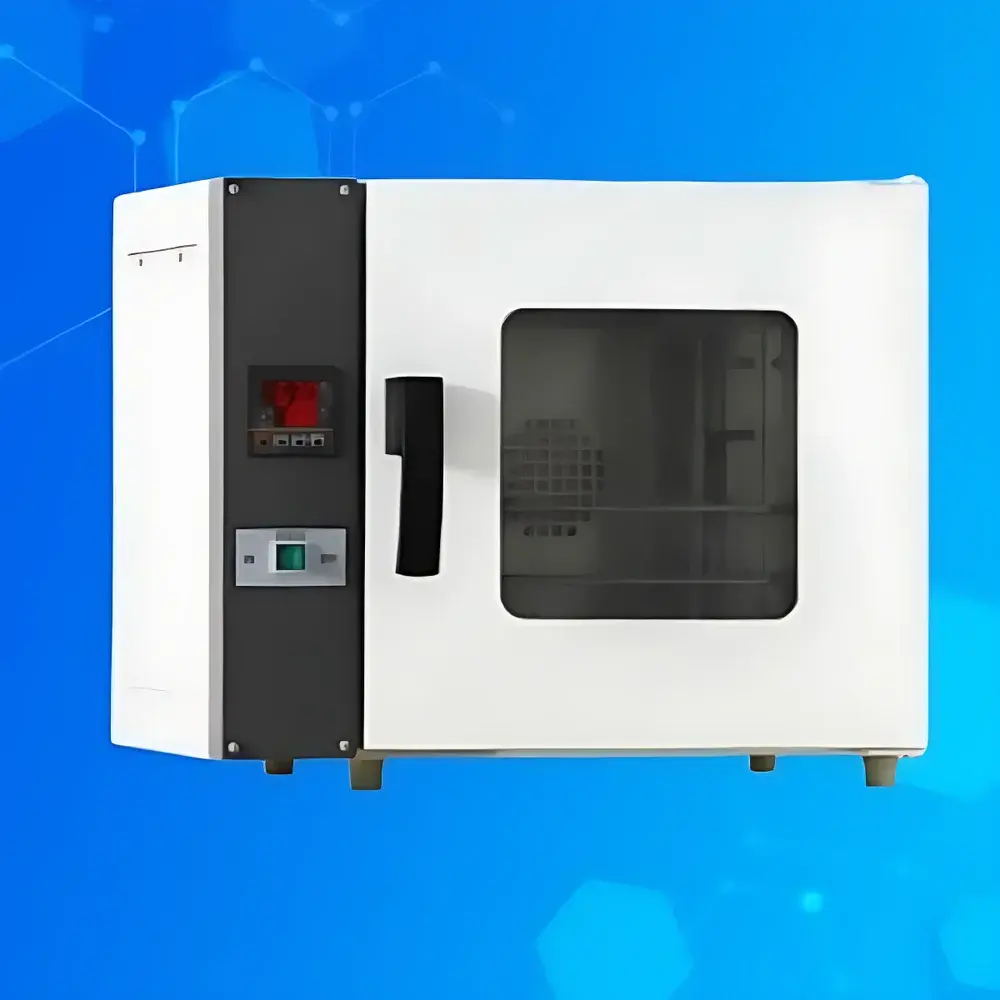
Zuofei DHG-9203A Forced-Air Constant-Temperature Drying Oven
| Brand | Zuofei |
|---|---|
| Origin | Shanghai, China |
| Manufacturer Type | Direct Manufacturer |
| Product Category | Domestic |
| Model | DHG-9203A |
| Instrument Type | High-Temperature Forced-Air Oven |
| Temperature Range | RT+10°C to 250°C |
| Temperature Uniformity | ±1.0°C |
| External Dimensions (W×D×H, cm) | 88×74×82 |
| Internal Chamber Dimensions (W×D×H, cm) | 60×55×64.5 |
| Temperature Resolution | 0.1°C |
| Operating Ambient Temperature | +5°C to +40°C |
| Interior Material | Mirror-Finish Stainless Steel |
| Power Input | 1600 W |
| Timer Range | 1–9999 minutes |
| Standard Shelf Quantity | 2 adjustable shelves |
| Safety Features | Dual independent over-temperature protection circuits, built-in earth-leakage circuit breaker (ELCB) |
Overview
The Zuofei DHG-9203A is a microprocessor-controlled forced-air drying oven engineered for precise thermal processing in academic, industrial, and quality control laboratories. It operates on the principle of convective heat transfer via an internally mounted centrifugal blower that circulates preheated air uniformly throughout the chamber—ensuring rapid temperature equilibration and high spatial uniformity. Designed for dry-heat sterilization, moisture removal, thermal aging, and pre-conditioning of samples, the unit complies with fundamental thermal validation requirements outlined in ISO 17025-accredited testing environments. Its operational range (RT+10°C to 250°C) supports applications including residual solvent evaporation, polymer curing, desiccation of hygroscopic materials, and microbiological deactivation through oxidative denaturation of cellular proteins and nucleic acids.
Key Features
- Microcomputer-based PID temperature controller with large LCD display, offering real-time monitoring and setpoint adjustment with 0.1°C resolution.
- Forced-air convection system with adjustable fan speed—enabling optimization of airflow velocity for sensitive or densely packed samples.
- Dual redundant over-temperature protection: primary solid-state relay cutoff and secondary mechanical thermostat fail-safe, both independently wired to interrupt heating power above user-defined limits.
- Mirror-finish 304 stainless steel interior chamber—resistant to corrosion, easy to clean, and compliant with GLP hygiene standards for repeated use in regulated workflows.
- Two removable and repositionable chrome-plated wire shelves (standard), allowing flexible load configuration and full chamber access for cleaning or calibration verification.
- Integrated ELCB (Earth Leakage Circuit Breaker) rated at 30 mA for personnel and equipment protection against ground-fault hazards.
- Programmable timer (1–9999 minutes) with auto-shutdown function; optional auxiliary temperature controller available for redundancy-critical processes.
Sample Compatibility & Compliance
The DHG-9203A accommodates a broad spectrum of sample types—including glassware, metal components, ceramic substrates, polymer films, pharmaceutical excipients, and inert particulates—provided they are thermally stable within the specified operating envelope. Its chamber geometry (60 × 55 × 64.5 cm) permits stacking of standard Petri dishes, weighing boats, crucibles, and 500-mL beakers without airflow obstruction. The unit meets general safety requirements per IEC 61010-1:2010 for laboratory electrical equipment and conforms to ambient thermal management guidelines defined in ASTM E145–22 (Standard Specification for Gravity-Convection and Forced-Ventilation Ovens). While not certified for Class II biological safety, its dry-heat profile aligns with USP recommendations for depyrogenation of glass vials at ≥250°C for ≥45 minutes.
Software & Data Management
The DHG-9203A operates as a standalone instrument with embedded firmware—no proprietary software required for basic operation. Optional RS-485 serial interface enables integration into centralized lab monitoring systems using Modbus RTU protocol, supporting remote parameter readout, event logging, and alarm triggering. When paired with compatible SCADA or LIMS platforms, temperature data can be timestamped and archived with audit-trail capability compliant with FDA 21 CFR Part 11 (electronic records and signatures) when implemented with appropriate system validation. An optional SMS alert module provides real-time notifications upon deviation from preset thresholds—useful for unattended overnight runs or facility-wide environmental surveillance.
Applications
- Dry-heat sterilization of stainless steel instruments and glassware in research and clinical labs.
- Moisture content determination per AOAC 950.46 and ISO 5530-1 for food, feed, and agricultural commodities.
- Thermal stability assessment of active pharmaceutical ingredients (APIs) and excipients under accelerated conditions (ICH Q1A).
- Curing of epoxy resins, powder coatings, and composite laminates in materials science R&D.
- Pre-drying of filter membranes prior to gravimetric analysis in environmental water testing (EPA Method 160.1).
- Baking of printed circuit board (PCB) assemblies to eliminate latent moisture before soldering.
FAQ
What is the maximum recommended continuous operating temperature?
The DHG-9203A is rated for sustained operation up to 250°C; prolonged use above this limit may compromise sensor accuracy and chamber integrity.
Is calibration traceability available?
Yes—optional NIST-traceable calibration certificates (including as-found/as-left data at three points: 100°C, 150°C, and 200°C) can be supplied upon request.
Can the oven be used for pyrolysis or ashing?
No—it lacks exhaust ducting, oxygen control, or high-temperature insulation required for muffle furnace applications; it is not designed for combustion or volatile residue analysis.
Does the unit support ramp-soak programming?
Not natively—the standard controller supports only single-setpoint operation with timer-based shutdown; multi-step profiles require external programmable logic controllers (PLCs) or third-party DAQ systems.
How often should preventive maintenance be performed?
We recommend quarterly inspection of fan motor bearings, seal integrity, and thermal cut-off functionality—especially in high-utilization settings exceeding 8 hours/day.



