
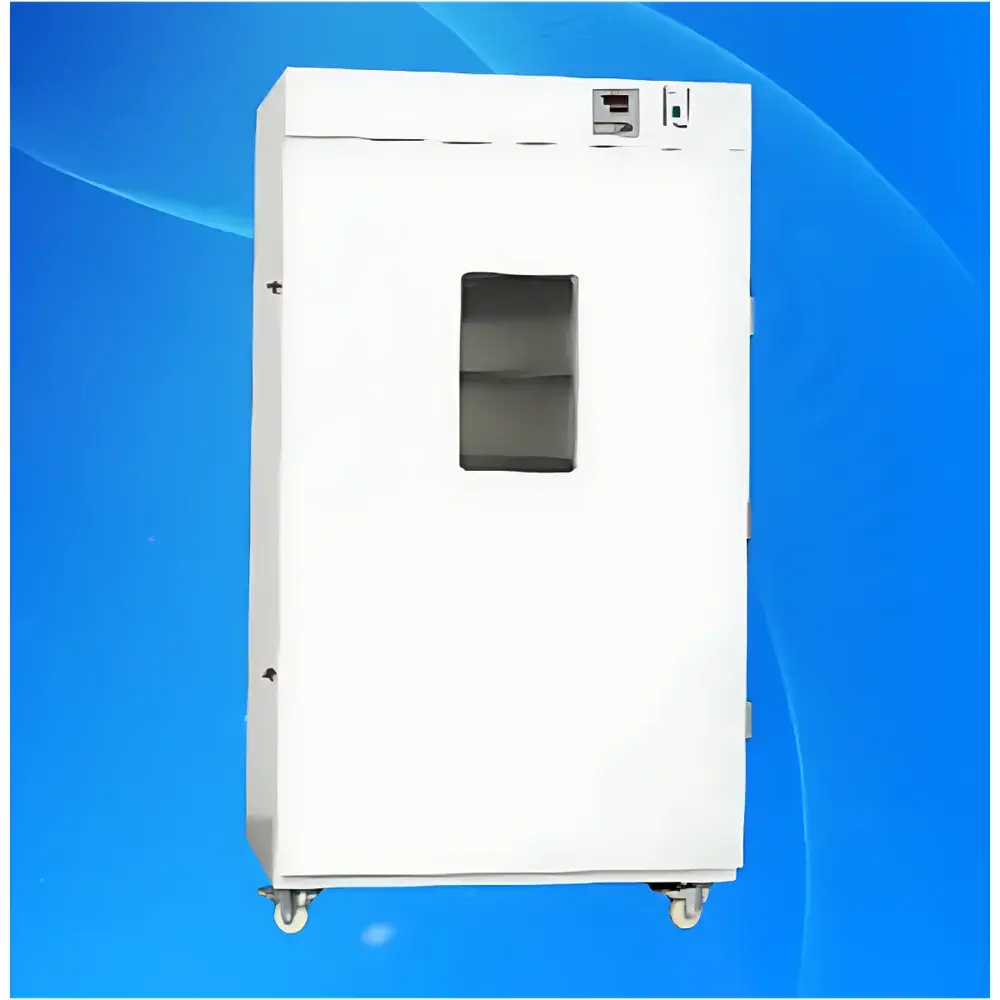
Zuofei DHG-9620A Forced-Air Constant-Temperature Drying Oven
| Brand | Zuofei |
|---|---|
| Origin | Shanghai, China |
| Manufacturer Type | Direct Manufacturer |
| Product Category | Domestic |
| Model | DHG-9620A |
| Instrument Type | General-Purpose Forced-Air Oven |
| Temperature Range | RT+10°C to 250°C |
| Temperature Fluctuation | ±1.0°C |
| External Dimensions (W×D×H) | 102×86×173 cm |
| Internal Dimensions (W×D×H) | 80×60×130 cm |
| Temperature Resolution | 0.1°C |
| Operating Ambient Temperature | +5°C to +40°C |
| Interior Material | Mirror-Finish Stainless Steel |
| Heating Method | Rear-Mounted Stainless Steel Electric Heating Elements |
| Temperature Uniformity | ±3% (at 100°C test point) |
Overview
The Zuofei DHG-9620A is a vertically oriented, forced-air constant-temperature drying oven engineered for precision thermal processing in laboratory, quality control, and industrial R&D environments. It operates on the principle of convective heat transfer via a high-reliability centrifugal blower system integrated with a multi-zone rear-mounted heating architecture. Unlike natural convection ovens, this model employs active air circulation—driven by a thermally stable fan capable of continuous operation at elevated temperatures—to ensure consistent thermal distribution across the entire working chamber. The oven is designed for applications requiring controlled, repeatable thermal exposure—including moisture removal from solid samples, pre-conditioning of polymeric materials, solvent evaporation in analytical sample preparation, sterilization of glassware and tools, and thermal stability testing per ISO 5725 and ASTM E2018 protocols.
Key Features
- Robust construction featuring a mirror-finish stainless steel interior chamber (SUS304 grade), corrosion-resistant and easy to decontaminate; outer casing fabricated from cold-rolled steel with powder-coated finish.
- Microprocessor-based PID temperature controller with dual-line digital display, offering programmable timing (1–9999 minutes), over-temperature deviation alarm, and automatic recovery after power interruption.
- Optimized airflow design: rear-mounted triple-heating-zone configuration with independent ducting ensures uniform heat delivery and minimizes thermal stratification.
- High-transparency double-layer tempered glass observation window with silicone-sealed frame, enabling real-time visual monitoring without compromising chamber integrity or thermal efficiency.
- Advanced sealing system utilizing high-temperature silicone gasket (rated to 300°C), engineered for long service life and low maintenance under cyclic thermal loading.
- Standard safety provisions include thermal cut-off protection, audible over-temperature alert, and grounded chassis with CE-compliant electrical insulation.
Sample Compatibility & Compliance
The DHG-9620A accommodates a wide range of sample types—including petri dishes, weighing boats, crucibles, glass vials, metal trays, and standard ISO/IEC 17025-compliant calibration standards—within its 624 L usable chamber volume. Its temperature uniformity specification (±3% at 100°C) meets the performance thresholds defined in ISO 17025:2017 Annex A3 for thermal validation of laboratory ovens used in accredited testing. While not certified to UL 61010-1 or IEC 61010-1 out-of-the-box, the unit complies with core safety requirements for Class II laboratory equipment when installed per manufacturer-specified clearances and grounding practices. Optional configurations—such as independent over-temperature limiters and RS485 communication modules—support integration into GLP/GMP workflows requiring audit-trail-capable instrumentation per FDA 21 CFR Part 11 Annex 11 guidelines.
Software & Data Management
The base model includes embedded firmware supporting time-stamped temperature logging via optional RS485 interface (Modbus RTU protocol), enabling seamless integration with LabVantage, Empower, or custom SCADA platforms. When equipped with the optional touchscreen multi-segment programmer, users gain access to up to 32 programmable steps—including ramp-hold-soak profiles, user-defined heating rates (°C/min), auto-start/sleep/shutdown scheduling, and real-time graphical temperature curve visualization. All logged data are timestamped and exportable in CSV format. Optional thermal printer support provides hard-copy records suitable for SOP-driven documentation in regulated environments.
Applications
- Moisture content determination per AOAC 950.46 and USP <731> for pharmaceutical excipients and herbal raw materials.
- Drying of filter papers, gravimetric precipitates, and ceramic green bodies prior to sintering analysis.
- Baking of electrode coatings in battery R&D labs (e.g., NMC cathode slurry drying at 120°C).
- Melt-point verification of waxes and thermoplastics using standardized ISO 306 methodology.
- Pre-sterilization conditioning of autoclave accessories and reusable labware in microbiology facilities.
- Accelerated aging studies for packaging materials per ASTM F1980, where precise thermal exposure is critical to shelf-life modeling.
FAQ
What is the maximum validated operating temperature for continuous use?
The DHG-9620A is rated for continuous operation up to 250°C. For extended-duration runs above 200°C, periodic verification of door seal integrity and fan bearing lubrication is recommended.
Can the oven be validated for IQ/OQ/PQ compliance?
Yes—the unit supports third-party qualification using calibrated PT100 probes and documented procedures aligned with ISO 17025 and GAMP5. Optional calibration certificates traceable to NIM (China) or NIST (USA) are available upon request.
Is the RS485 interface compatible with common LIMS systems?
Yes, Modbus RTU implementation allows direct integration with most modern LIMS and ELN platforms via standard serial-to-Ethernet gateways.
Does the oven meet electromagnetic compatibility (EMC) requirements for lab environments?
It conforms to GB/T 18268.1–2010 (equivalent to IEC 61326-1:2012) for electromagnetic immunity and emission limits applicable to laboratory measurement equipment.
What is the typical warm-up time to reach 150°C from ambient?
Approximately 22–26 minutes under no-load conditions, depending on ambient temperature and ventilation clearance. Load-dependent stabilization time may vary and should be verified during operational qualification.



