
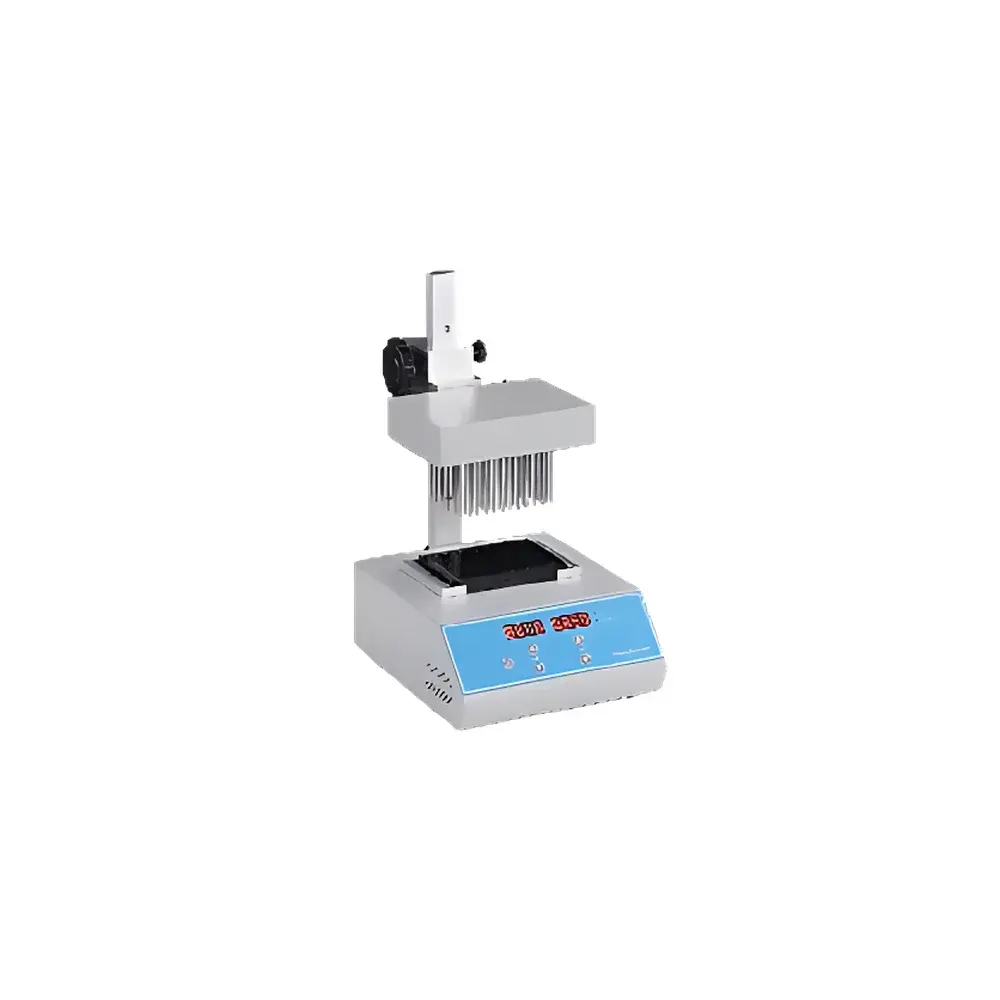
Zuofei DC-150 Series Visual Nitrogen Evaporator
| Brand | Zuofei |
|---|---|
| Origin | Shanghai, China |
| Manufacturer Type | Direct Manufacturer |
| Product Category | Domestic |
| Model | DC-150 |
| Heating Method | Dry-block Heating |
| Temperature Range | Ambient +5°C to 160°C |
| Temperature Stability | ≤±0.3°C (at 40°C) |
| Gas Flow Rate | 0–15 L/min |
| Sample Capacity | Configurable via interchangeable modules (e.g., 12×15 mm, 96-well PCR format) |
| Heating Power | Up to 500 W (model-dependent) |
| Display | Real-time digital temperature & countdown timer |
| Safety | Built-in over-temperature protection |
| Visual Access | Transparent front panel for real-time sample level monitoring |
| Gas Needle | Adjustable height and position |
| Modular Compatibility | 18+ standardized aluminum heating blocks (including conical-bottom, flat-bottom, PCR plate, and microcentrifuge tube configurations) |
Overview
The Zuofei DC-150 Series Visual Nitrogen Evaporator is an engineered dry-block thermal concentrator designed for high-throughput, oxygen-sensitive sample preparation in analytical laboratories. It operates on the principle of inert gas-assisted solvent evaporation: precisely controlled nitrogen flow is directed through adjustable stainless-steel needles onto the surface of heated samples, accelerating solvent removal while minimizing oxidative degradation, analyte loss, or thermal decomposition. Unlike rotary evaporation—limited by single-vessel throughput and vacuum-related volatility constraints—the DC-150 enables parallel processing of up to 96 samples (depending on module configuration), significantly reducing batch turnaround time in applications such as LC-MS/MS sample cleanup, clinical steroid profiling, pesticide residue analysis, and pharmaceutical impurity isolation. Its visual observation window allows uninterrupted monitoring of solvent meniscus recession without opening the chamber or interrupting gas flow—critical for method reproducibility and endpoint determination in regulated environments.
Key Features
- Dry-block heating architecture with rapid thermal response: achieves 25°C → 160°C in ≤15 minutes (DC-150-1 variant), ensuring minimal process lag between setpoint adjustment and actual sample temperature stabilization.
- High-precision PID temperature control with ±0.3°C stability at 40°C and ≤±1.0°C uniformity across the block surface at 120°C—validated per ASTM E220 for thermal performance in laboratory equipment.
- Modular aluminum heating block system compatible with 18 standardized configurations—including conical-bottom vials (0.2–2.0 mL), 12-mm and 13-mm round-bottom tubes, 96-well PCR plates (ZD17), and microtiter formats (ZD18)—enabling seamless transition between sample types without hardware replacement.
- Vertically adjustable gas manifold with independently positionable 150-mm stainless-steel needles; needle height and lateral alignment are tool-free, supporting consistent gas impingement geometry across heterogeneous tube geometries.
- Integrated safety architecture: automatic cut-off at preset over-temperature threshold (programmable), grounded chassis design compliant with IEC 61010-1, and optional integration into fume hood workflows for handling halogenated or low-boiling solvents (e.g., chloroform, dichloromethane).
- Real-time digital interface displaying current temperature (0.1°C resolution), remaining countdown time (1 min–99 h 59 min), and system status indicators—designed for GLP-compliant documentation when paired with external logging software.
Sample Compatibility & Compliance
The DC-150 accommodates a broad spectrum of sample containers—from 0.2 mL conical PCR tubes to 40 mm diameter digestion vessels—via its standardized ZD and KS series aluminum blocks. All modules undergo thermal stress testing to ensure dimensional stability under repeated thermal cycling (−20°C to +160°C). The instrument complies with electromagnetic compatibility requirements per CISPR 11 Group 1 Class B and meets electrical safety standards outlined in UL 61010-1 and GB 4793.1–2019 (Chinese national standard equivalent to IEC 61010-1). For regulated QC/QA labs, the system supports audit-ready operation when used with validated SOPs and external timestamped data capture—fully compatible with FDA 21 CFR Part 11–aligned electronic record systems via RS-232 or optional USB-to-serial interface.
Software & Data Management
While the DC-150 operates as a standalone benchtop device with embedded firmware, it supports bidirectional serial communication (RS-232) for integration into centralized laboratory information management systems (LIMS) or custom Python/MATLAB automation scripts. Temperature logs, run duration, and user-defined presets can be exported in CSV format for traceability. No proprietary software is required; configuration is performed directly via the front-panel keypad and LCD. All firmware updates are delivered as signed binary packages with version-controlled release notes—maintaining integrity for ISO/IEC 17025-accredited calibration workflows.
Applications
- Preparative concentration of biological extracts prior to HPLC or GC-MS injection—especially for thermolabile compounds (e.g., prostaglandins, catecholamines).
- High-volume environmental testing: EPA Method 525.3 (drinking water), 8082 (PCBs), and 8270 (semivolatiles) require nitrogen-based evaporation to avoid co-distillation artifacts.
- Clinical toxicology screening: simultaneous concentration of 24-hr urine specimens for amphetamine, opioid, and benzodiazepine metabolite quantification per CLIA guidelines.
- Food safety labs: AOAC 2007.01-compliant pesticide residue cleanup from QuEChERS extracts.
- Academic research: solvent exchange protocols in nanomaterial synthesis, where inert atmosphere preservation is mandatory during ligand removal steps.
FAQ
Is the DC-150 suitable for use with flammable solvents such as hexane or ether?
Yes—when operated inside a certified fume hood with appropriate nitrogen pressure regulation (≤0.1 MPa) and verified ventilation rates (>0.5 m/s face velocity), the system meets NFPA 45 requirements for low-flashpoint solvent handling.
Can the gas flow rate be calibrated per needle?
No—flow is regulated at the manifold inlet using a single precision needle valve; individual needle flow uniformity is ensured by matched orifice diameters and laminar flow design, with inter-needle variation <±3% at 10 L/min (verified by hot-wire anemometry).
What is the maximum recommended operating temperature for aluminum modules?
160°C is the upper thermal limit for all ZD/KS series blocks; prolonged exposure above this threshold may induce annealing effects, reducing thermal conductivity and long-term dimensional accuracy.
Does the visual window compromise thermal insulation or nitrogen efficiency?
No—the front panel uses low-emissivity tempered glass with dual-layer construction and silicone gasket sealing, maintaining >92% nitrogen retention efficiency versus opaque variants (per ASHRAE Standard 111 tracer gas test protocol).
Are third-party modules supported?
Only Zuofei-certified ZD and KS series modules are guaranteed for thermal calibration traceability; non-OEM blocks void the factory temperature uniformity warranty and invalidate regulatory compliance claims.



