
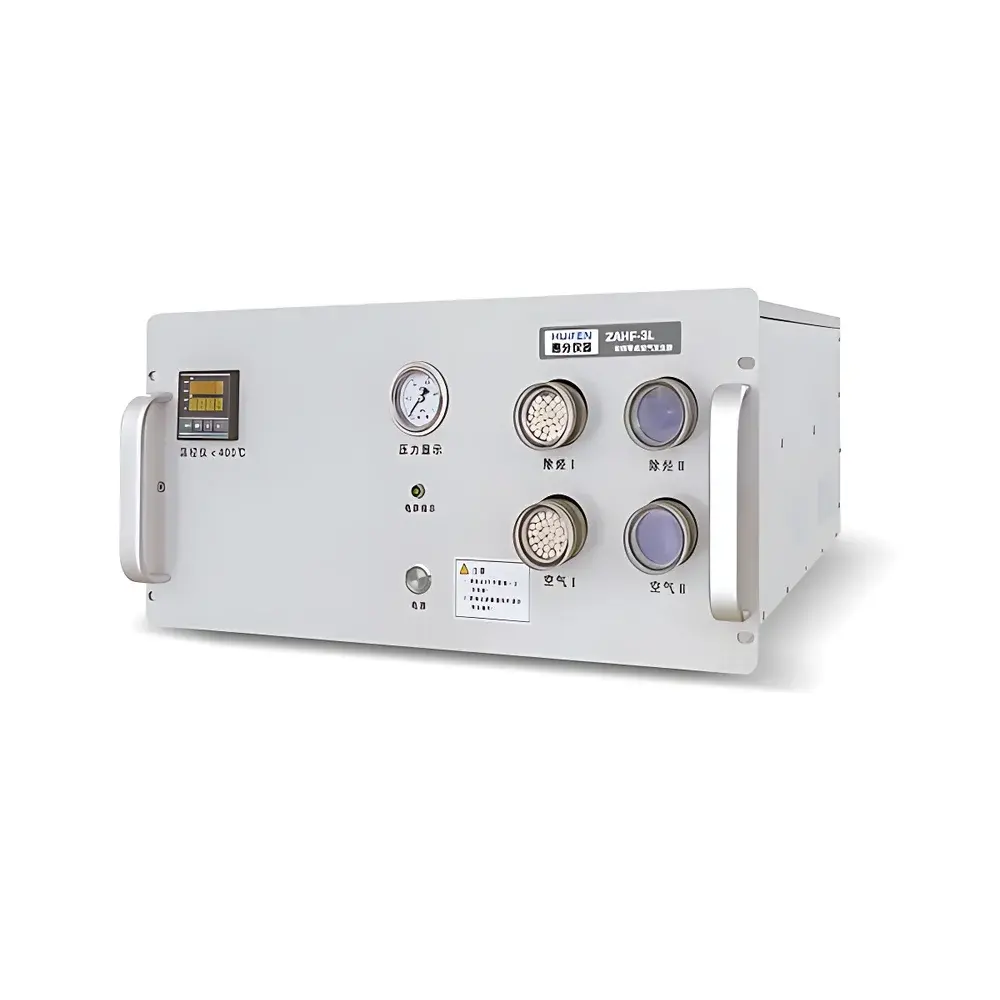
Huifen Instruments ZAHF-3L Zero Air Generator
| Brand | Huifen Instruments |
|---|---|
| Origin | Shandong, China |
| Model | ZAHF-3L |
| Hydrocarbon Removal Principle | Integrated physical adsorption (5A molecular sieve, silica gel, activated carbon), chemical absorption (sodium hydroxide asbestos), and catalytic oxidation (Pd/6201 catalyst) |
| Output Flow | 0–1000 mL/min (adjustable) |
| Output Pressure | A: 0–0.45 MPa |
| B | 0–0.45 MPa |
| Maximum Output Pressure | 7 bar (100 psi) |
| Hydrocarbon Content (as CH₄) | <0.1 ppm |
| Dew Point | −60 °C |
| Power Supply | 220 V, 50 Hz |
| Operating Temperature | 15–40 °C |
| Relative Humidity | ≤70% |
| Noise Level | ≤42 dB(A) |
| Rated Power | 800 W |
| Weight | ~25 kg |
| Dimensions | 5U rack-mountable form factor |
| Stabilization Time | <0.5 h |
Overview
The Huifen Instruments ZAHF-3L Zero Air Generator is an engineered solution for laboratories requiring high-purity, hydrocarbon-free compressed air as a carrier, purge, or combustion gas in analytical instrumentation—including gas chromatography (GC), GC–MS, flame ionization detection (FID), chemiluminescence NOx analyzers, and ambient air monitoring systems. It operates on a multi-stage purification architecture combining selective adsorption, chemical scrubbing, and low-temperature catalytic oxidation to achieve consistent zero-air specifications compliant with ASTM D6159, ISO 8573-1 Class 1:2:1 (for hydrocarbons and moisture), and EPA Method TO-14/TO-15 support requirements. Unlike oil-lubricated compressors or bottled air, the ZAHF-3L eliminates batch-to-batch variability, supply chain dependency, and contamination risks associated with cylinder handling—delivering continuous, on-demand zero air at up to 1000 mL/min with trace-level hydrocarbon removal and deep desiccation.
Key Features
- Multi-modal hydrocarbon abatement: Sequential beds of 5A molecular sieve (for H2O and CO2 co-removal), silica gel (bulk moisture), activated carbon (non-polar VOCs), sodium hydroxide–impregnated asbestos (acidic impurities), and Pd/6201 catalyst (oxidative conversion of residual C1–C4 hydrocarbons to CO2 and H2O at ≤350 °C)
- Dual independent pressure-regulated outputs (A & B), each adjustable from 0 to 0.45 MPa (0–65 psi), enabling simultaneous supply to multiple instruments with isolated pressure control
- Integrated dew point suppression achieving −60 °C (at 7 bar), meeting ISO 8573-1:2010 Class 2 for water content (≤0.05 g/m³) without external refrigerated dryers
- Rack-mountable 5U industrial chassis (21.5″ W × 19″ D × 8.75″ H) optimized for integration into centralized lab gas distribution systems or analytical instrument cabinets
- Thermal stability management: PID-controlled furnace zone (0–600 °C) ensures consistent catalytic efficiency across ambient fluctuations; full operational stabilization achieved within 30 minutes
- Low acoustic signature (≤42 dB[A]) suitable for shared laboratory environments; 800 W nominal draw compatible with standard 220 V/50 Hz circuits
Sample Compatibility & Compliance
The ZAHF-3L delivers air meeting stringent purity benchmarks required by regulatory-grade analytical platforms. Its output (<0.1 ppm total hydrocarbons as methane equivalent, <1 ppb benzene, dew point ≤−60 °C) satisfies calibration gas preparation protocols under ISO/IEC 17025-accredited laboratories. It supports compliance with US EPA Method IO-3.2 (for FID fuel gas), ASTM D6216 (for ambient air analyzers), and pharmacopeial requirements for residual solvent testing (USP , EP 2.2.46). The unit’s non-oil-based generation mechanism eliminates silicone, phthalate, and lubricant-derived artifacts—critical for trace-level VOC analysis and high-resolution mass spectrometry workflows.
Software & Data Management
While the ZAHF-3L operates as a standalone hardware system without embedded firmware or network connectivity, its design supports full auditability in GLP/GMP environments. All critical operating parameters—including inlet air quality assumptions (CH4 ≤100 ppm), pressure setpoints, runtime hours, and maintenance intervals—are documented in the user manual and service logbook per ISO/IEC 17025 clause 7.6. Optional analog output (0–10 V or 4–20 mA) can be integrated via third-party PLCs for centralized monitoring. Maintenance records—including adsorbent bed replacement schedules (recommended every 6–12 months depending on inlet air quality) and catalyst reactivation logs—are structured to align with FDA 21 CFR Part 11 data integrity expectations when paired with validated electronic lab notebooks (ELNs).
Applications
- Carrier and makeup gas for capillary GC and GC–MS systems, especially in environmental, petrochemical, and forensic labs performing EPA TO-14A/TO-15 analyses
- Fuel and oxidant gas for flame-based detectors (FID, FPD, NPD), where hydrocarbon background directly impacts baseline stability and detection limits
- Purge gas for dynamic headspace and thermal desorption units (TD-GC–MS), preventing carryover and ghost peaks
- Zero-air reference gas for calibrating ambient air quality monitors (O3, NOx, SO2) per EN 14625 and ISO 12039
- Cleanroom and inert-atmosphere glovebox make-up gas where oil-free, particle-free, and hydrocarbon-free air is mandatory
FAQ
What inlet air quality is required for optimal ZAHF-3L performance?
Ambient intake air should contain ≤100 ppm methane-equivalent hydrocarbons and ≤70% RH. Use of a pre-filter (particulate + coalescing) is recommended if inlet air contains oil aerosols or >0.1 µm particulates.
How often must the purification media be replaced?
Under typical lab conditions (24/7 operation, clean ambient air), the 5A molecular sieve and activated carbon beds require replacement every 9–12 months; the Pd/6201 catalyst has a service life of ≥2 years and may be thermally regenerated onsite per manufacturer protocol.
Can the ZAHF-3L be used with ozone generators or NOx calibration systems?
Yes—its ultra-low hydrocarbon and moisture output prevents quenching reactions and ensures stoichiometric accuracy in photolytic and chemiluminescent calibration standards.
Is the unit compliant with electrical safety standards for international use?
The ZAHF-3L conforms to GB 4793.1–2019 (equivalent to IEC 61010-1:2010) for laboratory electrical equipment. CE marking is not applied; users deploying outside China must verify local conformity (e.g., UL 61010-1, UKCA) via authorized third-party assessment.
Does the generator include pressure relief or fail-safe mechanisms?
Yes—the system incorporates dual redundant pressure relief valves (set at 7.5 bar), overtemperature cutoff (620 °C), and automatic shutdown upon sustained outlet pressure deviation (>±5% setpoint for >60 s).



