
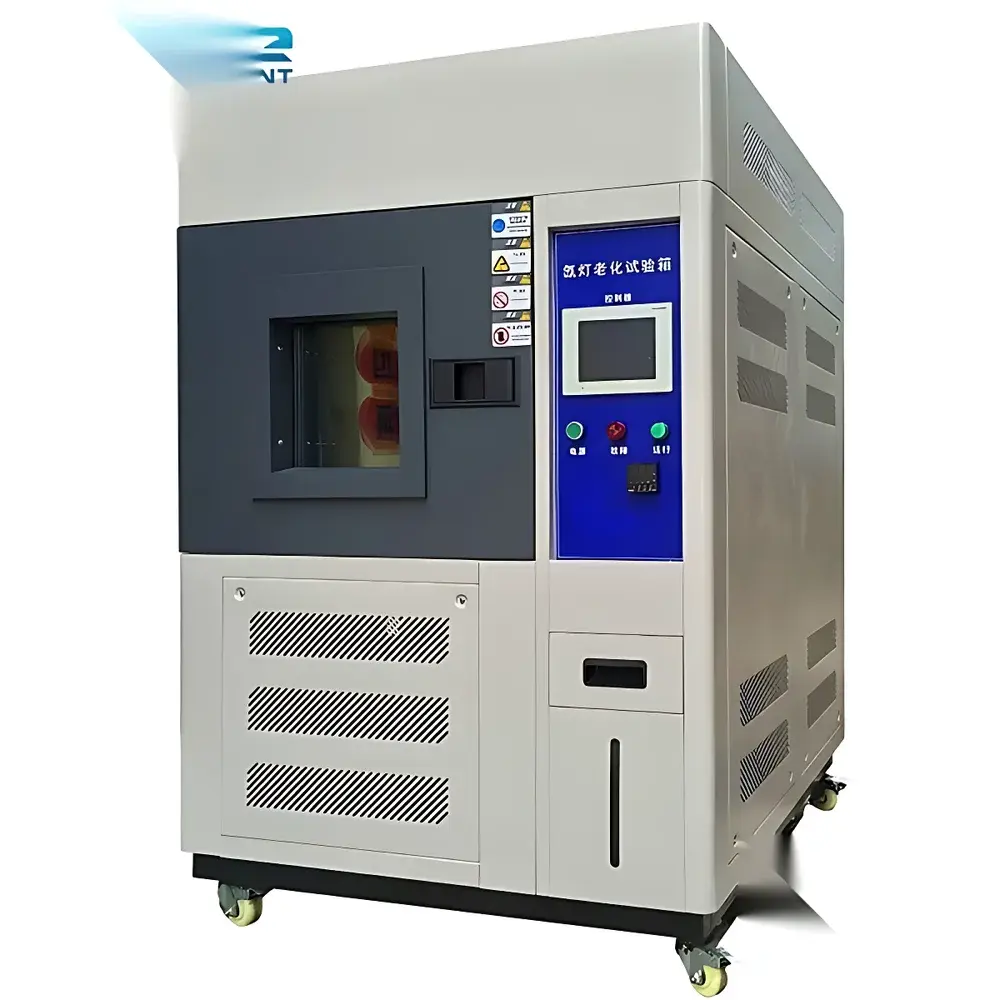
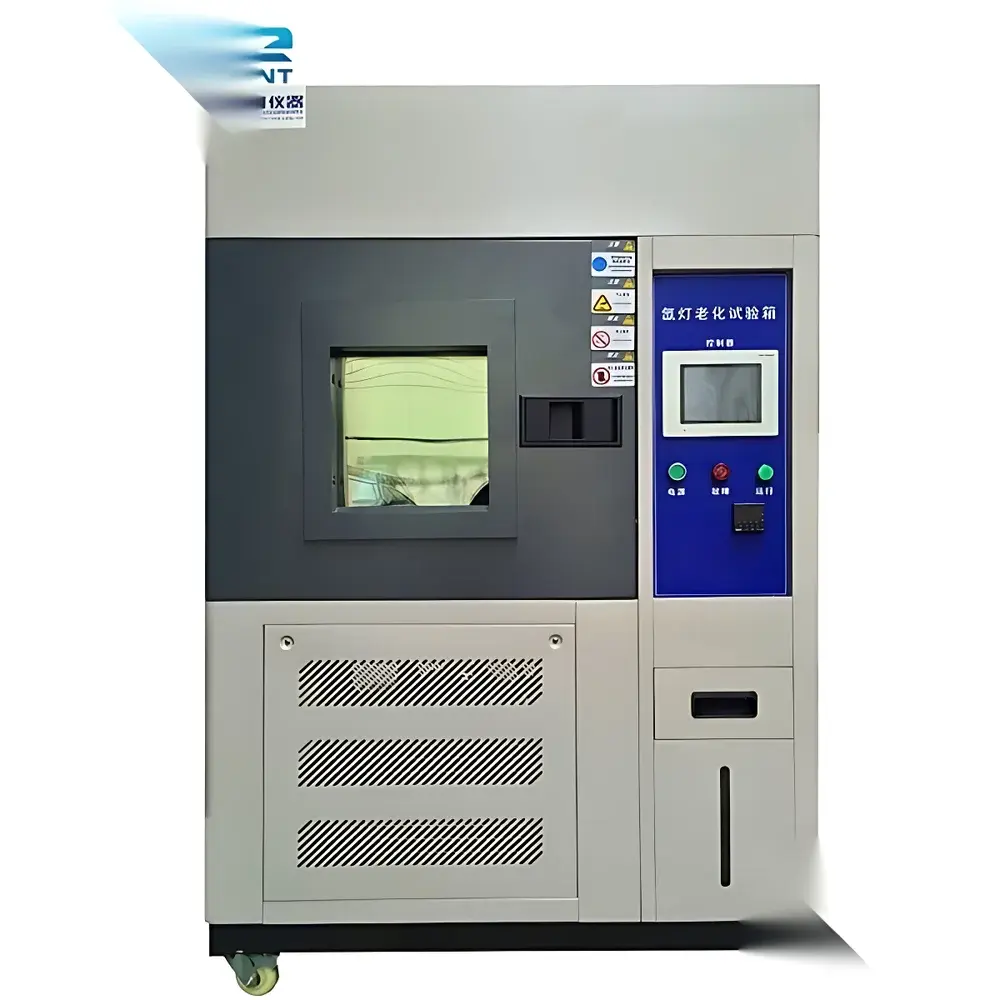
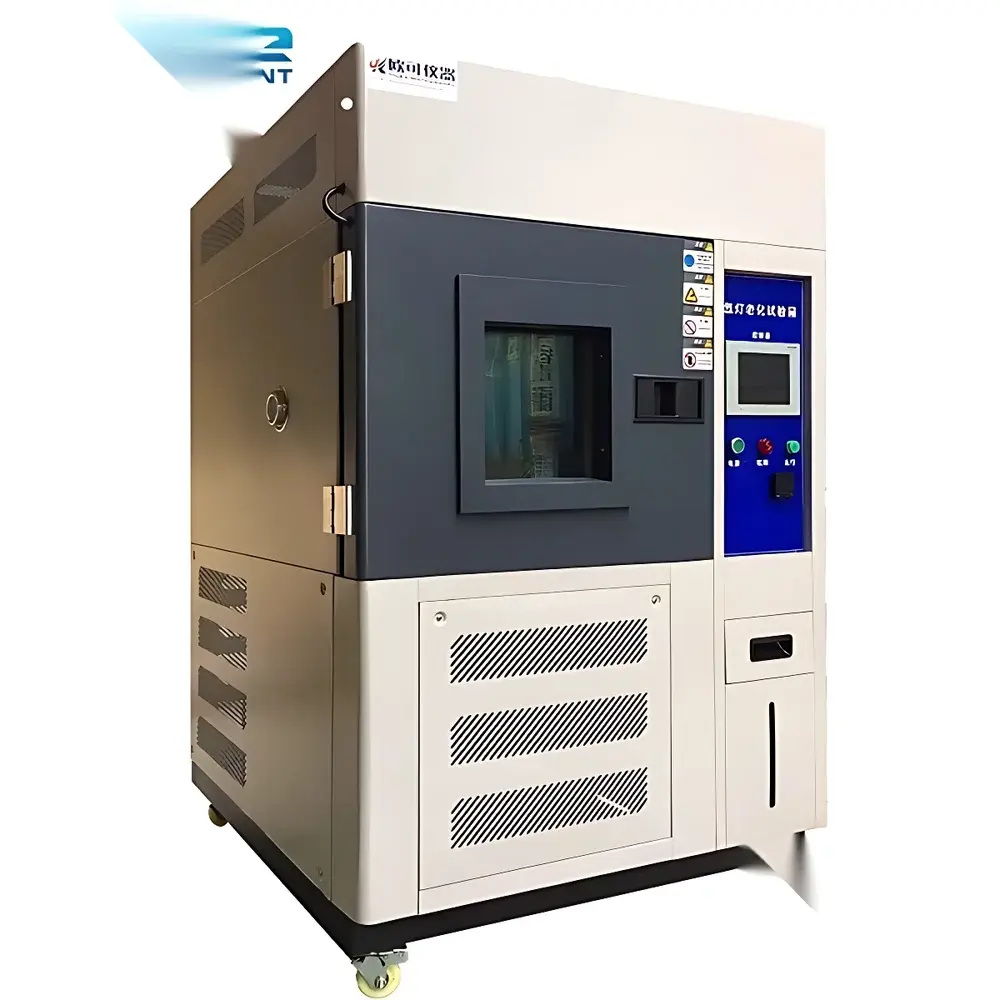
Xenon Arc Weathering Test Chamber System
| Brand | Other Brands |
|---|---|
| Origin | Imported |
| Manufacturer Type | Authorized Distributor |
| Chamber Dimensions (W×H×D) | 500 × 700 × 600 mm |
| External Dimensions | Custom-Fit Enclosure |
| Total Power Consumption | 9 kW |
| Lamp Configuration | Single Air-Cooled 1.8 kW Xenon Arc Lamp |
| Spectral Range | 290–800 nm |
| Irradiance (290–800 nm) | 550 W/m² |
| Black Panel Temperature Range | 63 °C / 100 °C (selectable) |
| Temperature Range | RT to +80 °C |
| Temp. Uniformity | ±2.0 °C |
| Temp. Stability | ±0.5 °C |
| Humidity Range | 45–90 %RH |
| Humidity Control Accuracy | ≤ ±2 %RH |
| Water Spray Nozzle Diameter | Ø0.8 mm |
| Spray Duration | 0–9999 min (continuous) |
| Spray Cycle Interval | 0–240 min (intermittent) |
| Sample Rack Distance from Lamp | 230–280 mm |
| Heating Power | 3 kW |
| Humidification Power | 1.5 kW |
| Filter | Single Borosilicate Glass Daylight Filter |
Overview
The Xenon Arc Weathering Test Chamber System is an engineered environmental simulation platform designed to replicate the full solar spectrum—including UV, visible, and near-infrared radiation—using a calibrated air-cooled xenon arc lamp. Based on ASTM G155, ISO 4892-2, and SAE J2527 standards, this system enables accelerated exposure testing under controlled irradiance, temperature, and humidity conditions. Unlike UV fluorescent lamp systems, xenon arc technology delivers spectral power distribution closely matching natural sunlight (AM1.5), making it the reference method for evaluating photostability, color fade, gloss loss, chalking, cracking, and mechanical degradation in polymers, coatings, textiles, automotive interiors, and architectural materials. The chamber integrates real-time irradiance monitoring, closed-loop black panel temperature control, and programmable wet/dry cycles to ensure test reproducibility across laboratories and compliance with GLP and ISO/IEC 17025 requirements.
Key Features
- Single 1.8 kW air-cooled xenon lamp with spectral output spanning 290–800 nm, filtered through borosilicate glass to simulate daylight exposure (CIE No. 85 or ISO 4892-2 Option A)
- Precise irradiance control at 550 W/m² (integrated over 290–800 nm), maintained via optical feedback and lamp power regulation
- Black panel temperature sensor (63 °C or 100 °C setpoint) mounted adjacent to specimen plane for accurate surface thermal loading assessment
- Chamber temperature range: ambient to +80 °C, stabilized within ±0.5 °C; uniformity maintained at ±2.0 °C across working volume
- Relative humidity control: 45–90 %RH, regulated via steam humidifier with ≤ ±2 %RH deviation
- Programmable water spray subsystem: continuous or cyclic (0–240 min interval), duration adjustable up to 9999 minutes, using precision Ø0.8 mm nozzles
- Adjustable sample rack (height-variable) positioned 230–280 mm from lamp axis to optimize irradiance homogeneity and thermal gradient consistency
- Microprocessor-based controller with data logging, alarm history, and password-protected parameter locking—supports audit trail generation per FDA 21 CFR Part 11 guidelines
Sample Compatibility & Compliance
This system accommodates flat-panel specimens up to 500 mm (W) × 700 mm (H) × 600 mm (D) in the working chamber. Standard fixtures support ISO 105-B02, ASTM D2244, and GB/T 1865-compliant sample mounting. All operational parameters—including irradiance setpoints, temperature ramps, humidity profiles, and spray timing—are fully programmable and traceable. The system meets essential safety and electromagnetic compatibility requirements per IEC 61000-6-3 and IEC 61000-6-4. It supports validation documentation packages aligned with ISO/IEC 17025 clause 5.5.2 (equipment verification) and ASTM E2090 (calibration of xenon arc exposure devices). Optional NIST-traceable irradiance calibration certificates and IQ/OQ protocols are available upon request.
Software & Data Management
The embedded controller provides local operation with real-time graphical display of irradiance (W/m²), black panel temperature (°C), chamber RH (%), and elapsed exposure time. Logged data (minimum 30-day buffer) is exportable via USB to CSV format for post-processing in MATLAB, Excel, or LIMS platforms. Remote monitoring and parameter adjustment are supported via Ethernet interface using Modbus TCP protocol—enabling integration into centralized lab automation networks. Audit trails record all user actions, setpoint changes, alarm events, and calibration interventions with timestamps and operator IDs, satisfying FDA 21 CFR Part 11 electronic record requirements when paired with organizational access controls and electronic signatures.
Applications
- Accelerated weathering evaluation of automotive exterior plastics, paint systems, and headlamp lenses per SAE J2527 and ISO 11341
- UV stability screening of medical device packaging materials under ISO 11607-1 accelerated aging protocols
- Colorfastness and gloss retention testing of textile dyes and outdoor signage films (AATCC TM16, ISO 105-B02)
- Photodegradation kinetics modeling for polymer additives (HALS, UV absorbers) under controlled spectral and thermal stress
- Correlation studies between laboratory xenon exposure and real-world field performance using Arrhenius-based acceleration factors
- Qualification of aerospace sealants and composite matrix resins per MIL-STD-810H Method 505.6
FAQ
What spectral filter configuration is used to match daylight exposure?
The system employs a single borosilicate glass daylight filter compliant with ISO 4892-2 Option A (CIE No. 85), transmitting wavelengths from 290 nm to >800 nm with minimal infrared cutoff—optimized for outdoor exposure simulation.
Is black panel temperature measurement required for all test standards?
Yes—ASTM G155, ISO 4892-2, and SAE J2527 mandate black panel or black standard thermometer (BST) temperature monitoring to control thermal load independently of chamber air temperature.
Can the system operate without water spray during dark cycles?
Yes—the spray function is fully decoupled from light/dark sequencing; users may define independent spray timing, duration, and frequency regardless of irradiation status.
How often does the xenon lamp require recalibration or replacement?
Lamp spectral output degrades over time; we recommend irradiance recalibration every 1,000 hours of operation and lamp replacement after 1,500 hours—or sooner if irradiance drift exceeds ±5% of setpoint.
Does the controller support multi-step test programs with ramping profiles?
Yes—the microprocessor supports up to 100 program steps, including linear temperature/humidity ramps, irradiance modulation, and conditional spray triggers based on elapsed time or cycle count.



