
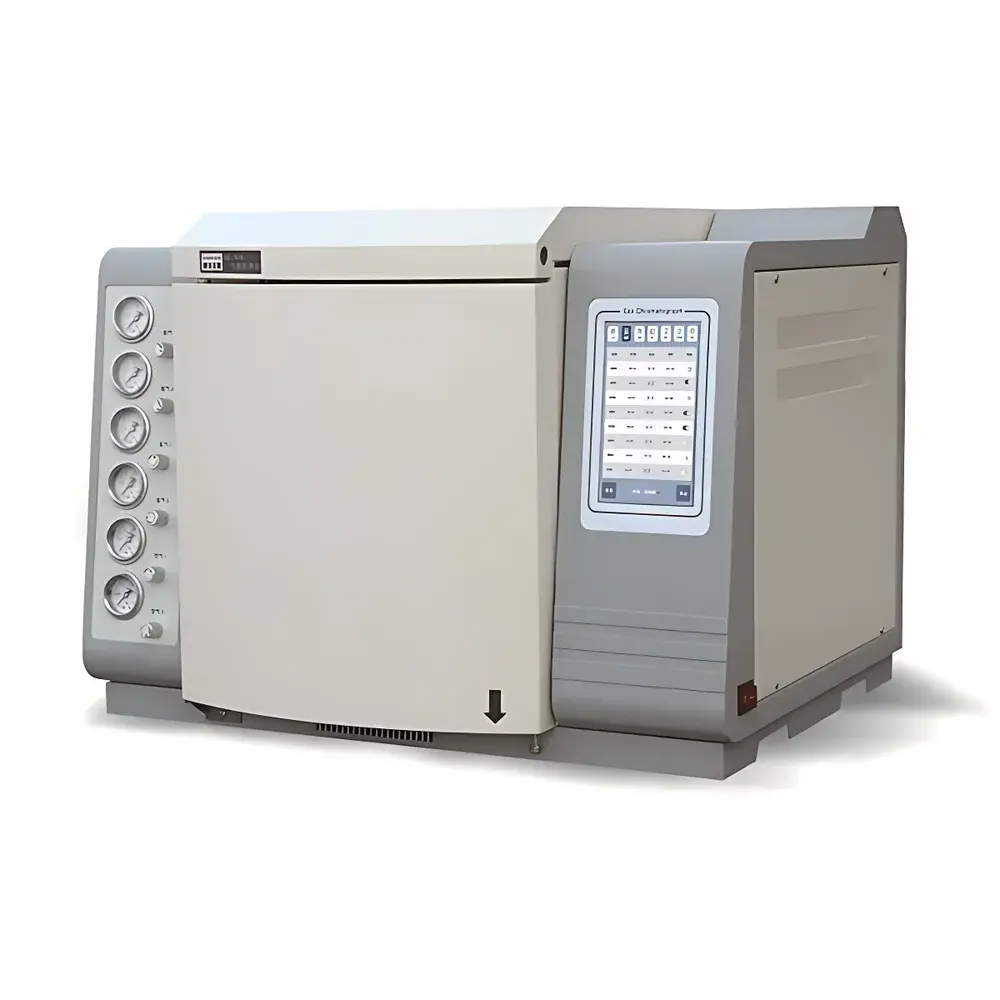
Huifen Instruments GC-7820S Trace Sulfur Analyzer
| Brand | Huifen Instruments |
|---|---|
| Origin | Shandong, China |
| Model | GC-7820S Trace Sulfur Analyzer |
| Instrument Type | Laboratory Gas Chromatograph |
| Application Field | Petrochemical Industry Dedicated |
| Oven Temperature Range | Ambient + 3 °C to 450 °C |
| Oven Ramp Rate | 0.1–40 °C/min |
| Oven Cool-down | ~8 min (450 °C to 50 °C) |
| Carrier Gas Flow Range & Control | 0–1200 mL/min |
| Carrier Gas Pressure Range & Control | 0–970 kPa |
| Injector Maximum Operating Temperature | 450 °C |
| Injector Pressure Setting Range | 0–970 kPa |
| Injector Total Flow Setting Range | 0–1200 mL/min |
| Detector | Flame Photometric Detector (FPD) |
| FPD Sulfur Minimum Detectable Amount | 5 pg/s (as dodecanethiol) |
| FPD Phosphorus Minimum Detectable Amount | 0.11 pg/s (as tributyl phosphate) |
| FPD Dynamic Range (S) | 10³ |
| FPD Dynamic Range (P) | 10⁴ |
| Column Oven Programmable Temperature Steps | 16 |
| Column Oven Temperature Setting Accuracy | ±0.1 °C |
| Injector Types Supported | Packed Column, Split/Splitless |
| Valve System | Multi-position automated switching valves (4-, 6-, 10-port), electromechanical or electronic pressure/flow-controlled auxiliary valves |
| Valve Switching Speed | 10 ms |
| Rated Valve Lifetime | 1,000,000 cycles |
| Data Interface | 10/100M adaptive Ethernet with embedded TCP/IP stack |
| Display | 7-inch full-color resistive touchscreen LCD |
| Language Support | English and Chinese UI |
| Software | Dedicated sulfur analysis workstation supporting up to 253 concurrent GC systems, Modbus RTU server integration for DCS connectivity |
| Optional Configuration | Electronic Pressure Control (EPC) module with auto-ignition, flame-out recovery, and pneumatic fault self-protection |
Overview
The Huifen Instruments GC-7820S Trace Sulfur Analyzer is a dedicated laboratory gas chromatograph engineered for ultra-sensitive, quantitative determination of organic and inorganic sulfur compounds in complex hydrocarbon matrices—primarily targeting refinery streams, natural gas, liquefied petroleum gas (LPG), gasoline, naphtha, and benzene derivatives. Its analytical core relies on high-resolution capillary gas chromatography coupled with a rigorously optimized Flame Photometric Detector (FPD), operating under controlled stoichiometric combustion conditions to generate chemiluminescent emission at 394 nm specific to sulfur-containing species. The system integrates thermally stable, fully inert fluidic pathways—including PEEK tubing and specially passivated switching valves—to minimize adsorption, memory effects, and catalytic decomposition of labile sulfur analytes such as H2S, COS, CH3SH, C2H5SH, CS2, thiophene, and tetrahydrothiophene. Designed for compliance-driven environments, the GC-7820S meets essential performance criteria outlined in ASTM D5504, ISO 8570, UOP 78, and IP 572 for trace sulfur measurement in petrochemical feedstocks and products.
Key Features
- Full-PEEK flow path architecture with surface-passivated multi-port switching valves to suppress sulfur adsorption and ensure reproducible low-pico-gram detection.
- Dual-column configuration capability: Simultaneous use of sulfur-selective column I (e.g., DB-Sulfur or equivalent) and column II (e.g., DB-1 or PLOT Al2O3/KCl) enables comprehensive speciation across volatile and semi-volatile sulfur species in a single injection.
- Advanced FPD with localized active cooling: Maintains detector stability at sustained 450 °C operation while preserving photomultiplier tube linearity and signal-to-noise ratio.
- Integrated EPC (Electronic Pressure Control) option: Provides closed-loop regulation of carrier, makeup, and hydrogen/air flows; supports automated startup sequences, flame monitoring, and pneumatic fault diagnostics per IEC 61508 functional safety principles.
- 7-inch resistive touchscreen interface with dual-language (English/Chinese) firmware, real-time chromatogram display, method editor, and local data storage—operable without external PC dependency.
- Embedded Modbus RTU server and native TCP/IP stack enable seamless integration into plant-wide DCS, MES, or LIMS infrastructure via standard industrial protocols.
Sample Compatibility & Compliance
The GC-7820S accommodates gaseous, liquefied, and liquid samples—ranging from raw natural gas and FCC off-gas to high-purity benzene and reformate fractions—using validated sampling interfaces including gas-tight syringes, pressurized loop injectors, and cryo-trap modules. It complies with regulatory requirements for sulfur reporting under EPA Method 1664B (for total recoverable sulfur), ASTM D6667 (for volatile sulfur compounds in light hydrocarbons), and EN 15470 (for sulfur in automotive fuels). All hardware components meet RoHS Directive 2011/65/EU material restrictions. When operated with audit-trail-enabled software and user-access controls, the system supports GLP and GMP-aligned workflows compliant with FDA 21 CFR Part 11 Annex 11 requirements for electronic records and signatures.
Software & Data Management
The dedicated sulfur analysis workstation supports centralized control of up to 253 GC-7820S units across distributed laboratory networks. It provides peak integration using iterative Gaussian deconvolution algorithms, retention time locking (RTL) for cross-instrument method transfer, and customizable calibration curve fitting (linear, quadratic, or weighted least-squares). Raw data files are stored in vendor-neutral .CDF format (compatible with OpenChrom and Chromeleon), while processed reports export to PDF, CSV, or XML for ERP integration. The built-in Modbus RTU server maps calibrated sulfur concentration values directly to register addresses readable by Siemens PCS7, Honeywell Experion, or Yokogawa CENTUM VP DCS platforms—eliminating manual transcription errors and enabling real-time process feedback loops.
Applications
- Quantification of ppm- to ppb-level thiophenic compounds in benzene feedstock per ASTM D7183.
- Simultaneous analysis of H2S, COS, SO2, and mercaptans in refinery fuel gas per UOP 78 revision.
- Trace sulfur profiling in polymer-grade ethylene and propylene per ISO 8570.
- Monitoring sulfur breakthrough in amine scrubber effluents and Claus tail gas.
- Validation of sulfur removal efficiency in hydrotreating and hydrodesulfurization (HDS) unit optimization studies.
FAQ
What sulfur species can the GC-7820S reliably quantify at sub-ppb levels?
The system achieves validated quantitation down to 0.05 ppm for thiophene in benzene and <5 pg/s for H2S, COS, and mercaptans when configured with sulfur-selective columns and optimized FPD gas ratios.
Is the instrument compatible with existing LIMS or SAP QM modules?
Yes—via its native Ethernet interface and configurable OPC UA or Modbus TCP gateways, it supports direct bidirectional communication with major laboratory informatics platforms without middleware.
Can the GC-7820S operate unattended for extended periods in 24/7 refinery labs?
With optional EPC, auto-ignition, and remote diagnostic telemetry, it supports >168-hour unattended sequence runs under ISO/IEC 17025 environmental monitoring conditions.
Does the system support method validation per ICH Q2(R2) guidelines?
The workstation includes tools for precision, accuracy, LOD/LOQ, linearity, and robustness assessment; raw data integrity is preserved through immutable .CDF archives with SHA-256 checksums.
Are consumables such as sulfur-specific columns and FPD filters available through global distribution channels?
Huifen Instruments maintains authorized distributor agreements in North America, EMEA, and APAC; all critical consumables carry lot-specific QC certificates traceable to NIST SRMs.
Related Products





