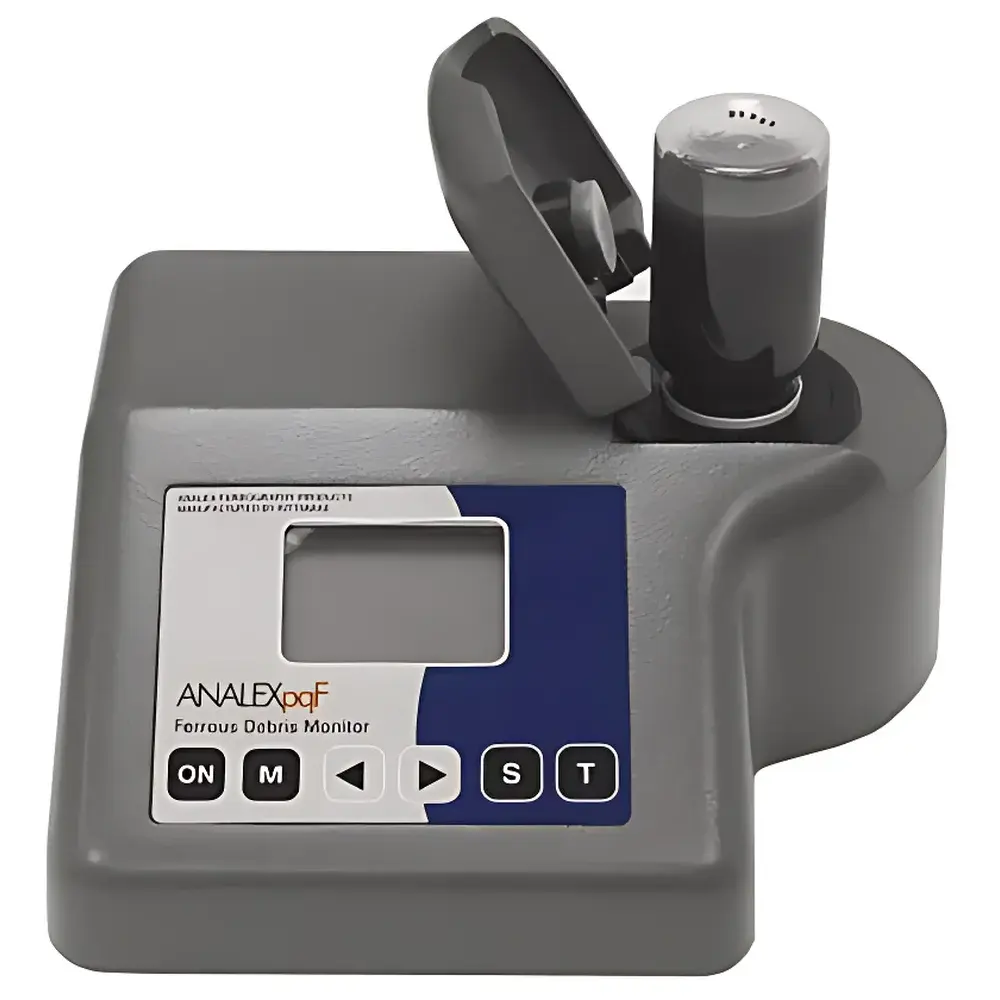
Kittiwake PQF Portable Ferrographic Index Analyzer
| Brand | Kittiwake |
|---|---|
| Origin | United Kingdom |
| Model | FG-K16000-KW |
| Measurement Range | 0–2000 PQ |
| Display Accuracy | ±5 PQ |
| Repeatability | ±15 PQ or ±3% of mean (whichever is greater) |
| Operating Temperature | 15–35 °C |
| Power Supply | 110–250 VAC, auto-switching 50/60 Hz |
| Warm-up Time | <5 min |
| Test Time per Sample | ≤15 s |
| Sample Vessel | Standard 100 mL bottle or 2 mL vial |
| Weight | 1.4 kg |
| Safety Rating | 2.5 A, 250 VAC, HRC A/S T ceramic fuse |
| Lid Detection | Optical reflection sensor |
| Sample Detection | Optical reflection sensor |
Overview
The Kittiwake PQF Portable Ferrographic Index Analyzer is a field-deployable magnetic susceptibility instrument engineered for rapid, quantitative assessment of ferromagnetic wear debris concentration in lubricating oils and hydraulic fluids. Unlike elemental spectroscopic techniques (e.g., ICP-OES or RDE), which detect dissolved or sub-micron metallic species, the PQF operates on the principle of magnetic permeability perturbation: when a fluid sample containing ferrous (Fe, Ni, Co) particles is exposed to a controlled alternating magnetic field, the aggregate magnetic moment induced by particle volume, shape, and crystalline alignment alters the field’s impedance. This change is transduced into a dimensionless Ferrographic Index (PQ), linearly correlated with both total ferromagnetic mass loading and the presence of coarse particles (>5–10 µm)—a critical size range often undetected by conventional spectrometry due to sedimentation losses, incomplete digestion, or optical scattering limitations. Designed for condition monitoring programs aligned with ISO 4406, ASTM D7690, and SAE ARP5585, the PQF delivers actionable data within seconds—enabling real-time triage of oil samples prior to lab-based ferrography or spectroscopy.
Key Features
- True portable architecture: Compact 1.4 kg footprint with integrated carry case, optimized for on-site use in engine rooms, wind turbine nacelles, or remote compressor stations.
- Zero-sample-prep operation: Direct measurement from standard 100 mL bottles or 2 mL vials; no filtration, acid digestion, or electrode rotation required.
- Automated calibration and diagnostics: Self-checking magnetic sensor array with built-in reference compensation; automatic zero-point verification at power-on and user-initiated recalibration.
- Digital data integrity: Onboard non-volatile memory stores ≥1,000 test records with timestamp, sample ID, operator code, and environmental metadata (ambient temperature).
- Robust industrial interface: Optical lid and vial detection prevents erroneous readings; ceramic HRC fuse and reinforced housing meet IP54-rated ingress protection for workshop environments.
- Stable thermal performance: Active thermal stabilization ensures <±0.5 °C internal drift across 15–35 °C ambient range, minimizing PQ index drift during extended field deployments.
Sample Compatibility & Compliance
The PQF is validated for mineral-, synthetic-, and bio-based lubricants (including diesel engine oils, turbine oils, gear oils, and compressor fluids) per ASTM D7690 Annex A1. It responds exclusively to ferromagnetic elements—primarily iron and nickel—with negligible sensitivity to non-ferrous metals (e.g., Al, Cu, Pb, Sn), making it ideal for detecting catastrophic wear events (e.g., gear tooth fracture, bearing cage disintegration) while avoiding interference from normal alloy dissolution. Its measurement domain bridges the gap between elemental spectroscopy (ppm-level dissolved metals) and analytical ferrography (microscopic particle morphology). The instrument complies with CE marking requirements (EMC Directive 2014/30/EU, Low Voltage Directive 2014/35/EU) and supports GLP/GMP-aligned workflows through audit-trail-capable data export (CSV via USB 2.0) and optional integration with LIMS platforms compliant with FDA 21 CFR Part 11.
Software & Data Management
Data acquisition and reporting are managed via the proprietary PQ Manager desktop application (Windows 10/11 compatible), supporting batch import, trend visualization (PQ vs. operating hours), alarm threshold configuration (user-definable PQ alert bands), and automated report generation per ISO 17359. All stored measurements include embedded checksums and tamper-evident timestamps. Exported datasets retain full traceability—including instrument serial number, firmware revision, calibration date, and operator credentials—ensuring compliance with ISO/IEC 17025 documentation requirements. No cloud connectivity or subscription services are required; all processing occurs locally to preserve data sovereignty.
Applications
- Early detection of abnormal ferrous wear in diesel and gas engines, where sudden PQ spikes (>200 PQ) indicate filter bypass, seal failure, or component fracture.
- Trend-based health assessment of gearbox and compressor lubricants, correlating PQ index growth rates with ISO wear particle counting (ISO 4406) and elemental spectroscopy (ASTM D5185).
- Verification of filter efficiency: A sustained rise in PQ without corresponding increase in elemental Fe suggests mechanical filter degradation rather than accelerated wear.
- Baseline establishment for new equipment commissioning and post-maintenance validation (e.g., verifying absence of machining debris after bearing replacement).
- Integration into predictive maintenance programs compliant with ISO 13374-1 (Condition Monitoring and Diagnostics of Machines) and ISO 17359 (Condition Monitoring Standards).
FAQ
Does the PQF measure non-ferrous metals such as aluminum or copper?
No. The PQF responds only to ferromagnetic materials—primarily iron, nickel, and cobalt. Non-ferrous wear debris requires complementary analysis via ICP-OES or RDE spectroscopy.
Can PQ values be directly converted to ppm iron concentration?
Not universally. While PQ correlates with total ferromagnetic mass, conversion to ppm requires matrix-specific calibration curves established using reference oils spiked with known ferrous particle concentrations and sizes.
What is the minimum detectable particle size?
The PQF is most sensitive to particles >5 µm. Sub-micron particles contribute minimally to the PQ signal due to their low magnetic moment per unit mass.
Is the PQF suitable for used oil analysis in aviation turbine engines?
Yes—provided the base oil chemistry falls within validated ranges (e.g., Mobil Jet Oil II, Shell Turbine Oil Aero). Validation per SAE AS6222 is recommended for safety-critical applications.
How frequently should calibration be performed?
Factory calibration is stable for 12 months under normal use. Field recalibration is advised after exposure to strong external magnetic fields, mechanical shock, or ambient temperature excursions beyond 15–35 °C.
Related Products