
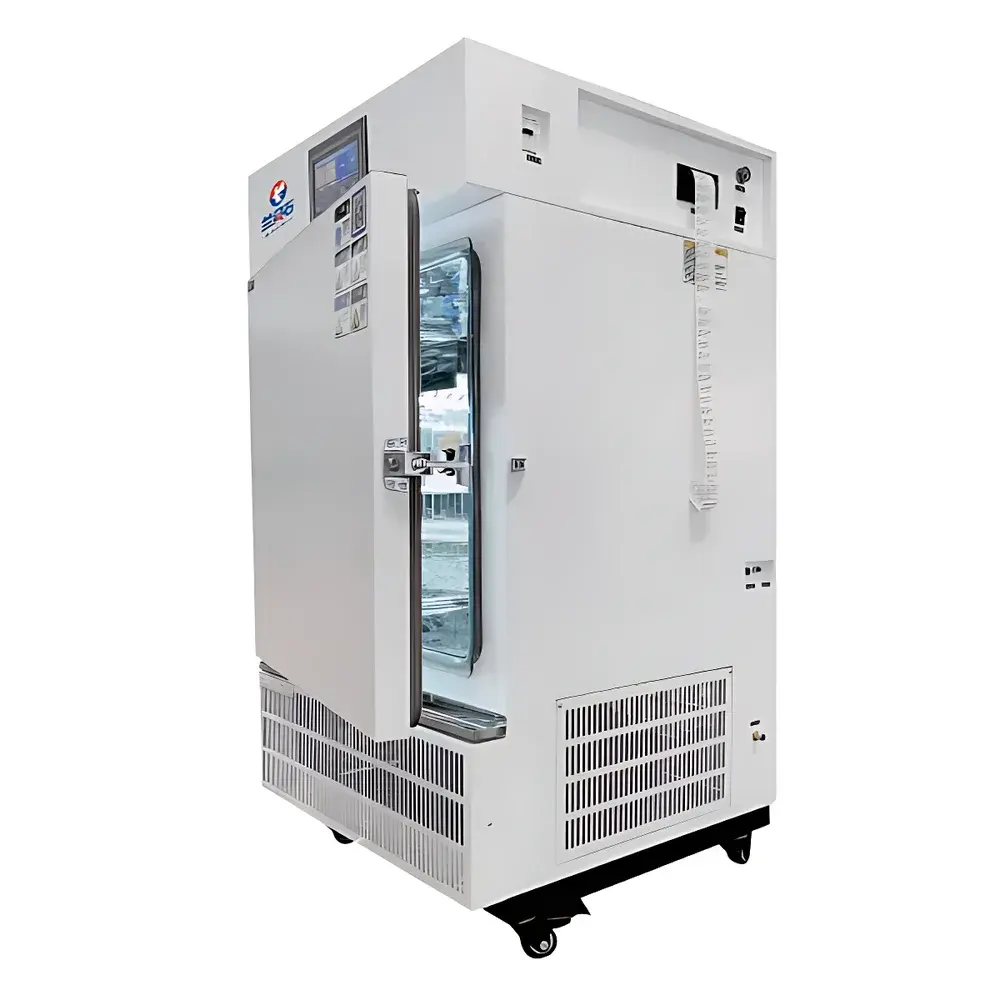
Labonce Labonce-250CGS-FC Drug Stability Testing Chamber with Visible Light & Near-Ultraviolet Illumination
| Brand | Labonce |
|---|---|
| Origin | Beijing, China |
| Manufacturer Type | Direct Manufacturer |
| Country of Origin | China |
| Model | Labonce-250CGS-FC |
| Quotation | Upon Request |
| Temperature Range | 15–65°C |
| Humidity Range | 20–95% RH |
| Chamber Volume | 250 L |
| Inner Dimensions (W×D×H) | 600×500×830 mm |
| Outer Dimensions (W×D×H) | 780×880×1650 mm |
| Power Consumption | 1.8 kW |
| Standard Shelves | 3 (7 total positions) |
| Temp. Uniformity (no light) | ≤2.0°C |
| Temp. Fluctuation | <±0.5°C |
| Temp. Deviation | <±1.0°C |
| RH Fluctuation | <±2% RH |
| RH Deviation | <±3% RH |
| Visible Light Range | 100–8000 lux |
| Cumulative Visible Light Dose | ≥1.2×10⁶ lux·hr |
| Near-UV Irradiance Range | 0.84–5 W/m² |
| Cumulative Near-UV Energy | ≥200 W·hr/m² |
| Ambient Operating Temperature | +5 to +35°C |
| Supply Voltage | AC 220 V ±10%, 50 Hz |
| Control System | 7-inch color programmable touchscreen with variable-frequency compressor output display |
| User Access | Three-tier permission levels with username/password authentication |
| Audit Trail | Timestamped operation and alarm logs, exportable via USB in write-protected format |
| Humidity Sensor | Imported capacitive type, high accuracy, low drift, maintenance-free |
| Safety Protections | Compressor overheat/overpressure, water shortage, dry-run prevention, independent overtemperature cutoff |
| Alarm Outputs | Local audible alarm + remote SMS alerts for temperature/humidity deviation and power failure |
| Dual-door Design | Tempered glass inner door + insulated solid outer door |
| Insulation | High-density polyurethane foam throughout cabinet walls and door |
| Interior Material | Mirror-finish AISI 304 stainless steel |
| Exterior Material | Powder-coated steel |
| Compliance References | ICH Q1A(R2), Q1B, Q5C |
Overview
The Labonce Labonce-250CGS-FC Drug Stability Testing Chamber is an ICH-compliant environmental simulation system engineered for long-term, high-reliability stability studies under regulated pharmaceutical development and quality control environments. It integrates precise temperature and humidity control with calibrated visible light (100–8000 lux) and near-ultraviolet irradiation (0.84–5 W/m²) to fulfill photostability testing requirements per ICH Q1B and Chinese Pharmacopoeia 2020 Edition Section 9101. The chamber employs a variable-frequency hermetic compressor—imported from leading European manufacturers—to ensure energy-efficient, low-vibration thermal regulation with >50% reduction in electricity and water consumption versus conventional fixed-speed systems. Its all-stainless-steel (AISI 304) interior eliminates leachable contaminants and supports routine cleaning validation, while the dual-door architecture—featuring a tempered glass inner door and insulated outer door—minimizes environmental disturbance during sample inspection without compromising chamber integrity.
Key Features
- Triple-layer security architecture: Role-based user authentication with three distinct permission tiers (Operator, Supervisor, Administrator), each enforcing granular access to parameter modification, data export, and system configuration.
- Audit-trail functionality compliant with FDA 21 CFR Part 11: All critical events—including setpoint changes, alarm triggers, door openings, and calibration actions—are timestamped, uniquely identified, and stored with immutable metadata. Logs are exportable via USB in tamper-evident, read-only formats (e.g., PDF/A or encrypted CSV).
- High-fidelity environmental control: Temperature uniformity ≤2.0°C (no illumination), fluctuation <±0.5°C, and deviation <±1.0°C; relative humidity fluctuation <±2% RH and deviation <±3% RH—validated per ISO 16770 and ASTM E2739 protocols.
- Photometric traceability: Integrated visible-light and near-UV sensors continuously monitor irradiance in real time. The system automatically adjusts lamp output to maintain target dose accumulation (≥1.2×10⁶ lux·hr for visible light; ≥200 W·hr/m² for near-UV), with dose metrics logged and printed alongside environmental data.
- Robust safety infrastructure: Independent overtemperature cutoff circuit, compressor thermal/pressure overload protection, water-level monitoring with auto-shutdown, and anti-dry-burn safeguards for humidification elements.
- Human-centric interface: 7-inch full-color resistive touchscreen controller provides intuitive navigation, real-time visualization of compressor frequency output, multi-segment programmable profiles, and graphical trend displays for temperature, humidity, and irradiance channels.
Sample Compatibility & Compliance
The Labonce-250CGS-FC accommodates standard pharmaceutical packaging configurations—including blister packs, HDPE bottles, amber vials, and aluminum foil pouches—within its 250 L working volume. Its mirror-finish 304 stainless-steel chamber minimizes particulate shedding and facilitates residue-free cleaning, satisfying GMP Annex 1 surface qualification criteria. The system is pre-configured to execute ICH-defined storage conditions: Long-term (25°C/60% RH), Accelerated (40°C/75% RH), Intermediate (30°C/65% RH), and Photostability (Option 1: UV + visible; Option 2: visible only). All hardware and firmware components meet electromagnetic compatibility (EMC) standards per IEC 61326-1 and electrical safety requirements per IEC 61010-1. Documentation packages include Factory Acceptance Test (FAT), Installation Qualification (IQ), Operational Qualification (OQ), and Performance Qualification (PQ) templates aligned with EU GMP Annex 15 and USP .
Software & Data Management
Data integrity is maintained through dual-channel recording: real-time electronic storage (internal flash memory, ≥12 months’ capacity at 1-minute intervals) and optional thermal line-printer output (needle-type, non-removable ribbon). Export functions support both manual USB transfer and scheduled network-based uploads (via optional Ethernet module) to centralized LIMS or ELN platforms. All exported files contain embedded digital signatures, device ID, operator ID, and hash verification codes to satisfy ALCOA+ principles (Attributable, Legible, Contemporaneous, Original, Accurate, Complete, Consistent, Enduring, Available). Software firmware supports periodic self-diagnostic routines and automatic sensor drift compensation—calibration status indicators appear directly on the main screen.
Applications
- ICH Q1A(R2)-mandated long-term and accelerated stability studies for APIs and finished dosage forms.
- Photostability assessment per ICH Q1B, including forced degradation under UV and visible spectra to identify light-sensitive degradation pathways.
- Accelerated aging for shelf-life prediction of biologics, lyophilized products, and moisture-sensitive formulations.
- Reference standard storage under controlled conditions per USP and Ph. Eur. 5.19.
- Environmental stress testing during formulation development and container-closure system evaluation.
- Regulatory submission support: Raw data packages generated by the system comply with eCTD Module 3 technical documentation requirements for stability protocols and reports.
FAQ
Does the Labonce-250CGS-FC support 21 CFR Part 11 compliance?
Yes—the system implements electronic signature workflows, audit trail logging with immutable timestamps, and role-based access controls required for Part 11 adherence. Full validation documentation and IQ/OQ/PQ protocols are provided.
Can the visible light and near-UV irradiance be independently controlled?
Yes—each light source operates on separate circuits with dedicated sensors and feedback loops. Users may activate either or both simultaneously and define unique intensity profiles per test phase.
What calibration certificates are included with shipment?
Each unit ships with NIST-traceable calibration certificates for temperature, humidity, visible light, and near-UV sensors, performed at three points across the operational range per ISO/IEC 17025-accredited procedures.
Is remote monitoring supported out of the box?
Standard configuration includes local alarm notification and SMS alerting. Optional Ethernet/Wi-Fi modules enable secure HTTPS-based remote viewing of real-time parameters and historical trends via browser or mobile app.
How is humidity maintained at low-temperature setpoints (e.g., 15°C)?
The chamber utilizes a dual-mode humidification system: ultrasonic misting for rapid RH ramp-up and steam injection for stable low-temperature maintenance, both regulated by the imported capacitive RH sensor with automatic dew-point compensation.





