
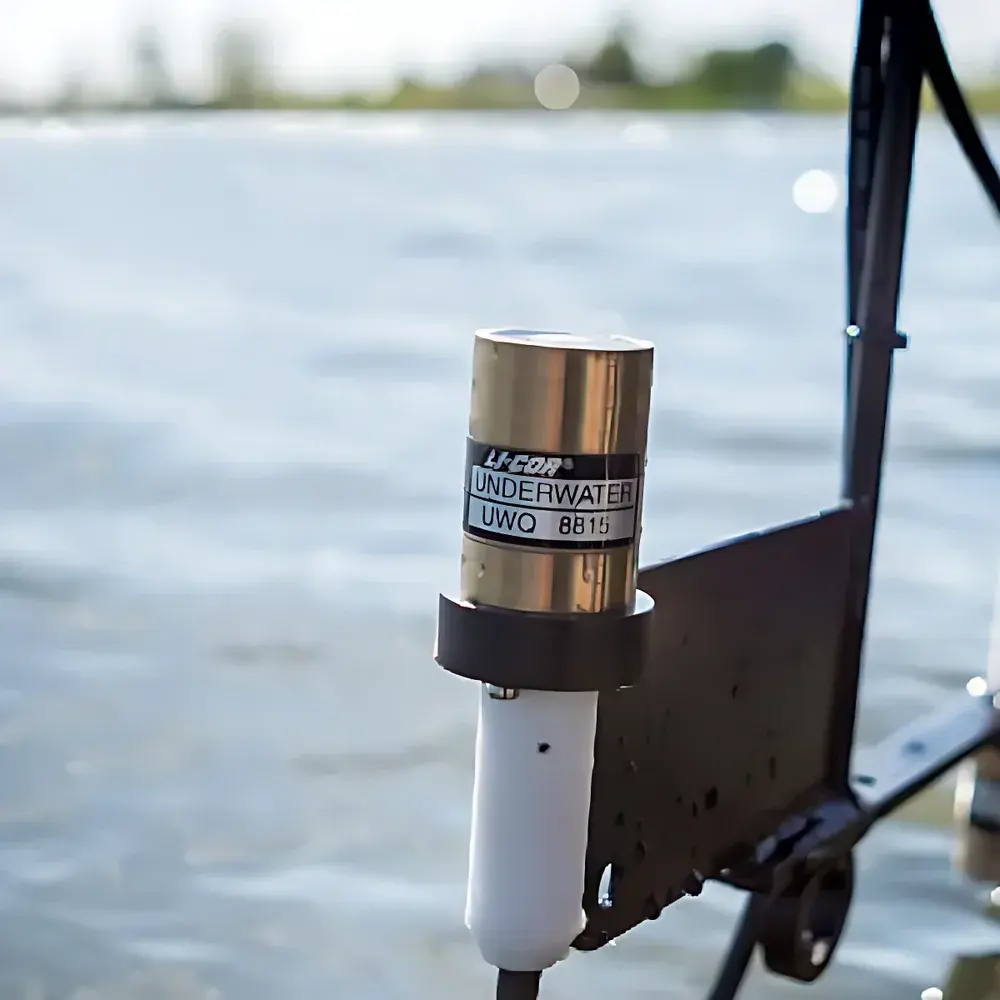
LI-COR LI-192 Underwater Quantum Sensor (Point-Source PAR Sensor)
| Brand | LI-COR |
|---|---|
| Origin | USA |
| Model | LI-192 |
| Measurement Range | 400–700 nm |
| Calibration Uncertainty | ±5% (in air) |
| Sensitivity | ~4 µA per 1000 µmol·s⁻¹·m⁻² (underwater) |
| Linearity Error | ≤1% up to 10,000 µmol·s⁻¹·m⁻² |
| Response Time | 10 µs |
| Temperature Dependence | ≤±0.15%/°C |
| Cosine Correction | Optimized for both air and underwater use |
| Azimuthal Error | <±1% at 45° elevation over full 360° |
| Operating Temperature | −40 to +65 °C |
| Pressure Rating | 5500 kPa (equivalent to 560 m depth) |
| Detector | Blue-enhanced, high-stability silicon photovoltaic cell |
| Housing | Corrosion-resistant metal, submersible in freshwater and seawater |
| Dimensions | 3.18 cm Ø × 4.62 cm H |
| Weight | 227 g |
| Cable Options | LI-COR 2222UWB underwater cable (3, 10, 30, 50, or 100 m) |
Overview
The LI-COR LI-192 Underwater Quantum Sensor is a precision-calibrated, submersible instrument engineered to quantify photosynthetically active radiation (PAR) in aquatic environments. It measures the total photon flux density—expressed as photosynthetic photon flux density (PPFD) in µmol·s⁻¹·m⁻²—integrated over a 2π steradian (hemispherical) field of view. Based on the fundamental principle of quantum detection, the sensor employs a blue-enhanced silicon photovoltaic detector paired with a rigorously characterized glass optical filter that delivers uniform spectral responsivity across the 400–700 nm waveband—the biologically relevant range for photosynthesis in phytoplankton, macroalgae, and submerged vascular plants. Critically, the filter exhibits sharp cut-off beyond 700 nm, minimizing infrared (IR) contamination—a key requirement in underwater optics where IR-to-visible radiance ratios are significantly elevated due to water’s differential absorption characteristics. The LI-192 is validated for operation both above water (with strict moisture avoidance) and fully submerged to depths of 560 meters, maintaining metrological integrity under hydrostatic pressure up to 5500 kPa (800 psi).
Key Features
- Optimized cosine response for accurate angular integration in both air and water—validated to <±1% azimuthal error at 45° elevation across full 360° rotation
- Hermetically sealed, corrosion-resistant metallic housing rated for long-term deployment in saline and freshwater systems without performance degradation
- Ultrafast 10 µs electrical response time, enabling capture of transient light events including sunflecks, wave focusing, and rapid vertical mixing signatures
- Thermal stability of ≤±0.15%/°C ensures minimal drift across diel and seasonal temperature gradients typical of limnological and oceanographic profiling
- Factory absolute calibration traceable to NIST-standard irradiance sources, with uncertainty of ±5% in air and validated underwater performance protocols
- Interchangeable cable system using LI-COR’s 2222UWB low-noise, high-flexibility underwater cable—available in lengths from 3 to 100 meters for mooring, ROV, or CTD-integrated deployments
Sample Compatibility & Compliance
The LI-192 is compatible with a broad spectrum of aquatic matrices—including oligotrophic open-ocean waters, turbid estuarine plumes, eutrophic lakes, coral reef crevices, and ice-covered polar systems—without requiring recalibration or optical correction. Its pressure-rated construction meets ISO 9001-certified manufacturing standards and conforms to IEC 60529 IP68 ingress protection requirements for continuous submersion. When deployed with the optional 2009S dual-mounting frame, the sensor supports simultaneous upward- and downward-facing PPFD measurements—enabling direct calculation of scalar irradiance, extinction coefficients (Kd), and quantum yield profiles. For regulated environmental monitoring programs, data acquisition using LI-COR’s LI-1500 datalogger or LI-250A meter supports audit-ready timestamping and metadata logging aligned with GLP-compliant workflows.
Software & Data Management
Raw analog output (0–2.5 V or 4–20 mA) from the LI-192 interfaces seamlessly with third-party data loggers (e.g., Campbell Scientific CR series, Onset HOBO, Sea-Bird Electronics SBE37) and LI-COR’s native platforms. The LI-1500 Datalogger provides real-time visualization, automatic unit conversion (to µmol·s⁻¹·m⁻²), and built-in temperature compensation algorithms. All acquired datasets support export in CSV, Excel, and NetCDF formats—facilitating integration into ecological modeling frameworks such as PROOF, AQUATOX, or FVCOM. Firmware updates and calibration history management comply with FDA 21 CFR Part 11 requirements when used in GLP/GMP-aligned aquatic toxicology or aquaculture research settings.
Applications
- Oceanographic and limnological profiling of vertical PAR attenuation to parameterize primary production models (e.g., Platt’s photosynthesis–irradiance curves)
- In situ validation of satellite-derived surface downwelling irradiance products (e.g., NASA OBPG MODIS-Aqua, ESA Sentinel-3 OLCI)
<liMonitoring light availability in aquaculture ponds, recirculating aquaculture systems (RAS), and coral nursery tanks
<liQuantifying light microenvironments within benthic boundary layers, seagrass meadows, and microbial mats
<liLong-term moored observatories measuring diel and seasonal PAR dynamics in coastal upwelling zones and hypoxic basins
<liCalibration reference for hyperspectral radiometers and active fluorescence systems (e.g., Fast Repetition Rate fluorometers)
FAQ
Can the LI-192 be used in both freshwater and seawater without recalibration?
Yes—the sensor’s corrosion-resistant housing and optically stable filter stack are qualified for indefinite deployment in either medium. No recalibration is required when transitioning between salinities.
Is the LI-192 suitable for use with autonomous underwater vehicles (AUVs) or remotely operated vehicles (ROVs)?
Yes—its compact form factor (3.18 cm diameter), low mass (227 g), and pressure rating to 560 m make it ideal for integration onto AUV/ROV sensor skids and towed bodies.
Does the LI-192 require external power?
No—it is a passive, self-generating quantum sensor; no excitation voltage or bias current is needed. Output is proportional to incident photon flux.
How is cosine error corrected for underwater deployment?
The optical diffuser and detector geometry are empirically optimized for Snell’s law refraction effects at the water–sensor interface, ensuring minimal deviation from ideal cosine-weighted response across immersion angles.
Can multiple LI-192 sensors be synchronized for spatial gradient studies?
Yes—when connected to a centralized datalogger with common timebase (e.g., GPS-synchronized LI-1500), temporal alignment accuracy is better than ±10 ms across channels.





