
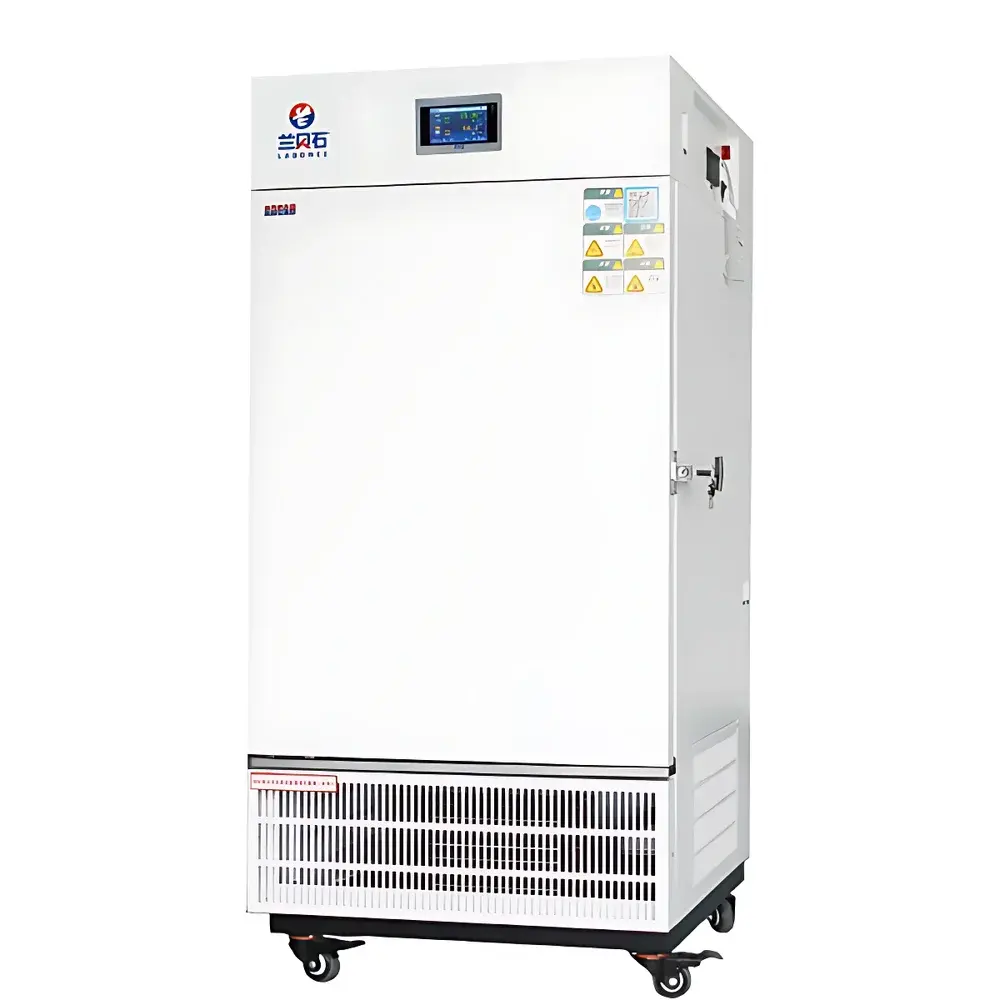
Labonce Labonce-250LGS Pharmaceutical Stability Testing Chamber (Packaging-Specific)
| Brand | Labonce |
|---|---|
| Origin | Beijing, China |
| Manufacturer Type | Direct Manufacturer |
| Model | Labonce-250LGS |
| Temperature Range | 15–65 °C |
| Humidity Range | 10–90 %RH |
| Chamber Volume | 250 L |
| Temperature Uniformity | ±0.5 °C (fluctuation), ±1.0 °C (deviation) |
| Humidity Uniformity | ±2.0 %RH (fluctuation), ±3.0 %RH (deviation) |
| Internal Dimensions (W×D×H) | 600×500×830 mm |
| External Dimensions (W×D×H) | 780×880×1650 mm |
| Power Consumption | 1.8 kW |
| Standard Shelves | 3 pcs |
| Compliance | ICH Q1–Q5, Chinese Pharmacopoeia 2020 Edition, GMP/GLP-ready |
| Data Integrity | Audit trail, 3-tier user permissions, USB data export, thermal printer |
| Safety Systems | Independent overtemperature protection, compressor overheat/overpressure cutoff, low-water and dry-run prevention, door-open alarm |
| Dual-door Design | Tempered glass inner door + insulated solid outer door |
| Insulation | High-density polyurethane foam (≥80 mm thickness) |
| Interior Material | Mirror-finish 304 stainless steel |
| Exterior Finish | Powder-coated steel |
| Environmental Operating Range | +5 to +35 °C ambient |
| Electrical Supply | 220 V, 50/60 Hz |
Overview
The Labonce Labonce-250LGS Pharmaceutical Stability Testing Chamber is an engineering-grade environmental simulation system purpose-built for packaging stability studies under ICH Q1, Q5, and the Chinese Pharmacopoeia 2020 Edition. It employs a dual-loop PID-controlled refrigeration-dehumidification architecture with independent temperature and humidity regulation—enabling precise, reproducible maintenance of demanding conditions such as 60 °C / 10 %RH and 25 °C / 20 %RH (ambient ≤25 °C). Unlike general-purpose climate chambers, the LGS series integrates pharmaceutical-specific design logic: ultra-low humidity capability down to 10 %RH is achieved via a dedicated desiccant-assisted cooling coil system, minimizing condensation risk during rapid RH ramping. The chamber’s thermal mass, high-density polyurethane insulation (≥80 mm), and dual-door configuration ensure <±0.3 °C internal temperature deviation during brief door openings—critical for maintaining integrity during routine sample inspection.
Key Features
- Pharmaceutical-grade control architecture compliant with FDA 21 CFR Part 11 requirements for electronic records and signatures, featuring full audit trail logging of all parameter changes, user logins, alarm events, and calibration actions.
- Three-tier role-based access control (Administrator, Supervisor, Operator) enforced at firmware level—preventing unauthorized modification of test protocols or system settings.
- Programmable color touchscreen controller with intuitive graphical interface; supports up to 100 multi-step programs with ramp/soak profiles, real-time trend display, and automatic recovery after power interruption.
- Dual-door structure: inner tempered glass door enables visual monitoring without compromising chamber environment; outer solid door provides enhanced thermal and moisture barrier plus light exclusion—essential for photostability-compliant storage.
- Robust mechanical design: evaporator and condenser coils constructed from corrosion-resistant copper-aluminum alloys; hermetically sealed imported compressor (Embraco or equivalent) rated for >30,000 hours MTBF.
- Comprehensive safety redundancy: independent mechanical overtemperature cutoff (separate from main controller), low-water detection in humidifier reservoir, anti-dry-burn heater protection, and real-time compressor discharge pressure monitoring.
Sample Compatibility & Compliance
The Labonce-250LGS accommodates primary and secondary pharmaceutical packaging configurations—including blister cards, HDPE/PP bottles, aluminum foil pouches, and laminated sachets—within its 250 L working volume. Its mirror-finish 304 stainless steel interior eliminates particulate shedding and facilitates cleaning validation per ISO 14644-1 Class 8 (ISO Class 5 at rest). All wetted components comply with USP for plastic materials. The chamber meets ICH Q1A(R2) long-term, intermediate, and accelerated testing condition specifications and satisfies Annex 15 (Qualification and Validation) prerequisites for Installation Qualification (IQ), Operational Qualification (OQ), and Performance Qualification (PQ) documentation support. Optional IQ/OQ/PQ protocol templates are available upon request.
Software & Data Management
Data integrity is maintained through synchronized local and removable media storage. All sensor readings (temperature, relative humidity, runtime, alarm status) are timestamped and logged internally with ≥12-month retention capacity. A built-in thermal line printer outputs hard-copy reports on demand, including current setpoints, deviations, and pass/fail status against ICH-defined acceptance criteria. Raw data export is supported via USB 2.0 interface in CSV format—compatible with LIMS integration and statistical process control (SPC) platforms such as Minitab or JMP. Audit trails are encrypted and tamper-evident; user-initiated deletions require dual authorization and generate immutable event records.
Applications
- ICH Q1A(R2) accelerated stability testing (40 °C / 75 %RH), long-term storage (25 °C / 60 %RH), and intermediate condition (30 °C / 65 %RH) assessment of drug product packaging systems.
- Evaluation of moisture barrier performance for cold-chain packaging under sub-20 %RH conditions (e.g., 25 °C / 10–20 %RH).
- Accelerated aging studies of polymer-based containers, closures, and desiccant-containing blister packs per USP and ASTM D4332.
- Support for regulatory submissions requiring documented environmental control history, including ANDA, NDA, and MA dossier preparation.
- Compatibility verification of labeling adhesives, ink stability, and printed carton integrity under cyclic humidity exposure.
FAQ
Does the Labonce-250LGS meet FDA 21 CFR Part 11 requirements for electronic records?
Yes—the system implements role-based authentication, electronic signatures, immutable audit trails, and data encryption aligned with Part 11 Subpart B controls.
Can the chamber maintain 10%RH at 60°C reliably?
Yes, provided ambient temperature remains ≤25°C; this is validated per ICH Q1B photostability annex methodology using calibrated chilled-mirror hygrometry.
Is the stainless steel interior electropolished or mechanically polished?
Interior surfaces are mechanically polished to Ra ≤0.8 µm finish, meeting USP surface roughness requirements for non-porous pharmaceutical contact materials.
What calibration standards are used for temperature and humidity sensors?
Factory calibration traces to NIST-certified reference instruments (Fluke 9142 for temperature, Rotronic HC2-S for RH); optional UKAS-accredited field calibration services available.
How is data backup handled during extended power outages?
Internal non-volatile memory retains all logs for ≥72 hours without power; UPS integration is recommended for mission-critical deployments.





