
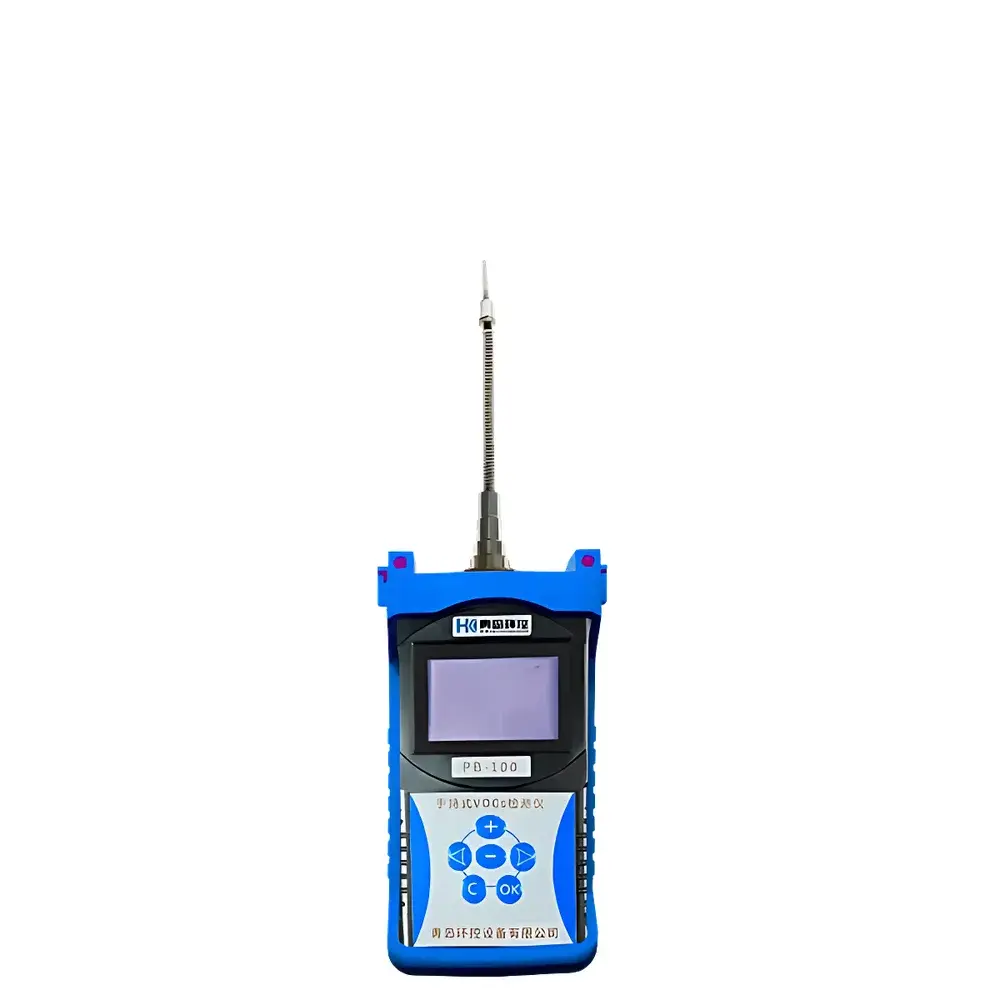
HUANKONG PB-100 Handheld VOC Gas Detector
| Brand | HUANKONG |
|---|---|
| Origin | Shandong, China |
| Manufacturer Type | Manufacturer |
| Product Origin | Domestic |
| Model | PB-100 |
| Detection Principle | Photoionization Detection (PID) |
| Instrument Type | Portable |
| Configuration | Multi-range Composite VOC Detector |
| Detection Range | Selectable (ppb to 10,000 ppm) |
| Resolution | 0.001 ppm / 0.01 ppm / 0.1 ppm / 1 ppm |
| Accuracy | ±3% F.S. or ±5% F.S. (depending on sensor configuration) |
| Response Time | < 5 s |
| Power Supply | Rechargeable high-energy lithium battery (24 h continuous operation) |
| Alarm | Configurable audible/visual high/low limit alarms |
| Data Output | Bluetooth-enabled optional thermal printing |
| Units | ppm, mg/m³, ppb (user-selectable) |
| Flow Control | Electronic mass flow meter with closed-loop regulation |
| Calibration Standards Compliance | JJF 1172–2007, HJ 1019–2019, GB 12358–2006, GB 20950–2007 |
Overview
The HUANKONG PB-100 Handheld VOC Gas Detector is a field-deployable, photoionization detection (PID)-based instrument engineered for rapid, on-site quantification of total volatile organic compounds (TVOC) in ambient air and industrial environments. Unlike flame ionization detector (FID)-based systems—often misstated in preliminary specifications—the PB-100 utilizes a 10.6 eV ultraviolet lamp to ionize a broad spectrum of VOCs, including aromatic hydrocarbons (e.g., benzene, toluene), aliphatic compounds (e.g., hexane, heptane), ketones (e.g., acetone), and chlorinated solvents (e.g., trichloroethylene). This principle enables real-time measurement without combustion or catalytic oxidation, preserving sample integrity and eliminating cross-sensitivity to methane or CO₂. Designed for regulatory field use, the PB-100 supports compliance-driven workflows in environmental site assessments, occupational exposure monitoring, leak detection and repair (LDAR) programs, and emergency response scenarios involving chemical release.
Key Features
- Multi-range PID sensor architecture with selectable full-scale ranges—from sub-ppb (1 ppb resolution) up to 10,000 ppm—enabling adaptability across low-level ambient monitoring and high-concentration industrial leak detection.
- Built-in correction factor library covering >100 individual VOC species (e.g., isopropanol, styrene, formaldehyde), allowing automatic concentration compensation based on compound-specific ionization efficiency relative to isobutylene calibration gas.
- Integrated electronic mass flow controller ensures stable sampling at 0.5–1.0 L/min, independent of variable suction pressure or pipeline vacuum conditions—critical for consistent readings during valve, flange, or tank seam inspections.
- Rechargeable high-energy lithium-ion battery provides ≥24 hours of continuous operation under typical field duty cycles (including alarm activation and data logging), certified to UN 38.3 transport safety standards.
- Dual-unit display and conversion (ppm, mg/m³, ppb) with real-time temperature/pressure compensation per ISO 8573-1:2010 Annex B methodology for volumetric-to-mass concentration equivalence.
- User-configurable TWA (Time-Weighted Average) and STEL (Short-Term Exposure Limit) calculation engine compliant with OSHA PEL and ACGIH TLV® frameworks; stores peak, average, and instantaneous values with timestamps.
- Optional Bluetooth 5.0 module supports wireless export of CSV-formatted datasets to iOS/Android tablets or Windows PCs, with configurable print templates via thermal printer integration.
Sample Compatibility & Compliance
The PB-100 is validated for direct sampling of undiluted ambient air, workplace breathing zone gas, and vapor-phase emissions from storage tanks, transfer lines, and process equipment. It meets functional requirements defined in Chinese national standards GB 12358–2006 (General Technical Requirements for Gas Detectors in Workplaces), GB 20950–2007 (Emission Limits for Atmospheric Pollutants from Oil Storage Tanks), and HJ 1019–2019 (Sampling Techniques for VOCs in Soil and Groundwater). Its calibration traceability aligns with JJF 1172–2007, which specifies performance verification protocols—including zero stability, linearity, repeatability (<2% RSD), and response time validation—using certified reference materials traceable to NIM (National Institute of Metrology, China). While not intrinsically safe per IEC 60079-0, it is rated IP54 for dust and splash resistance and operates within –10 °C to +50 °C ambient range.
Software & Data Management
Data acquisition and reporting are managed through embedded firmware supporting GLP-compliant audit trails: each measurement event logs operator ID (optional), GPS coordinates (via paired smartphone), timestamp (RTC with ±2 s/year drift), sensor serial number, calibration due date, and battery status. All stored records include metadata required for ISO/IEC 17025:2017 clause 7.7.1 (result reporting) and support retrospective review under FDA 21 CFR Part 11 when used in pharmaceutical facility LDAR programs. Exported datasets retain full traceability, with no proprietary binary encoding—CSV files open natively in Excel, LabChart, or LIMS platforms.
Applications
- Environmental site investigations: Screening for VOC plumes in soil gas and near-surface air per EPA Method TO-15 derivations.
- Occupational hygiene: Real-time personal exposure assessment against OSHA 29 CFR 1910.1200 and EU Directive 2004/37/EC (carcinogens/mutagens).
- Refinery and petrochemical LDAR: Quantitative leak screening per US EPA 40 CFR Part 60, Subpart VV and EU IED Annex I BREF documents.
- Indoor air quality (IAQ) audits: TVOC baseline mapping in offices, schools, and healthcare facilities per ISO 16000-29:2015.
- Hazardous materials response: First-responder triage of unknown vapor releases using onboard compound identification hints derived from ionization potential matching.
FAQ
What VOC compounds can the PB-100 detect?
The PB-100 detects any VOC with an ionization potential (IP) below 10.6 eV—including benzene (9.24 eV), toluene (8.82 eV), xylene (8.57 eV), acetone (9.70 eV), and methanol (10.84 eV is outside range; thus not detected). Compounds with IP > 10.6 eV (e.g., methane, ethane, formaldehyde) exhibit negligible response.
Is calibration required before each use?
Field zeroing is recommended before deployment; full span calibration with isobutylene (or compound-specific gas) is required per JJF 1172–2007 at intervals ≤30 days or after sensor exposure to >10× full-scale concentration.
Can the PB-100 be used in explosive atmospheres?
No. The PB-100 is not certified for Class I, Division 1 hazardous locations. Use only in non-classified areas or with supplemental ventilation control per NFPA 325 guidelines.
Does the device support multi-gas detection?
The PB-100 is a dedicated TVOC analyzer. For simultaneous CO, H₂S, or O₂ measurement, external electrochemical sensors must be integrated via third-party docking stations—not natively supported.
How is measurement uncertainty quantified?
Total expanded uncertainty (k=2) is ≤±5.2% F.S. at 23 °C and 50% RH, incorporating contributions from lamp intensity drift, humidity interference (±0.8% per 10% RH change), and analog-to-digital conversion noise—per GUM (JCGM 100:2018) methodology.







