
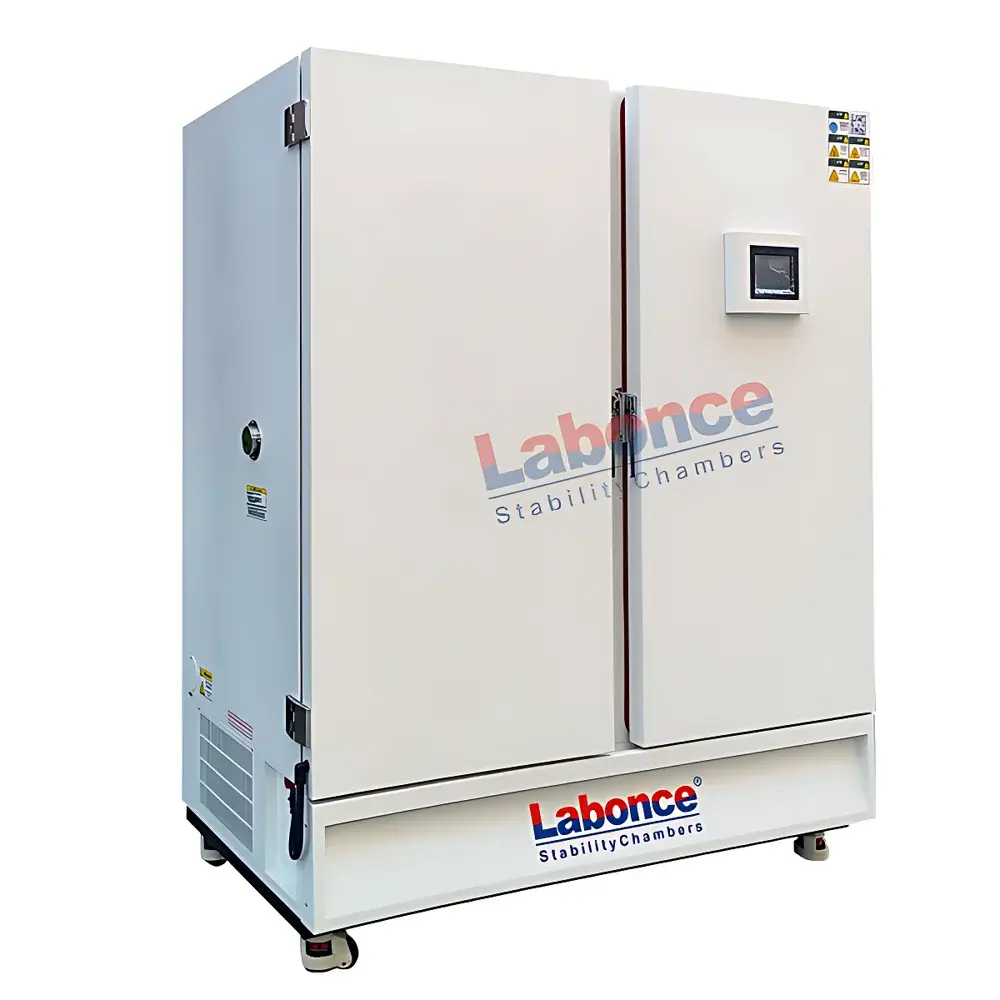
Labonce Labonce-720CT Drug Stability Testing Chamber
| Brand | Labonce |
|---|---|
| Model | Labonce-720CT |
| Application Category | Pharmaceutical Stability Testing Chamber |
| Temperature Range | 0–85 °C |
| Internal Volume | 720 L |
| Internal Dimensions (W×D×H) | 1200×490×1360 mm |
| External Dimensions (W×D×H) | 1390×900×1970 mm |
| Power Consumption | 2.5 kW |
| Temperature Uniformity | ≤2.0 °C |
| Temperature Fluctuation | <±0.5 °C |
| Temperature Deviation | <±1.0 °C |
| Construction | Exterior – Powder-coated steel |
| Cooling System | Imported variable-frequency compressor |
| Controller | Programmable color touchscreen with three-tier user permissions and audit trail capability |
| Data Storage | Onboard electronic logging with USB export |
| Safety | Independent over-temperature protection circuit |
| Compliance | Designed per GB/T 10586–2006 “Technical Specifications for Damp Heat Test Chambers” |
Overview
The Labonce Labonce-720CT Drug Stability Testing Chamber is an engineered environmental simulation system designed to meet the rigorous requirements of pharmaceutical stability testing under ICH Q1–Q5 guidelines. It operates on the principle of forced-air convection with precision-controlled thermal regulation, enabling reproducible exposure of drug substances and products to defined temperature conditions over extended durations. This chamber supports long-term, accelerated, and intermediate stability studies—including real-time storage simulations (e.g., 25 °C/60% RH), high-temperature stress testing (e.g., 40 °C, 50 °C, or 60 °C), and packaging material thermal endurance evaluation. Its 720 L internal volume accommodates multiple ICH-compliant stability cabinets per ICH Q5C recommendations, while its structural integrity and thermal performance ensure compliance with GLP and GMP-aligned validation protocols.
Key Features
- Forced-air circulation system with optimized duct geometry—ensures uniform temperature distribution (≤2.0 °C uniformity) across the entire working chamber, validated per ISO 16770 and ASTM E2296.
- Dual-door architecture: outer solid insulated door minimizes heat exchange and light ingress; inner tempered glass door enables non-intrusive visual monitoring without compromising thermal stability during observation intervals.
- Stainless steel interior chamber (AISI 304) with seamless welds and rounded corners—facilitates cleaning, prevents condensation pooling, and resists corrosion from repeated thermal cycling.
- Imported inverter-driven refrigeration unit—delivers stable cooling capacity across the full 0–85 °C range with >50% energy reduction versus fixed-speed compressors, verified under IEC 60068-3-5.
- Programmable touchscreen controller with configurable test profiles (up to 99 segments), real-time graphing, and embedded event logging—supports multi-step ramp-soak-hold sequences required for ICH Q1B photostability pre-screening and thermal aging protocols.
- Three-level access control (Operator / Supervisor / Administrator) with password-protected parameter modification and full audit trail—meets FDA 21 CFR Part 11 requirements for electronic records and signatures when configured with time-stamped, non-erasable logs.
Sample Compatibility & Compliance
The Labonce-720CT accommodates standard stability storage configurations including open trays, sealed aluminum foil-wrapped vials, blister-packed tablets, and primary/secondary packaging units. Its interior layout supports placement of calibrated reference sensors (e.g., NIST-traceable PT100 probes) at designated ICH-defined locations (geometric center, top/bottom corners) for qualification (IQ/OQ/PQ). The chamber conforms to GB/T 10586–2006 for damp heat test equipment performance criteria and aligns with ISO 16770:2021 for pharmaceutical stability chamber validation methodology. Optional humidity control modules (not included in CT series) can be integrated to support combined temperature/humidity testing per ICH Q1A(R2).
Software & Data Management
Onboard firmware provides continuous data acquisition at user-selectable intervals (1–60 min), storing temperature readings, alarm events, program status, and user actions in a tamper-resistant internal memory. All logs are exportable via USB interface in CSV format for external analysis in validated statistical software (e.g., JMP, Minitab). Audit trail entries include timestamp, operator ID, action type (e.g., setpoint change, door opening), and pre-/post-value states—fully compliant with ALCOA+ principles (Attributable, Legible, Contemporaneous, Original, Accurate, Complete, Consistent, Enduring, Available). Remote monitoring via optional Ethernet module supports integration into centralized laboratory information management systems (LIMS) with TLS 1.2 encrypted data transmission.
Applications
- ICH-compliant long-term stability studies (25 °C/60% RH, 30 °C/65% RH) and accelerated testing (40 °C/75% RH).
- Thermal degradation profiling of APIs and formulated products under controlled isothermal conditions.
- Primary packaging compatibility assessment—including blister foil delamination, cap seal integrity, and polymer dimensional stability at elevated temperatures.
- Material aging tests for excipients, polymers, and medical device components per ISO 10993-12 and ASTM F1980.
- Pre-validation chamber mapping and sensor calibration verification per USP and PDA Technical Report No. 68.
FAQ
Does the Labonce-720CT comply with FDA 21 CFR Part 11 for electronic records?
Yes—when operated with audit trail enabled and user permissions configured, it satisfies Part 11 requirements for secure electronic signatures, record retention, and system validation documentation.
Can this chamber be qualified per IQ/OQ/PQ protocols?
Yes—the design supports installation qualification (IQ), operational qualification (OQ), and performance qualification (PQ) using calibrated reference sensors and documented test scripts aligned with ISO 16770 and Annex 15 of the EU GMP Guide.
Is humidity control available for the CT series?
No—humidity control is not standard on the CT series. For combined temperature/humidity testing, consider the TT-series variants or add-on humidification modules subject to engineering review.
What is the maximum allowable load mass for thermal stability during continuous operation?
The chamber maintains specified uniformity and fluctuation limits with up to 40 kg of thermally inert mass (e.g., stainless steel blocks) placed uniformly across shelves—validated per ICH Q1A(R2) Annex 2 load testing guidance.
How frequently should the system undergo preventive maintenance?
Labonce recommends biannual inspection of refrigerant pressure, airflow calibration, door gasket integrity, and controller firmware updates—documented in accordance with ISO 9001:2015 clause 7.1.5.
Related Products






