
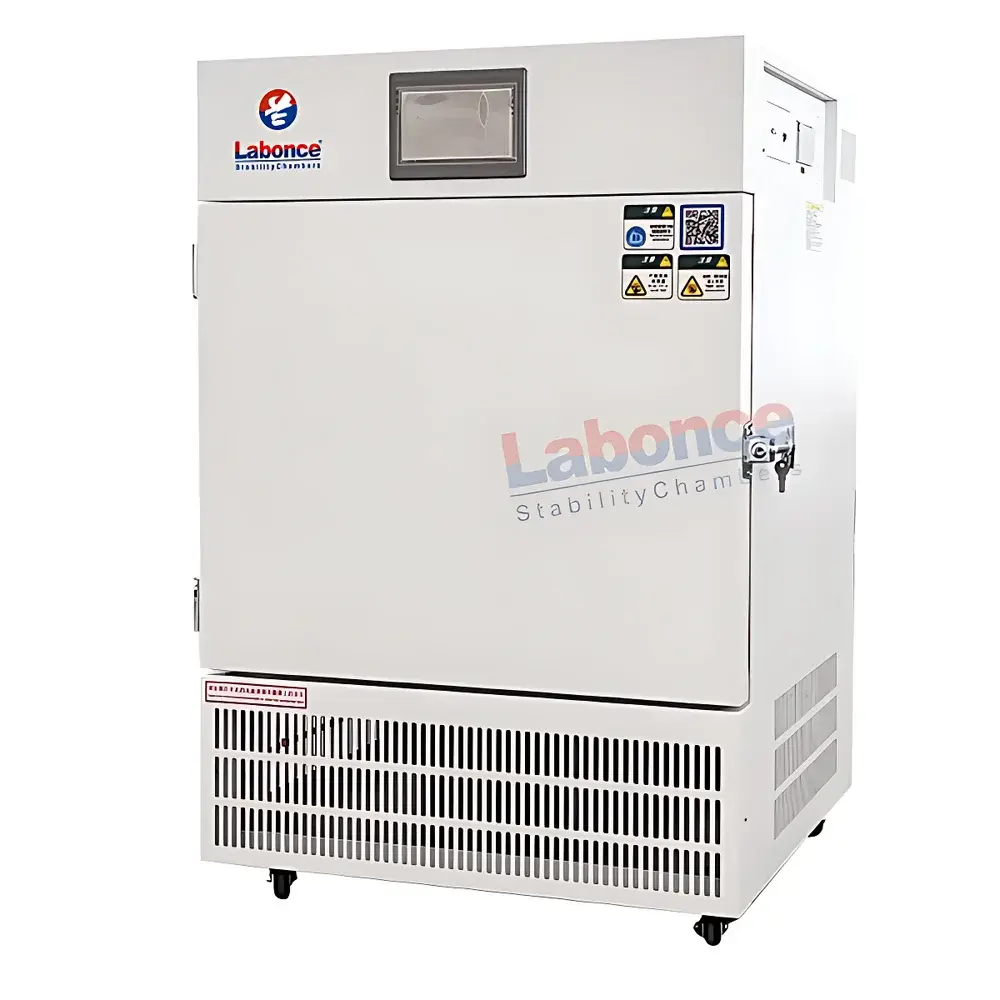
Labonce Labonce-150LTPS-1 Photostability Testing Chamber
| Brand | Labonce |
|---|---|
| Origin | Beijing, China |
| Manufacturer Type | Direct Manufacturer |
| Model | Labonce-150LTPS-1 |
| Temperature Range | 2–30 °C |
| Chamber Volume | 150 L |
| Internal Dimensions (W×D×H) | 650 × 490 × 500 mm |
| External Dimensions (W×D×H) | 830 × 790 × 1250 mm |
| Power Consumption | 1.5 kW |
| Visible Light Range | 100–6000 Lux (setpoint: 4500 ± 500 Lux) |
| Near-Ultraviolet Irradiance | 0.84–1 W/m² |
| Total Light Exposure Requirement | ≥1.2 × 10⁶ Lux·hr |
| Near-UV Energy Dose Requirement | ≥200 W·hr/m² |
| Illumination Uniformity | ±2.0 °C temperature deviation across same shelf |
| Temperature Stability During Illumination | ±1.0 °C |
| Ambient Operating Temperature | +5 to +35 °C |
| Power Supply | AC 220 V ±10%, 50 Hz |
| Compliance | ICH Q1B, Chinese Pharmacopoeia 2020 Edition |
Overview
The Labonce Labonce-150LTPS-1 Photostability Testing Chamber is a purpose-built environmental test system engineered for pharmaceutical photostability assessment in accordance with ICH Q1B and the Chinese Pharmacopoeia (2020 Edition). It delivers controlled, reproducible exposure to both visible light (D65-simulated daylight spectrum) and near-ultraviolet radiation (320–400 nm), enabling regulatory-compliant forced degradation studies of drug substances and products. Unlike general-purpose climate chambers, the LTPS series integrates metrologically traceable irradiance monitoring, independent spectral channel control, and thermally stable illumination conditions—ensuring that light-induced degradation pathways are isolated from confounding thermal effects. The chamber operates within a precise 2–30 °C temperature range, with illumination-active temperature stability maintained at ±1.0 °C and intra-shelf uniformity ≤±2.0 °C—critical for multi-sample comparative studies under GLP/GMP-aligned workflows.
Key Features
- Independent dual-channel illumination control: Separate programmable regulation of visible light (100–6000 Lux, setpoint 4500 ± 500 Lux) and near-UV irradiance (0.84–1 W/m²), each monitored in real time via calibrated sensors;
- Top-mounted lamp array with optimized optical geometry ensures ≥90% irradiance uniformity across the entire shelf surface (per ICH Q1B Annex 1 spatial homogeneity guidance);
- Triple-tier user access control (Operator / Supervisor / Administrator) with full audit trail per FDA 21 CFR Part 11 and EU Annex 11 requirements—including timestamped log entries for parameter changes, door openings, alarm events, and data exports;
- 7-inch full-color programmable touchscreen controller with intuitive graphical interface, supporting multi-step irradiation profiles, ramp/soak cycles, and simultaneous temperature–light scheduling;
- Robust thermal architecture: High-density polyurethane foam insulation (≥80 mm thickness), mirror-finish 304 stainless steel interior, and sealed external powder-coated steel housing ensure long-term humidity retention and contamination-free sample environment;
- High-efficiency refrigeration system featuring imported hermetic compressor, low-noise operation (<55 dB(A)), and redundant safety layers including independent overtemperature cut-off, high-pressure shutdown, and phase-failure protection;
- Dual-door design: Inner tempered glass door permits visual inspection without compromising internal climate; outer solid insulated door maintains thermal integrity and blocks ambient light intrusion;
- Integrated data management: Real-time printing via built-in dot-matrix printer + non-volatile internal storage (≥12 months of 1-min interval data) + USB export capability for raw CSV files compatible with LIMS and statistical analysis platforms.
Sample Compatibility & Compliance
The Labonce-150LTPS-1 accommodates standard pharmaceutical packaging formats—including blister cards, HDPE bottles, amber vials, and sachets—on its single illuminated shelf (650 × 490 × 500 mm internal volume). Its D65-spectrum visible lamps and narrowband UV-A emitters (320–400 nm) replicate the spectral distribution required by ICH Q1B Option 1 (end-point exposure) and Option 2 (incremental exposure). All irradiance values are validated using NIST-traceable photometric and radiometric calibration protocols. The system meets essential design criteria outlined in USP <1191>, ISO 10993-12, and ASTM G155 for xenon-arc accelerated weathering—adapted for pharmaceutical photodegradation kinetics. Full compliance documentation—including IQ/OQ templates, calibration certificates, and traceability matrices—is provided upon delivery.
Software & Data Management
The embedded controller firmware supports configurable data logging intervals (1 sec to 60 min), automatic alarm escalation (local buzzer + remote SMS notification on temperature deviation or power failure), and encrypted electronic records compliant with ALCOA+ principles (Attributable, Legible, Contemporaneous, Original, Accurate, Complete, Consistent, Enduring, Available). Audit trails are immutable and exportable in PDF or CSV format. Data exports include timestamps, setpoints, actual values (temperature, Lux, W/m²), alarm status flags, and user login IDs—enabling seamless integration into enterprise quality systems (e.g., TrackWise, MasterControl) and facilitating regulatory inspections under FDA, EMA, or NMPA frameworks.
Applications
- ICH Q1B photostability testing of new drug substances and products;
- Forced degradation studies to identify light-sensitive degradation products (e.g., oxidation, hydrolysis, dimerization);
- Comparative evaluation of primary packaging materials (e.g., amber glass vs. opaque polymer) under standardized irradiance;
- Stability protocol development for registration dossiers (CTD Module 3);
- Internal QC release testing for batch-to-batch consistency of light-sensitive APIs;
- Support for ANDA submissions requiring photostability justification per FDA Guidance for Industry (2022).
FAQ
Does the Labonce-150LTPS-1 comply with ICH Q1B Option 2 (incremental exposure)?
Yes—the system supports programmable stepwise irradiation profiles with independent control of visible and UV channels, enabling sequential exposure durations per ICH Q1B Annex 1 recommendations.
Is the irradiance sensor calibrated and traceable to national standards?
All photometric (Lux) and radiometric (W/m²) sensors are factory-calibrated against NIST-traceable references, with calibration certificates supplied and re-certification recommended annually.
Can the chamber operate continuously at 2 °C while maintaining illumination stability?
Yes—its high-efficiency refrigeration system and thermal mass design ensure sustained operation at minimum setpoint with illumination active, meeting the ±1.0 °C stability requirement specified in ICH Q1B.
What data security measures are implemented for audit trail integrity?
Audit logs are write-once, digitally signed, and stored in segregated memory partitions inaccessible to routine operator functions—fully satisfying FDA 21 CFR Part 11 §11.10(e) and EU GMP Annex 11 §4.4 requirements.
Is third-party validation support available?
Labonce provides IQ/OQ documentation packages and can coordinate on-site PQ execution with qualified vendors accredited to ISO/IEC 17025 for pharmaceutical environmental testing equipment qualification.





