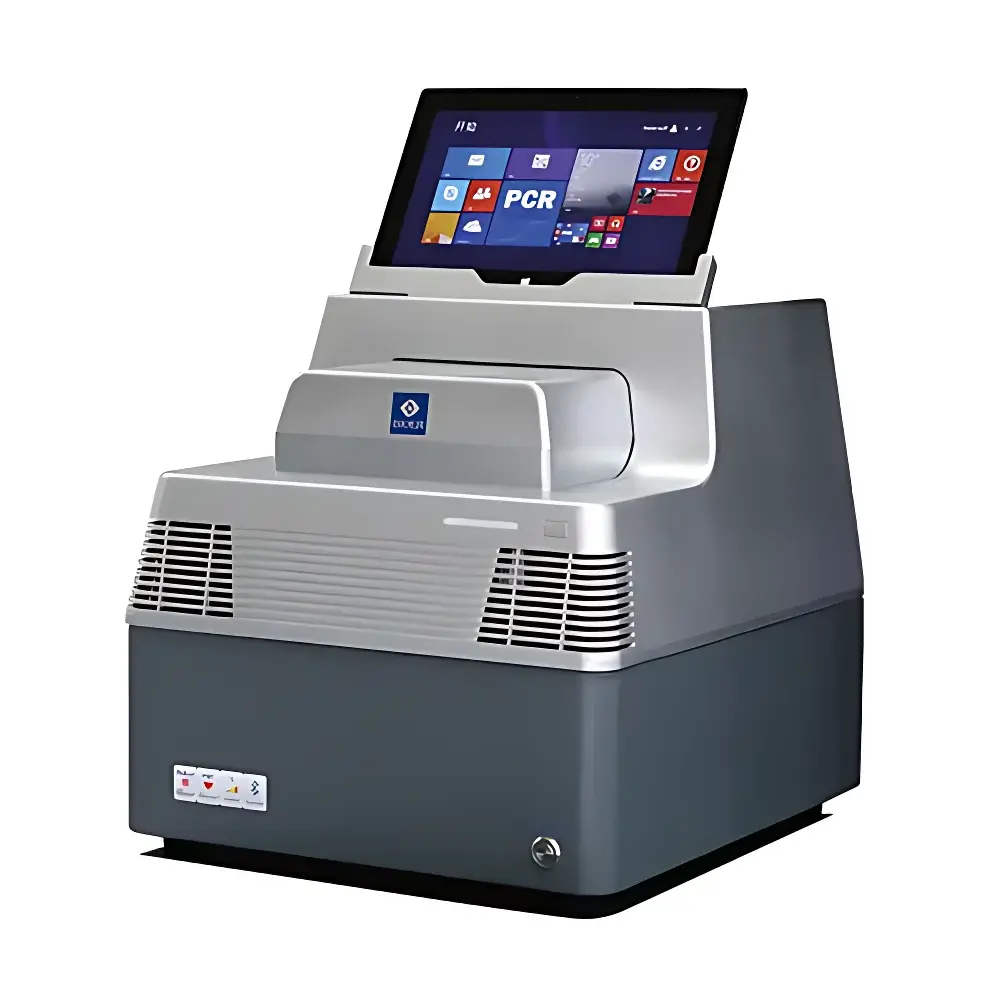
Bioer LineGene 9600 Plus Real-Time Fluorescence Quantitative PCR Detection System FQD-96A
| Brand | Bioer |
|---|---|
| Origin | Zhejiang, China |
| Model | FQD-96A |
| Sample Capacity | 96-well plate / 12×8 strip tubes / 96×0.2 mL single tubes (bottom-transparent) |
| Max Heating Rate | 5.0°C/s |
| Temperature Accuracy | ≤ ±0.1°C |
| Well-to-Well Temperature Uniformity | ≤ ±0.1°C |
| Fluorescence Channels | 6 (FAM/SYBR Green I |
| Dynamic Range | 1–10¹⁰ copies |
| Excitation Source | Long-life LED |
| Detection Mode | Bottom-scanning optical system |
| Thermal Block Control Modes | Block mode & Simulated Tube mode |
| Gradient Range | 1–36°C |
| Thermal Lid Temp Range | 30–110°C (auto-adjusting) |
| Power Input | 100–240 VAC, 50/60 Hz, 600 W |
| Dimensions | 410 × 386 × 352 mm |
| Certifications | CE, RoHS 2, MEC, MET, PICC Product Liability Insurance, China NMPA Registration No. 20153400273 |
Overview
The Bioer LineGene 9600 Plus Real-Time Fluorescence Quantitative PCR Detection System (Model FQD-96A) is an advanced, CE-certified thermal cycler engineered for high-precision nucleic acid quantification in research laboratories, clinical diagnostics, and quality control environments. It operates on the principle of real-time fluorescence detection during polymerase chain reaction amplification—capturing sequence-specific signals from intercalating dyes (e.g., SYBR Green I) or hydrolysis probes (e.g., FAM, VIC, ROX) as amplicons accumulate. The system integrates a proprietary Ferrotec Peltier thermoelectric module with patented heat-sink architecture and bottom-illumination optical design to ensure rapid thermal transitions, exceptional temperature homogeneity across all 96 wells, and minimal signal variability due to positional artifacts. Its modular thermal block supports standard 96-well plates, 12×8 strip tubes, and individual 0.2 mL bottom-transparent tubes—enabling flexible assay setup without compromising optical path integrity. The instrument complies with ISO 13485–aligned manufacturing practices and meets essential requirements of the EU In Vitro Diagnostic Medical Device Regulation (IVDR) Annex I, supporting GLP/GMP-aligned workflows through audit-trail-capable software logging.
Key Features
- Bottom-scanning optical detection architecture optimized for low-volume reactions (5–100 µL), minimizing well-edge refraction effects and enhancing signal reproducibility.
- Six independently calibrated fluorescence channels with spectral separation algorithms to eliminate cross-talk between FAM/SYBR Green I, HEX/VIC/JOE/Cy3/NED/TAMRA, Texas Red/ROX, Cy5, Cy5.5, and one reserved channel.
- Thermal performance: ≤ ±0.1°C temperature accuracy and ≤ ±0.1°C well-to-well uniformity across the full 4–105°C operating range, validated per ASTM E2216–17 protocols.
- Automated 3D thermal lid with pressure-sensing feedback—self-adjusts height and contact force for consistent sealing across variable tube geometries, eliminating manual lid calibration.
- Dual thermal control modes: “Block” mode for uniform heating/cooling; “Simulated Tube” mode dynamically adjusts ramp profiles based on programmed reaction volume—improving kinetic fidelity for low-volume assays.
- Integrated long-life LED excitation source (>50,000 hours MTBF), eliminating lamp replacement cycles and intensity drift over time.
- Touchscreen interface compatible with Windows-based tablets; fully localized English-language UI with intuitive navigation, drag-and-drop protocol building, and multi-user permission tiers.
Sample Compatibility & Compliance
The FQD-96A accommodates industry-standard consumables including ANSI/SLAS-compliant 96-well optical plates, skirted or semi-skirted, as well as 0.2 mL thin-wall tubes with optically clear bottoms—ensuring compatibility with major reagent vendors (e.g., Thermo Fisher, Qiagen, Takara). Its mechanical design includes finger-safe sample chamber ingress protection and automatic lid interlock to prevent accidental operation during loading. Regulatory compliance includes CE marking under Directive 2017/746 (IVDR), RoHS 2 (2011/65/EU), and conformity to EN 61010-1:2010 for laboratory equipment safety. The system’s NMPA registration (No. 20153400273) confirms its qualification for clinical molecular testing in China, and its data management architecture supports FDA 21 CFR Part 11–compliant electronic records when deployed with validated software configurations.
Software & Data Management
Bioer’s LineGene Analysis Software (v5.x) provides comprehensive analysis modules aligned with MIQE guidelines—including absolute quantification (with standard curve fitting), relative quantification (ΔΔCt), SNP genotyping, high-resolution melt (HRM) profiling, allelic discrimination, and isothermal amplification monitoring. All analyses generate export-ready reports in PDF, CSV, or Excel formats—with customizable templates for lab-specific SOPs. The software maintains full audit trails: every user action (protocol edit, run start/stop, parameter change) is timestamped and attributed, satisfying GLP audit requirements. Data backup supports encrypted USB storage, network drive mapping, and optional cloud sync via secure TLS 1.2–enabled endpoints. Raw fluorescence curves, melting derivative plots, and Ct value tables are stored in vendor-neutral .lgs binary format with embedded metadata (instrument ID, operator, date/time, thermal profile).
Applications
- Quantitative viral load monitoring (e.g., SARS-CoV-2, HIV, HBV, HCV) using probe-based assays.
- Gene expression profiling in translational research, including miRNA and lncRNA detection.
- SNP identification and pharmacogenomic screening in clinical pharmacology labs.
- Food authenticity testing and GMO detection per ISO 21571 and EN ISO 21569 standards.
- Environmental pathogen surveillance (e.g., Legionella, Cryptosporidium) in water safety programs.
- Quality control of biologics and cell therapies via residual host-cell DNA quantification (ICH Q5A).
FAQ
Does the LineGene 9600 Plus support gradient PCR optimization?
Yes—it offers programmable thermal gradients from 1°C to 36°C across the block, enabling simultaneous evaluation of annealing temperature windows in a single run.
Is the software compatible with LIMS integration?
The system exports structured data via CSV and XML APIs; custom middleware integration is supported under Bioer’s Developer License Agreement.
What maintenance is required for the optical detection system?
No routine optical alignment or lamp replacement is needed—the solid-state LED source and fixed-fiber optic path ensure zero-drift performance over 5+ years of continuous use.
Can the instrument perform HRM analysis with sufficient resolution?
Yes—its high-sampling-rate thermal ramping (0.01°C increments) and noise-suppressed CCD detection enable discrimination of single-base variants with ΔTm ≥ 0.2°C.
Is remote monitoring available?
Real-time run status and alert notifications (via email/SMS) are supported through optional Bioer Cloud Connect subscription service, compliant with GDPR and HIPAA data-handling frameworks.