
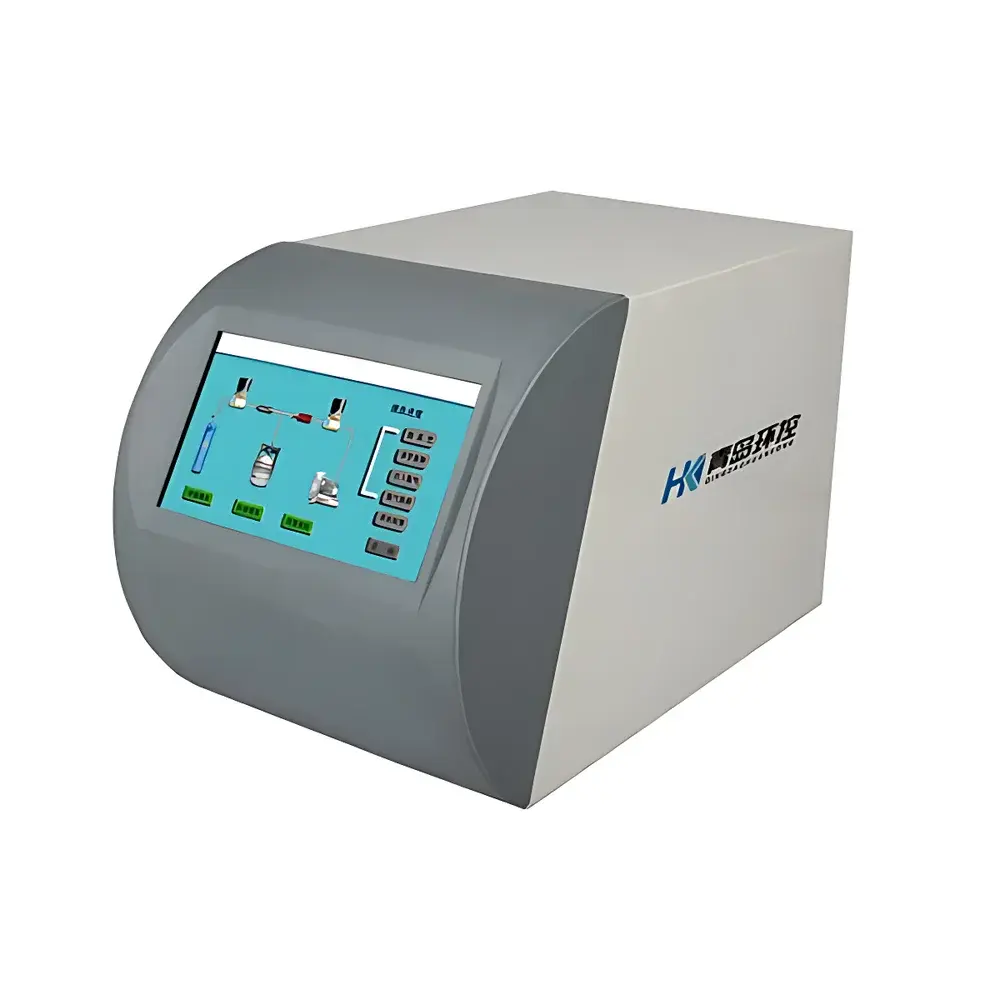
HUANKONG GHD-1200C Automated SUMMA Canister Cleaning System
| Brand | HUANKONG |
|---|---|
| Origin | Shandong, China |
| Manufacturer Type | Direct Manufacturer |
| Country of Origin | China |
| Model | GHD-1200C |
| Vacuum Pressure | <150 mtorr (standard), optional <50 mtorr |
| Cleaning Capacity | 2, 6, or 12 canisters per cycle |
| Temperature Range per Gas Path | 10–150 °C (above chamber ambient) |
| Gas Path Configuration | 4 independently controlled heating zones |
| Interface | 1/4" NPT female thread |
| Surface Treatment | Fully or partially silanized gas pathways |
| Vacuum Pump | Imported high-vacuum diaphragm pump |
| Compliance | HJ 759–2015 |
| Optional | Integrated temperature-controlled oven with PID regulation |
| Data Logging | Cycle timestamp, temperature setpoints, vacuum decay, purge count, and pressure hold duration |
Overview
The HUANKONG GHD-1200C Automated SUMMA Canister Cleaning System is an engineered solution for the rigorous decontamination of electropolished stainless-steel SUMMA canisters used in ambient air and emission source sampling for volatile organic compound (VOC) analysis. Designed to meet the procedural integrity requirements of regulatory trace-gas monitoring, the system executes a programmable sequence of vacuum evacuation, heated inert gas purging (typically ultra-high-purity nitrogen or helium), and thermal desorption—ensuring removal of residual analytes, moisture, and adsorbed contaminants without compromising canister passivation. Its operation is grounded in principles of dynamic vacuum cleaning and thermal conditioning, where precise control over pressure decay kinetics, purge gas residence time, and surface temperature profiles directly govern cleaning efficacy and reproducibility across multi-canister batches.
Key Features
- Modular batch configuration supporting 2, 6, or 12 SUMMA canisters per cleaning cycle—optimized for laboratory throughput without cross-contamination risk.
- Four independent gas-path heating zones, each adjustable from 10 °C above ambient to 150 °C, enabling differential thermal conditioning of inlet lines, manifold sections, and canister necks.
- Dual-vacuum performance tier: standard operation achieves <150 mtorr base pressure; optional high-vacuum upgrade delivers <50 mtorr for ultra-trace applications requiring sub-ppt background suppression.
- Full NPT 1/4″ female thread interface ensures mechanical and sealing compatibility with all commercially available SUMMA canisters (e.g., Entech, Markes, Thermo Fisher).
- Programmable cleaning parameters—including vacuum hold duration, pressure ramp rate, number of purge cycles, gas flow rate (mass-flow controlled), and temperature ramp/soak profiles—stored with timestamped audit trails.
- Critical gas-wetted surfaces undergo either full or selective silanization (dimethyldichlorosilane or similar), minimizing active sites for VOC adsorption and enhancing recovery consistency for polar compounds (e.g., aldehydes, ketones, organic acids).
- Integrated imported diaphragm vacuum pump with oil-free operation, low vibration, and CE-compliant electromagnetic compatibility—designed for continuous duty in ISO 17025-accredited laboratories.
Sample Compatibility & Compliance
The GHD-1200C is validated for use with standard 6-L and 3.2-L SUMMA canisters conforming to EPA Method TO-14A/TO-15 specifications. Its cleaning protocol satisfies the mandatory preconditioning requirements defined in Chinese Environmental Protection Standard HJ 759–2015 (“Determination of Volatile Organic Compounds in Ambient Air—SUMMA Canister Sampling/Gas Chromatography-Mass Spectrometry Method”), including minimum vacuum hold time (>8 hours), maximum residual blank concentration thresholds (<0.5 ppbv for target C2–C12 hydrocarbons), and documented thermal stability verification. The system supports GLP-compliant workflow integration through electronic record retention and user-access-level permissions, aligning with data integrity expectations under FDA 21 CFR Part 11 when paired with compliant LIMS or ELN platforms.
Software & Data Management
The embedded controller provides a touchscreen HMI with intuitive navigation, real-time pressure/temperature graphing, and automatic generation of .csv log files containing cycle ID, operator ID, start/end timestamps, vacuum decay curves, temperature profiles per zone, and final hold-pressure validation. All logs are stored internally (SD card) and exportable via USB. Optional Ethernet or RS-485 interfaces enable remote monitoring and centralized fleet management in multi-instrument labs. Audit trail functionality records parameter changes, user logins, and alarm events—supporting internal QA reviews and external accreditation audits (CNAS, ILAC).
Applications
- Pre-analysis preparation of SUMMA canisters in ambient air monitoring networks (e.g., national air quality stations, urban super-site campaigns).
- Reconditioning of canisters following field deployment in industrial fence-line monitoring or landfill gas studies.
- Blank verification and method detection limit (MDL) studies per EPA guidance.
- Support for multi-laboratory intercomparison exercises requiring identical canister conditioning protocols.
- Integration into automated VOC analysis workflows where canister cleaning must precede thermal desorption–GC/MS analysis without manual intervention.
FAQ
Does the GHD-1200C support automated validation of cleaning effectiveness?
Yes—users may initiate a “blank run” mode that performs a full cleaning cycle followed by immediate evacuation and sealing; the sealed canister can then be analyzed on a GC/MS system to quantify residual VOCs against HJ 759–2015 acceptance criteria.
Can the system accommodate non-standard canister sizes or custom fittings?
While optimized for standard SUMMA geometries, custom adapter plates and sealing manifolds are available upon request for 1-L or specialty canisters, subject to engineering review and leak-testing validation.
Is silanization performed in-house or required as a user-maintained step?
The factory-default configuration includes fully silanized gas pathways; partial silanization (e.g., only canister ports) is offered as a cost-optimized option. Re-silanization kits and procedures are supplied for scheduled maintenance every 500 cycles or annually.
What vacuum measurement standard does the integrated gauge reference?
The capacitance manometer is NIST-traceable and calibrated to ISO 20487:2019 (vacuum metrology), reporting absolute pressure in mtorr with ±1% full-scale accuracy from 10⁻³ to 10³ mtorr.
How is system performance verified during routine operation?
Built-in self-diagnostics monitor pump current draw, temperature sensor continuity, vacuum leak rate (<0.5 mtorr/min at 10 mtorr), and heater resistance drift—triggering maintenance alerts prior to out-of-spec operation.



