
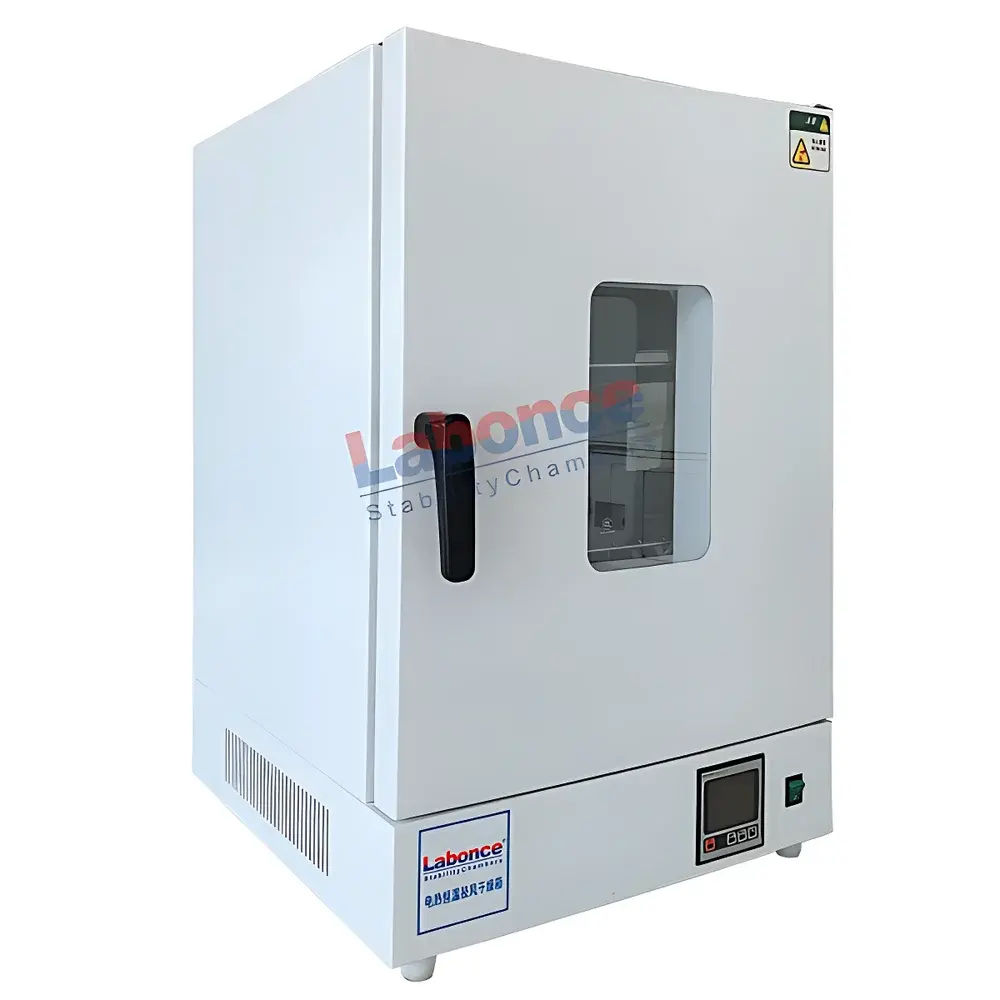
Labonce Labonce-70JM Precision Forced-Air Drying Oven (200 °C)
| Brand | Labonce |
|---|---|
| Model | Labonce-70JM |
| Temperature Range | RT+20 °C to 200 °C |
| Chamber Volume | 70 L |
| Internal Dimensions (W×D×H) | 400×400×450 mm |
| External Dimensions (W×D×H) | 540×530×800 mm |
| Power Rating | 1.0 kW |
| Standard Shelving | 2 adjustable stainless steel shelves (7 total positions) |
| Temperature Uniformity | ±3.0 °C at ≤200 °C |
| Temperature Fluctuation | ±1.0 °C |
| Supply Voltage | AC 220 V ±10%, 50 Hz |
| Construction | Exterior – powder-coated steel |
| Control System | Digital PID temperature controller with LED display |
| Safety | Independent over-temperature cut-off protection |
Overview
The Labonce Labonce-70JM Precision Forced-Air Drying Oven is an engineered solution for controlled thermal processing in research laboratories, quality control environments, and industrial R&D settings. Designed around forced-convection heat transfer principles, the oven utilizes a balanced axial fan-driven air circulation system to maintain consistent thermal distribution across its 70-liter working chamber. Unlike natural convection ovens, this model ensures rapid equilibration and high spatial temperature uniformity—critical for applications requiring reproducible drying, curing, aging, or moisture removal under defined thermal conditions. Its operational range spans from ambient +20 °C up to 200 °C, making it suitable for standard stability testing, pre-conditioning of polymeric substrates, residual solvent evaporation, and ASTM D2240-compliant elastomer conditioning. The unit complies with general laboratory safety architecture standards for Class II electrical equipment (IEC 61010-1) and supports GLP-aligned workflows through traceable setpoint logging and independent thermal safeguarding.
Key Features
- Optimized airflow path design with rear-mounted centrifugal blower and perforated top baffle—ensures <±3.0 °C temperature uniformity across the full chamber volume at 200 °C
- Robust dual-layer construction: exterior cold-rolled steel with epoxy-polyester powder coating; interior 1.2 mm thick 304 stainless steel chamber resistant to oxidation and chemical exposure
- Digital PID temperature controller with real-time LED display, intuitive push-button interface, and manual calibration offset capability
- Dual-stage thermal protection: primary control loop + independent mechanical over-temperature limiter (adjustable up to 220 °C), certified to UL/EN 60335-1 requirements
- Two standard 304 stainless steel wire shelves (load capacity: 15 kg per shelf), height-adjustable via notched side rails (seven positions)
- Energy-efficient 1.0 kW heating system with low thermal inertia ceramic-sheathed tubular elements and optimized insulation (80 mm mineral wool)
Sample Compatibility & Compliance
The Labonce-70JM accommodates a broad spectrum of sample formats—including Petri dishes, weighing boats, crucibles, glassware, PCB assemblies, and polymer film reels—without compromising thermal integrity. Its stainless steel chamber resists corrosion from mild organic solvents, aqueous salt solutions, and low-concentration acids commonly encountered during sample preparation. The oven meets baseline electrical safety requirements per IEC 61010-1 Ed.3 and is CE-marked for use within the European Economic Area. While not intrinsically rated for hazardous locations, it may be deployed in non-classified lab zones per NFPA 45 guidelines. For regulated environments (e.g., ISO/IEC 17025-accredited labs), the unit supports documented IQ/OQ protocols when paired with external calibrated thermocouple mapping (per ASTM E2251 or ISO 14644-3 Annex B). It does not include 21 CFR Part 11-compliant audit trail functionality natively but permits integration with third-party validation software via RS232 output (optional).
Software & Data Management
The Labonce-70JM operates as a standalone instrument with no embedded data logging or network connectivity. All operational parameters—including setpoint, actual chamber temperature, elapsed time, and alarm status—are displayed locally on the front-panel LED interface. For process documentation, users may connect a Class A PT100 probe (external, optional) to a validated data logger (e.g., Omega OM-DAQPRO-5300) to record temperature profiles compliant with ISO 9001 clause 8.5.2 or GMP Annex 15 section 5.3. The controller retains user-defined setpoints after power cycling and features anti-condensation heater logic during cooldown phases to minimize internal dew formation. Firmware updates are not supported; however, hardware-level calibration adjustments (span/zero) are accessible via service mode using the front panel.
Applications
- Moisture content determination per AOAC 950.46 and USP <1251> for pharmaceutical excipients and herbal matrices
- Thermal aging of adhesives, encapsulants, and conformal coatings per IPC-TM-650 2.6.23
- Pre-drying of filter papers, gravimetric crucibles, and silica gel prior to quantitative analysis
- Stability testing of electronic components under elevated temperature per JEDEC JESD22-A108
- Curing of epoxy-based composites and printed circuit board laminates at controlled ramp/soak profiles
- Residual solvent removal from thin-film coatings and inkjet-printed functional layers
FAQ
What is the maximum recommended continuous operating temperature?
The Labonce-70JM is rated for sustained operation up to 200 °C. For extended service life and optimal uniformity, Labonce recommends limiting continuous use to ≤190 °C.
Can the oven be used for sterilization or depyrogenation?
No. This unit lacks HEPA filtration, steam generation, vacuum capability, or validation-grade temperature mapping—key requirements for sterilization (ISO 11135) or depyrogenation (USP <1221>) processes.
Is the chamber door reversible?
No. The hinged door opens right-to-left only and is fitted with a high-temperature silicone gasket and dual-latch mechanism for positive sealing.
Does the oven support programmable ramp-hold cycles?
No. The standard controller provides only fixed-setpoint operation. Multi-step thermal profiling requires external programmable controllers or retrofit modules (not supplied by Labonce).
What maintenance is required for long-term reliability?
Biannual inspection of fan bearings, cleaning of air intake grilles, verification of door seal integrity, and annual verification of temperature sensor drift using NIST-traceable reference thermometers are advised.
Related Products



