
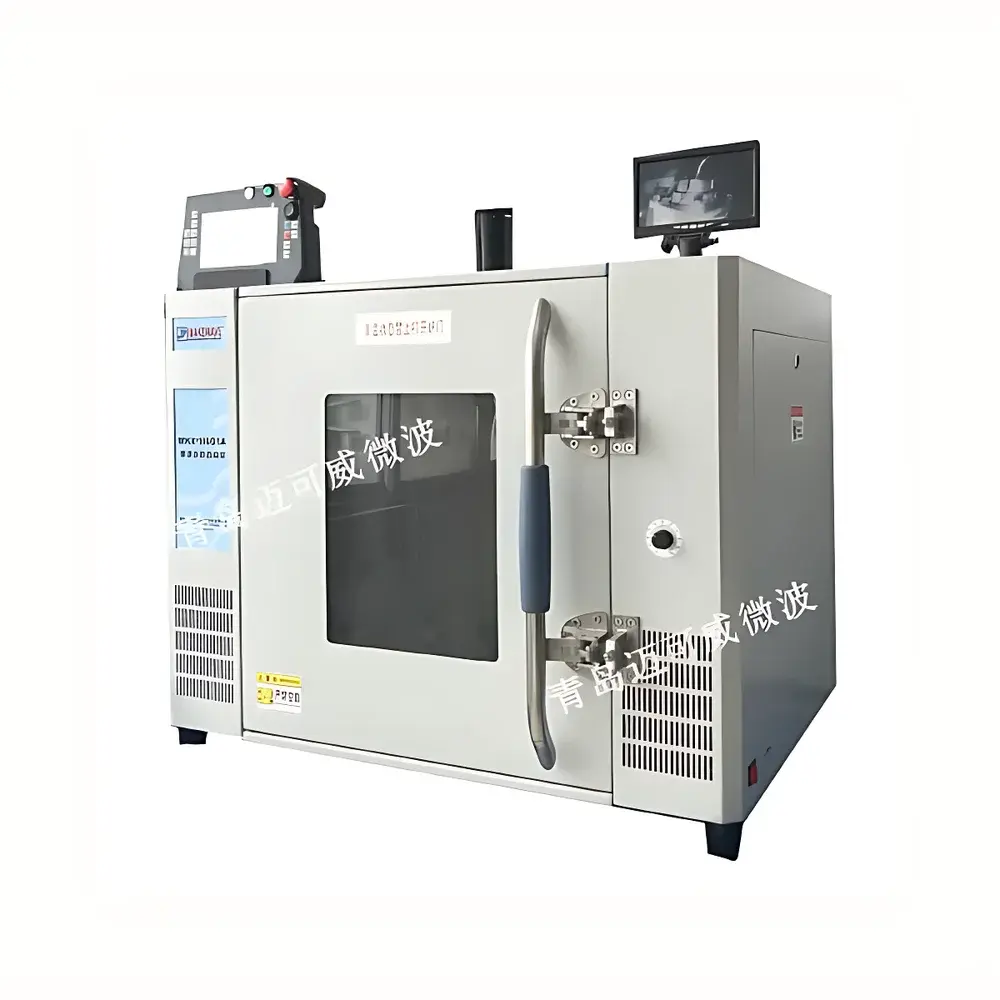
MakeWave MKX-H4G1A 3L Sealed Microwave High-Pressure Reactor
| Brand | MakeWave |
|---|---|
| Origin | Shandong, China |
| Manufacturer Type | Direct Manufacturer |
| Country of Origin | China |
| Model | MKX-H4G1A |
| Reactor Type | High-Pressure Batch Reactor |
| Vessel Capacity | 3 L |
| Working Pressure | Up to 3 MPa |
| Operating Temperature | Up to 220 °C |
| Microwave Frequency | 2450 MHz |
| Rated Microwave Power | 3200 W (continuous, non-pulsed) |
| Cavity Volume | 120 L |
| Construction Material | 304 Stainless Steel with Multi-Layer PTFE Coating |
| Stirring | Magnetic Stirring with PTFE-Coated Stir Bar |
| Temperature Sensing | Fiber-Optic Probe (Insertion Type) |
| Pressure Sensing | Integrated Piezoresistive Sensor |
| Microwave Leakage | <5 mW/cm² |
| Safety Compliance | ISO 9001 Certified |
| Power Supply | 220/380 VAC, 50 Hz |
| Total Power Consumption | 6 kW |
| Dimensions (W×H×D) | 920 × 966 × 685 mm |
| Net Weight | 120 kg |
Overview
The MakeWave MKX-H4G1A is a fully sealed, high-pressure microwave reactor engineered for controlled, reproducible chemical synthesis under elevated temperature and pressure conditions. It operates on the principle of dielectric heating—where microwave energy (2450 MHz) directly couples with polar molecules and ionic species in the reaction mixture—enabling rapid, volumetric, and selective thermal activation. Unlike conventional conductive heating, this mechanism reduces thermal gradients, minimizes side reactions, and significantly accelerates kinetics across heterogeneous and homogeneous systems. Designed for research-scale batch synthesis, the MKX-H4G1A integrates a 3 L PTFE-lined high-pressure reaction vessel into a 120 L industrial-grade microwave cavity, supporting safe operation up to 220 °C and 3 MPa. Its architecture conforms to fundamental requirements for pressurized chemical process development in academic, pharmaceutical, and materials laboratories—particularly where reaction intensification, solvent-free pathways, or low-temperature activation of thermally sensitive substrates are critical.
Key Features
- Sealed 3 L PTFE reaction vessel with integrated fiber-optic temperature probe and piezoresistive pressure transducer—enabling real-time, in-situ monitoring without signal interference.
- Continuous, non-pulsed 3200 W microwave output with closed-loop power modulation—ensuring stable energy delivery and precise thermal control during exothermic or endothermic transitions.
- 120 L cavity constructed from welded 304 stainless steel and coated with multi-layer PTFE—resistant to aggressive reagents (e.g., concentrated HNO₃, HF, KOH) and validated for long-term corrosion resistance at >200 °C.
- PLC-based control system with 7-inch touchscreen interface—displaying synchronized time–temperature–pressure–power profiles; supports up to 20 programmable reaction protocols with auto-save and USB data export (CSV format).
- Dual safety interlock door mechanism with λ/4 choke structure—meeting IEC 61000-4-3 EMC standards and limiting microwave leakage to <5 mW/cm² (exceeding GB 10436-2008 requirements).
- Integrated magnetic stirring with speed-adjustable PTFE-coated stir bar—maintaining homogeneity in viscous or precipitating systems without mechanical feedthroughs.
- Active exhaust system with negative-pressure fan—removing volatile byproducts and residual vapors post-reaction, supporting GLP-compliant fume management.
Sample Compatibility & Compliance
The MKX-H4G1A accommodates a broad range of sample matrices—including organometallic precursors, metal oxide nanoparticles, polymeric monomers, bioactive natural product extracts, and catalytic slurries—within its chemically inert PTFE vessel. It supports both aqueous and anhydrous media, including low-dielectric solvents (e.g., hexane, toluene) when combined with susceptors. The system complies with ISO 9001:2015 quality management standards and incorporates design elements aligned with ASTM E2877 (Standard Guide for Microwave-Assisted Reaction Optimization) and USP Analytical Instrument Qualification frameworks. While not intrinsically certified for ATEX or IECEx zones, its pressure containment design adheres to PED 2014/68/EU principles for Category III equipment (maximum allowable pressure >0.5 bar gauge). All pressure components undergo hydrostatic testing at 1.5× MAWP prior to shipment.
Software & Data Management
The embedded control firmware logs timestamped temperature, pressure, microwave power, and stirring speed at user-defined intervals (1–60 s resolution). Data is stored internally and exportable via USB to standard spreadsheet formats for downstream statistical analysis (e.g., kinetic modeling in OriginLab or MATLAB). The interface supports audit-trail-enabling configuration—allowing lab managers to assign operator IDs, define password-protected parameter limits, and generate PDF reports compliant with FDA 21 CFR Part 11 requirements when paired with networked time servers and electronic signature modules (optional add-on). No cloud connectivity is implemented by default, preserving data sovereignty in regulated environments.
Applications
This reactor is routinely deployed in:
- Organic synthesis—accelerating Suzuki, Heck, and Buchwald–Hartwig couplings under mild conditions;
- Inorganic nanomaterial synthesis—controlling crystallinity and phase purity of perovskites, MOFs, and transition metal oxides;
- Pharmaceutical process R&D—screening API salt forms and polymorphs with reduced thermal degradation;
- Environmental sample digestion—achieving complete acid dissolution of soil/sediment matrices for ICP-MS trace metal analysis;
- Biopolymer modification—facilitating esterification and crosslinking of chitosan or cellulose derivatives without chain scission;
- Fuel catalyst development—optimizing hydrothermal carbonization and sulfidation protocols for NiMo/Al₂O₃ systems.
FAQ
What is the maximum recommended operating pressure for routine use?
The recommended working pressure limit is 2.5 MPa at temperatures ≤210 °C to ensure long-term vessel integrity and measurement repeatability.
Can the system be used with flammable solvents such as diethyl ether or THF?
Yes—provided the vessel is pre-evacuated and backfilled with inert gas (N₂ or Ar), and the microwave power ramp rate is constrained to prevent localized superheating; consult the Safety Manual for solvent-specific startup protocols.
Is fiber-optic temperature measurement traceable to NIST standards?
The fiber-optic probe is factory-calibrated against a reference platinum RTD (Class A, IEC 60751); NIST-traceable calibration certificates are available upon request (additional charge).
Does the PLC controller support remote monitoring via Ethernet or Modbus?
Standard configuration includes RS-485 Modbus RTU output; Ethernet/IP and OPC UA gateways are available as optional hardware modules.
What maintenance is required for the PTFE vessel and cavity coating?
PTFE vessels should be inspected for microcracks or discoloration after every 50 cycles; cavity coating requires only periodic wipe-down with isopropanol—no reapplication is needed within the 5-year service life under normal usage.



