
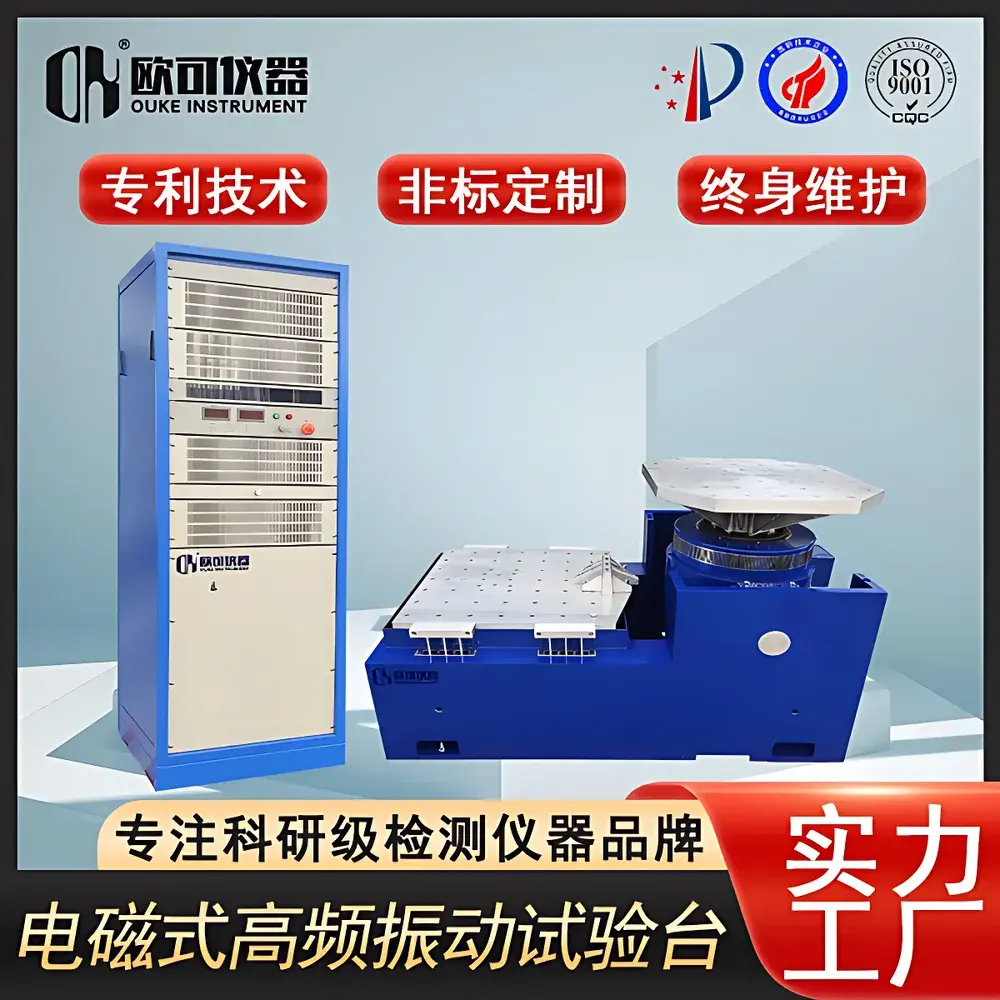
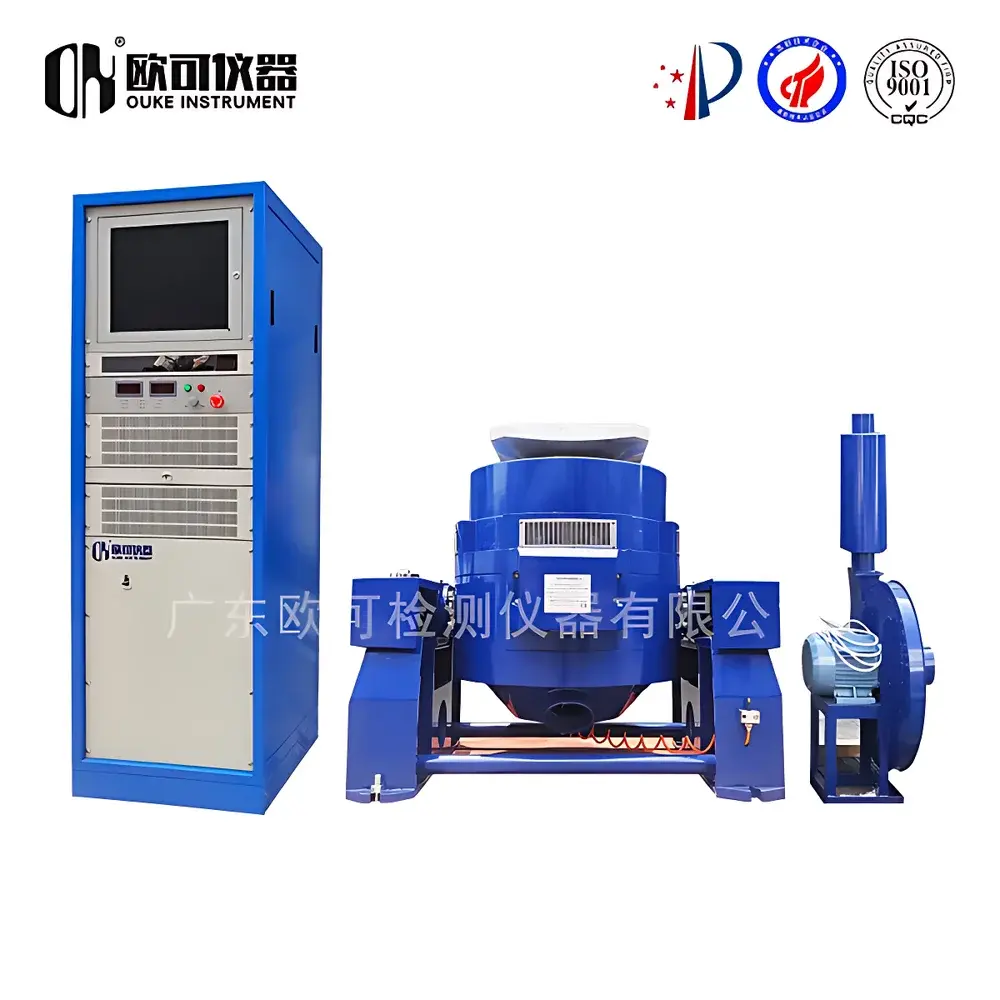
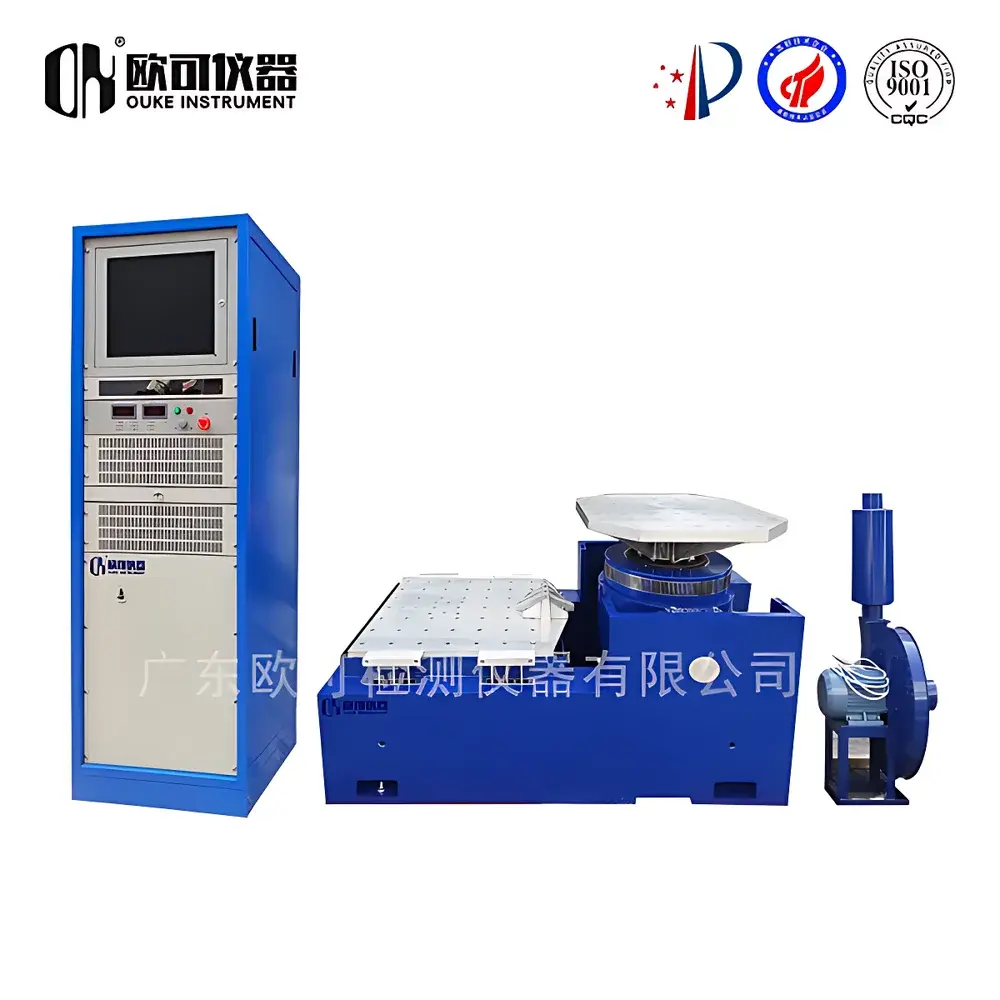
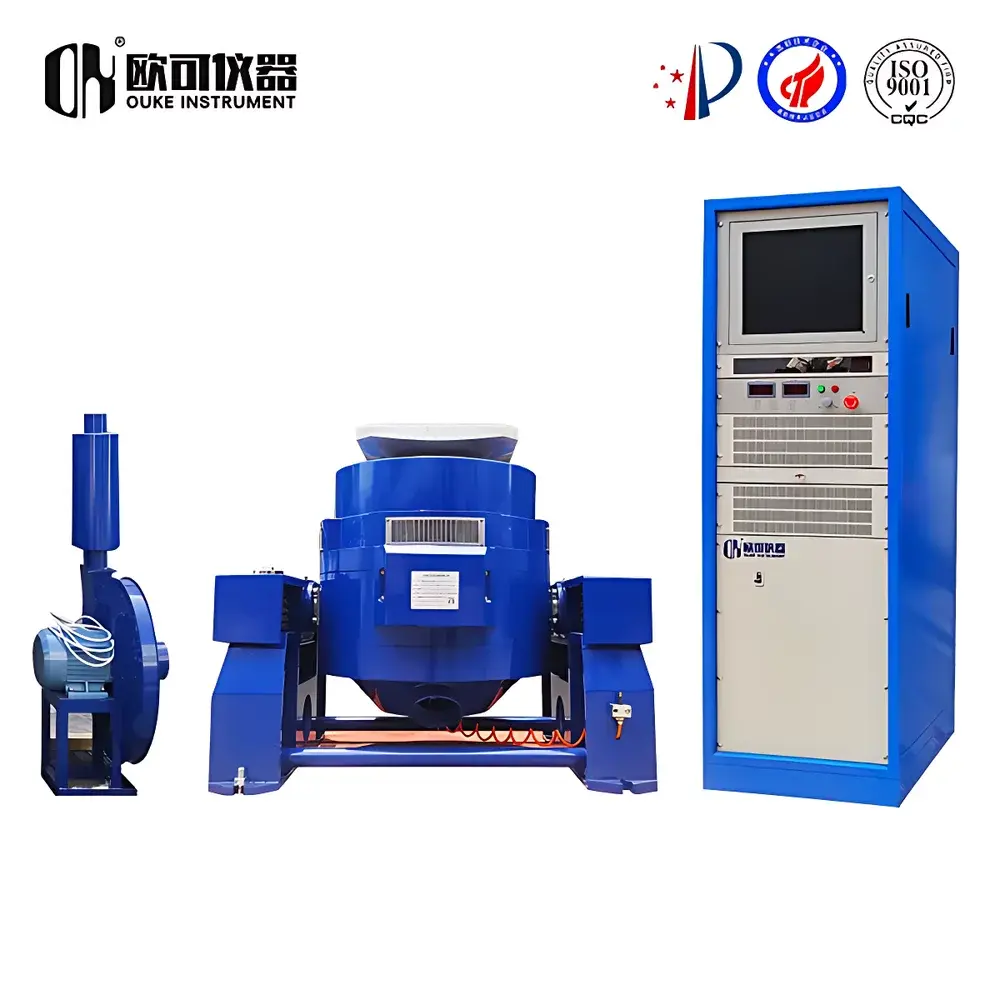
OK Instruments OK-ES-3.51 Electromagnetic Vertical & Horizontal Vibration Shaker System
| Brand | OK Instruments |
|---|---|
| Origin | Guangdong, China |
| Manufacturer Type | Direct Manufacturer |
| Instrument Type | Electromagnetic Vibration Shaker |
| Rated Thrust | 1.98 kN |
| Frequency Range | 5–5000 Hz |
| Max. Test Load | 70 kg |
| Table Dimensions | 300 × 300 × 30 mm |
| Max. Acceleration | 10 g |
| Table Surface | 500 × 500 mm |
| Axes | X/Y/Z (Triaxial) |
| Waveform | Sine |
| Amplitude Range | 0–5 mm peak-to-peak |
| Frequency Resolution | 0.01 Hz |
| Frequency Accuracy | ±0.1 Hz |
| Test Duration Range | 0–9999 h/m/s (programmable) |
| Power Supply | AC 220 V / 50 Hz or AC 380 V / 50 Hz |
| Compliance | GB/T 2423.10–2008 |
Overview
The OK Instruments OK-ES-3.51 Electromagnetic Vertical & Horizontal Vibration Shaker System is a triaxial (X/Y/Z), servo-controlled electromagnetic shaker engineered for precise mechanical stress simulation in product reliability and environmental qualification testing. Based on Lorentz-force actuation principles, the system generates controlled sinusoidal vibration profiles across a broad frequency spectrum (5–5000 Hz) to replicate real-world dynamic loading conditions—including transportation shock, operational resonance, and long-term fatigue exposure. Designed for laboratory and production-line validation environments, it supports both vertical and horizontal excitation modes with synchronized four-point drive architecture, ensuring uniform modal energy distribution across the 500 × 500 mm stainless-steel test table. Its robust electromagnetic actuator—rated at 1.98 kN thrust—delivers high-fidelity acceleration up to 10 g while maintaining thermal stability and minimal harmonic distortion during extended duty cycles.
Key Features
- Four-point synchronous electromagnetic excitation ensures homogeneous vibration amplitude distribution and minimizes nodal interference across the full 500 × 500 mm test surface.
- Embedded amplitude prediction algorithm enables rapid, repeatable amplitude calibration without external sensors—reducing setup time and operator dependency.
- Programmable multi-segment timing control supports complex test sequences: single-frequency dwell, stepped sweeps, and closed-loop cyclic profiles (e.g., 10 Hz → 30 Hz → 10 Hz repeated).
- Continuous amplitude adjustment (0–5 mm p-p) and fine frequency resolution (0.01 Hz display, ±0.1 Hz accuracy) accommodate stringent industry-specific test specifications.
- Electromagnetically shielded control electronics and dedicated anti-interference circuitry suppress EMI-induced signal drift—critical for compliance with ISO/IEC 17025-accredited labs and GMP-aligned manufacturing facilities.
- Non-magnetic, static-free table surface eliminates electrostatic discharge (ESD) risks and magnetic coupling errors—essential for testing sensitive electronic assemblies, MEMS devices, and precision optical components.
Sample Compatibility & Compliance
The OK-ES-3.51 accommodates test specimens up to 70 kg (with optional 100 kg configuration), spanning consumer electronics, automotive ECUs, aerospace avionics housings, medical device enclosures, and industrial instrumentation. Its triaxial capability allows sequential or simultaneous excitation along orthogonal axes—enabling full IEC 60068-2-6 and MIL-STD-810H Method 514.8-compliant vibration profiling. The system is fully aligned with GB/T 2423.10–2008 (equivalent to IEC 60068-2-6), supporting sine sweep, resonant dwell, and random vibration test protocols. Optional mounting fixtures, slip tables, and head expanders extend compatibility to non-planar or oversized assemblies. All firmware and control logic are designed to support audit-ready documentation per GLP and ISO 9001 quality management requirements.
Software & Data Management
The system operates via OK-VibControl™ v3.2—a Windows-based, deterministic real-time control suite with dual-mode operation: local HMI panel interface and remote PC connectivity via Ethernet (TCP/IP). Software features include waveform synthesis, live FFT spectral monitoring, automatic resonance tracking, and pre-defined test templates compliant with ASTM D999, ISO 13373-1, and USP . All test parameters, execution logs, and raw acceleration/time-series data are timestamped and stored in CSV and binary formats. Audit trail functionality records user actions, parameter changes, and calibration events—meeting FDA 21 CFR Part 11 requirements when configured with electronic signature modules and role-based access control.
Applications
- Design validation of printed circuit board (PCB) solder joint integrity under resonant frequency exposure.
- Structural fatigue assessment of electric vehicle battery modules subjected to road-spectrum vibration inputs.
- Pre-shipment durability screening of IoT sensor housings per IPC-9701A Class 2 criteria.
- Modal analysis support for finite element model correlation in mechanical packaging design.
- Qualification testing of surgical robotics actuators per IEC 62304 software lifecycle and IEC 60601-1 mechanical safety clauses.
- Environmental stress screening (ESS) of military-grade connectors using accelerated sine sweep profiles.
FAQ
What standards does the OK-ES-3.51 support for regulatory compliance?
It natively implements GB/T 2423.10–2008, and its programmable waveform engine supports test profiles aligned with IEC 60068-2-6, MIL-STD-810H Method 514.8, and ASTM D999.
Can the system perform simultaneous multi-axis vibration?
No—it operates in sequential X, Y, or Z axis mode per test sequence; simultaneous triaxial excitation requires optional slip-table integration and external controller synchronization.
Is the system suitable for HALT or HASS applications?
While optimized for qualification-level sine testing, it is not rated for high-gradient thermal-vibration combined stress; HALT/HASS requires specialized thermal-shaker integration beyond this unit’s scope.
What calibration documentation is provided?
Each unit ships with NIST-traceable factory calibration certificate covering thrust linearity, frequency response (5–5000 Hz), and amplitude repeatability (±1.5% over 1000-hour operational baseline).
Does the shaker require water cooling or external air supply?
No—it employs convection-cooled electromagnetic actuation and operates continuously at rated load without auxiliary cooling infrastructure.



