
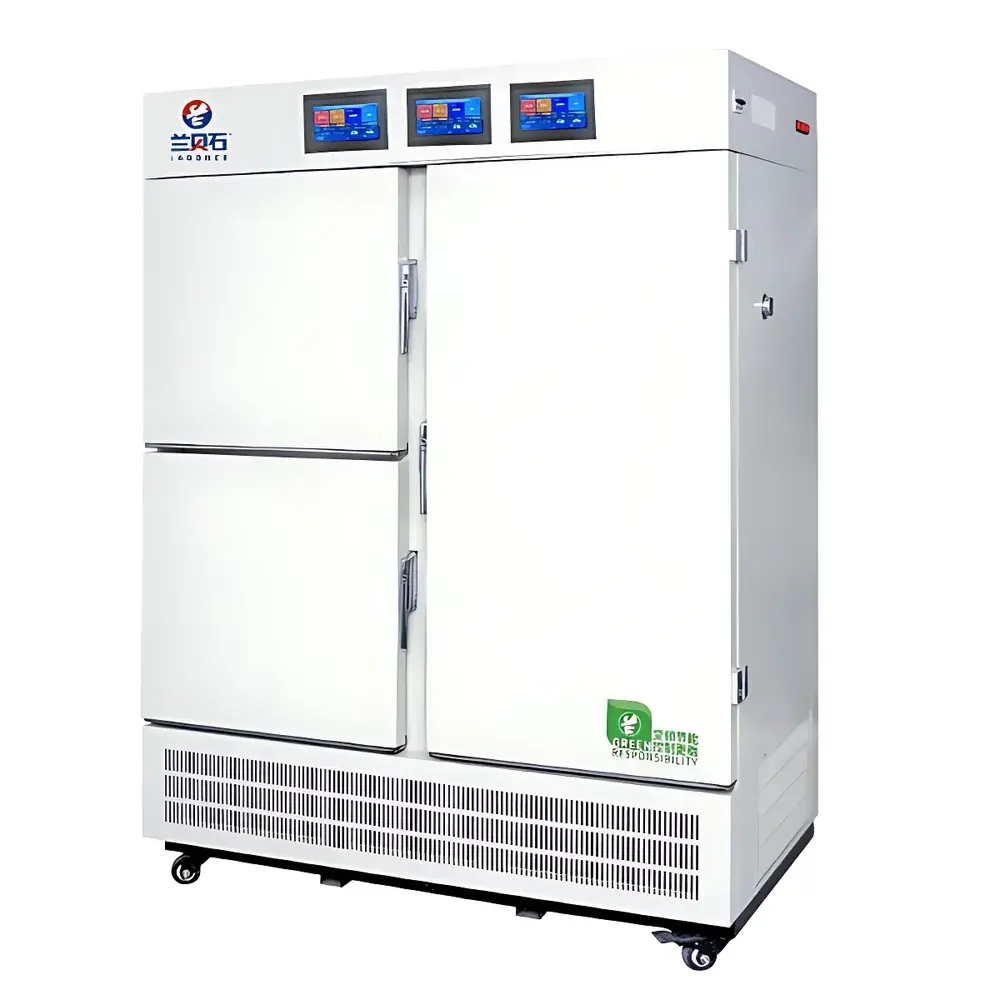
Labonce Labonce-930CGS-FC Tri-Chamber Comprehensive Drug Stability Testing Chamber
| Brand | Labonce |
|---|---|
| Origin | Beijing, China |
| Manufacturer Type | Direct Manufacturer |
| Model | Labonce-930CGS-FC |
| Temperature Range (Chamber A) | 15–65°C |
| Temperature Range (Chambers B & C) | 15–65°C |
| Humidity Range (Chambers B & C) | 20–95% RH |
| Illumination Range (Chamber A) | Visible Light 100–6000 Lux (4500 ± 500 Lux nominal), Near-UV 0.84–1.0 W/m² |
| Total Illumination Dose (Visible) | ≥1.2 × 10⁶ Lux·hr |
| Total UV Dose (Near-UV) | ≥200 W·hr/m² |
| Internal Volume | 220 L (A), 220 L (B), 480 L (C) |
| Internal Dimensions (W×D×H) | 600×700×520 mm (A/B), 600×700×1140 mm (C) |
| External Dimensions (W×D×H) | 1570×1060×1960 mm |
| Temperature Uniformity (no light) | ±1.0°C |
| Temperature Fluctuation | ±0.5°C |
| Humidity Uniformity (no light) | ±3% RH |
| Humidity Fluctuation | ±2% RH |
| Power Supply | AC 220 V ±10%, 50 Hz |
| Rated Power | 4.0 kW |
| Standard Shelves | 6 (A), 6 (B), 8 (C) |
| Construction | Exterior – Powder-coated steel |
| Insulation | High-density polyurethane foam (≥120 mm thickness) |
| Refrigeration System | Imported hermetic inverter compressor |
| Humidity Sensor | Imported capacitive type, maintenance-free, long-term stability |
| Control Interface | 7-inch color programmable touchscreen controller with real-time inverter output ratio display |
| User Access | Three-tier permission system (Administrator, Supervisor, Operator) with username/password authentication |
| Audit Trail | Time-stamped, tamper-resistant operation and alarm logs |
| Data Output | Integrated thermal line printer + internal electronic storage (≥1 year at 1-min intervals) |
| Safety Protections | Compressor overheat/overpressure protection, independent overtemperature cutoff, dry-run prevention, water shortage detection, anti-dry-burn heater control |
| Alarm System | Local audible alarm + remote SMS notification for temperature/humidity deviation and power failure |
| Dual-door Design | Outer solid insulated door + inner tempered glass door (minimizes environmental disturbance during observation) |
| Optional Ports | Ø50 mm test port with silicone plug, casters with locking mechanism, door lock |
Overview
The Labonce Labonce-930CGS-FC Tri-Chamber Comprehensive Drug Stability Testing Chamber is an ICH Q1-compliant, GMP-aligned environmental simulation system engineered for long-term stability studies of pharmaceutical products under defined temperature, humidity, and photostability conditions. Its tri-chamber architecture separates critical test environments into functionally independent zones: Chamber A delivers controlled temperature combined with calibrated visible light and near-ultraviolet irradiation per ICH Q1B and Chinese Pharmacopoeia 2020 Edition requirements; Chambers B and C operate as parallel temperature–humidity conditioning units supporting accelerated and intermediate condition testing (e.g., 40°C/75% RH, 30°C/65% RH). The system employs a closed-loop refrigeration cycle driven by an imported hermetic inverter compressor—enabling precise thermal modulation while reducing energy consumption by over 50% relative to fixed-speed alternatives. All chambers utilize high-density polyurethane insulation (≥120 mm) and mirror-finish 304 stainless-steel interiors to ensure chemical inertness, corrosion resistance, and cleanability—critical for GLP/GMP audit readiness.
Key Features
- Tri-chamber modular design enabling simultaneous execution of ICH Q1A(R3) long-term, accelerated, and photostability protocols
- Chamber A equipped with traceable visible light (100–6000 Lux, 4500 ± 500 Lux nominal) and near-UV (0.84–1.0 W/m²) sources; integrated sensors log cumulative exposure (≥1.2 × 10⁶ Lux·hr visible, ≥200 W·hr/m² UV)
- Inverter-driven refrigeration system with adaptive capacity modulation ensures stable thermal performance across ambient conditions (5–35°C)
- Capacitive humidity sensing technology with <±0.5% RH long-term drift specification and zero-maintenance operation
- 7-inch full-color programmable touchscreen controller displaying real-time inverter output ratio, chamber status, and setpoint deviation
- Three-tier user permission structure (Administrator, Supervisor, Operator) compliant with FDA 21 CFR Part 11 access control requirements
- Audit trail functionality records all parameter changes, user logins, alarm events, and system interventions with immutable timestamps
- Dual-door configuration minimizes thermal and hygric perturbation during sample inspection—inner tempered glass door enables visual monitoring without compromising chamber integrity
- Comprehensive safety architecture including independent overtemperature cutoff, refrigerant high-pressure shutdown, water-level monitoring, and heater dry-run prevention
Sample Compatibility & Compliance
The Labonce-930CGS-FC accommodates a wide range of pharmaceutical dosage forms—including tablets, capsules, injectables, ointments, and lyophilized powders—within standardized stainless-steel shelving configurations (6 shelves in Chambers A and B; 8 in Chamber C). Its physical dimensions (internal: 600 × 700 × 520 mm for A/B; 600 × 700 × 1140 mm for C) support ISO 17025-accredited placement of reference standards and stability batches per ICH Q5C guidance. The chamber meets the environmental uniformity criteria specified in USP , EP 2.2.45, and Chinese Pharmacopoeia 2020 Vol. IV General Chapter 9001: temperature deviation ≤ ±1.0°C (no illumination), fluctuation ≤ ±0.5°C; humidity deviation ≤ ±3% RH, fluctuation ≤ ±2% RH. Photometric calibration adheres to ICH Q1B Annex 1 protocols, with factory-certified irradiance mapping performed at multiple spatial points across Chamber A’s working volume.
Software & Data Management
Data integrity is maintained through dual-channel recording: real-time thermal/hygrometric traces are stored internally for ≥12 months at configurable logging intervals (default: 1 minute), while concurrent hardcopy output is provided via integrated thermal line printer. Export functionality supports USB-based retrieval of audit logs, alarm histories, and environmental profiles in non-editable formats (PDF or timestamped CSV), satisfying ALCOA+ principles. The controller firmware implements role-based session timeouts, password complexity enforcement, and automatic lockout after five failed login attempts. Electronic records include digital signatures for critical actions (e.g., program start/stop, setpoint modification), ensuring compliance with 21 CFR Part 11 Subpart B requirements for electronic records and signatures.
Applications
- ICH Q1A(R3)-compliant long-term (25°C/60% RH) and accelerated (40°C/75% RH) stability testing
- ICH Q1B photostability assessment under Option 1 (open container) and Option 2 (closed container) protocols
- Bracketing and matrixing study designs for multi-product or multi-strength filings
- Excipient compatibility screening under stress conditions
- Reference standard storage validation per ICH Q5C
- GMP facility qualification (IQ/OQ/PQ) of environmental chambers
- Regulatory submission support for NDA, ANDA, and MA applications requiring documented environmental control
FAQ
Does the Labonce-930CGS-FC comply with ICH Q1B photostability requirements?
Yes. Chamber A is configured with NIST-traceable visible and near-UV light sources, calibrated irradiance sensors, and automated dose accumulation tracking aligned with ICH Q1B Annex 1 specifications.
What data security measures are implemented for electronic records?
All electronic records include time-stamped, user-attributed entries with cryptographic hashing. Exported files are write-protected; internal storage enforces retention policies and prevents manual deletion.
Can the system be validated for GMP use?
Yes. The chamber includes IQ/OQ documentation templates, sensor calibration certificates (NIST-traceable), and full traceability of firmware version history—supporting formal qualification per ASTM E2500 and EU Annex 15.
Is remote monitoring supported?
Standard SMS-based alerting covers power failure, temperature/humidity excursions, and door-open events. Optional Ethernet/Wi-Fi integration enables secure web-based dashboard access and SNMP trap forwarding.
What maintenance is required for the humidity control system?
The capacitive humidity sensor is maintenance-free. Weekly distilled water top-up for the humidifier reservoir and quarterly inspection of condensate drain lines constitute routine operational checks.






