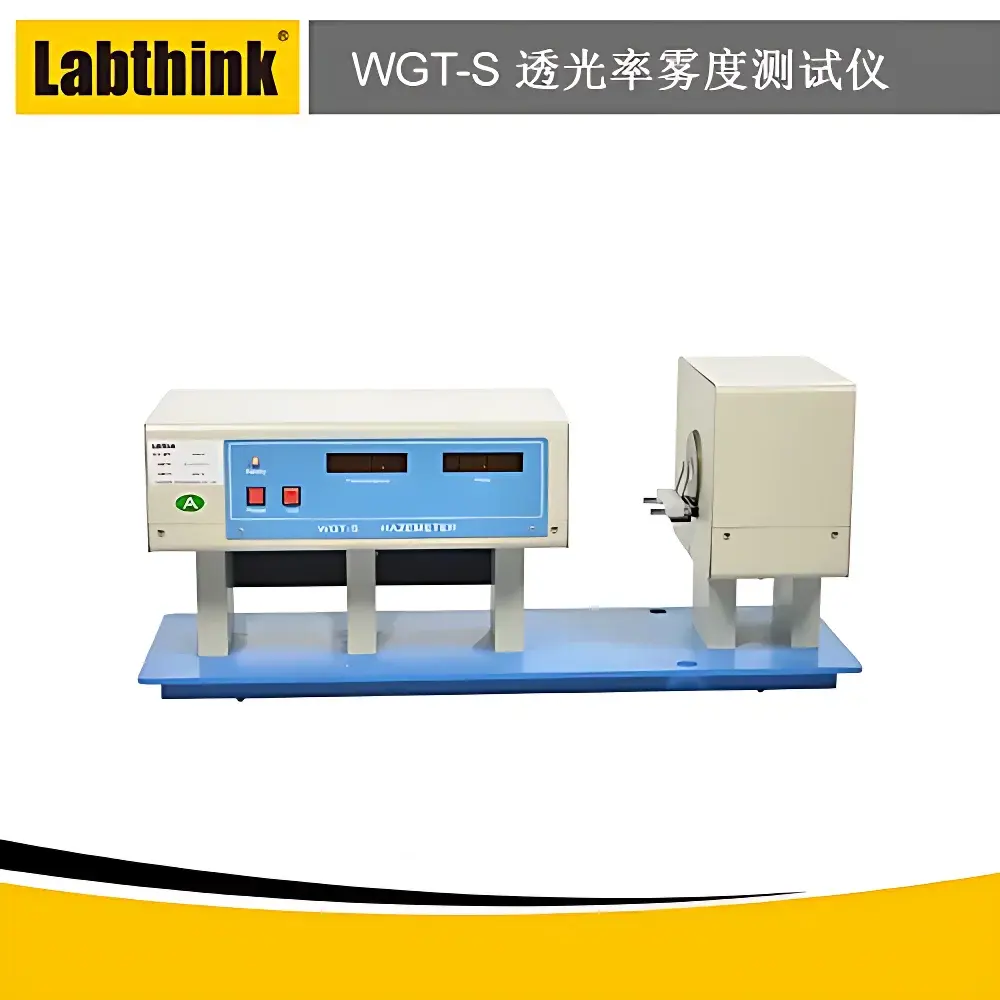
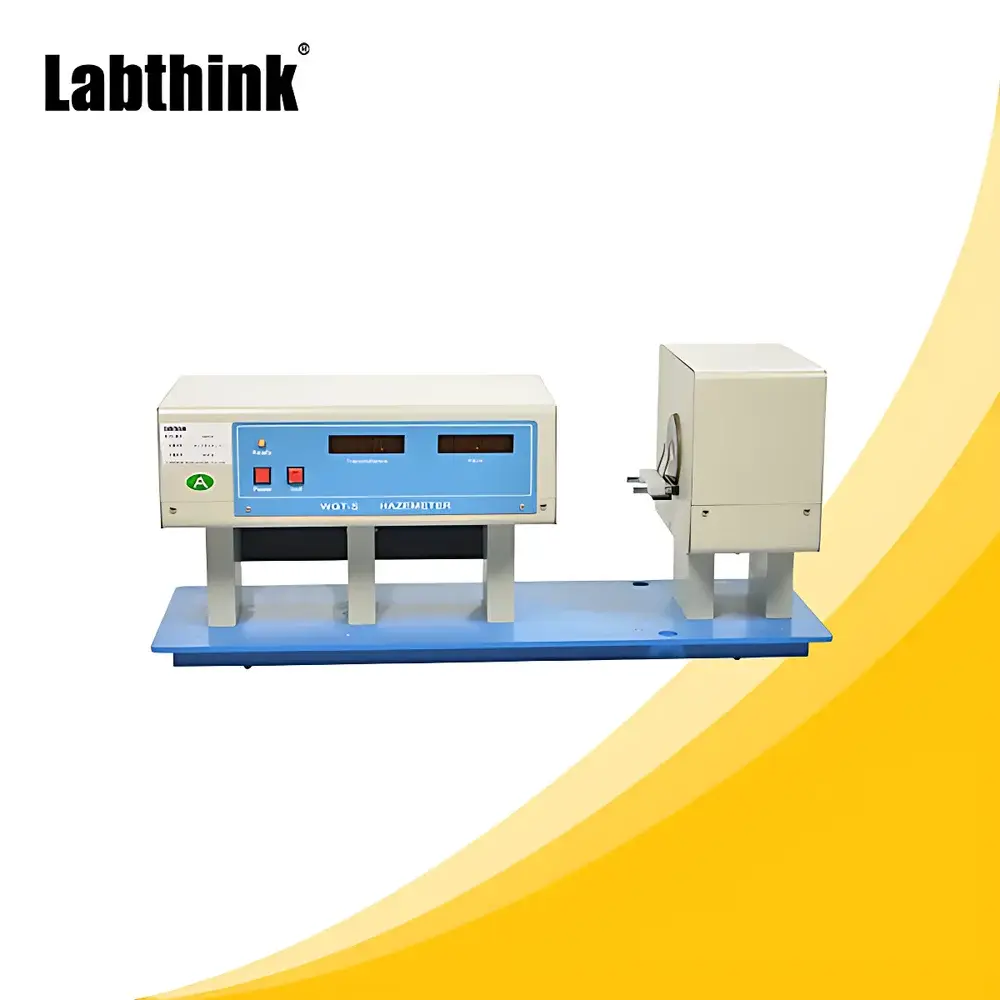
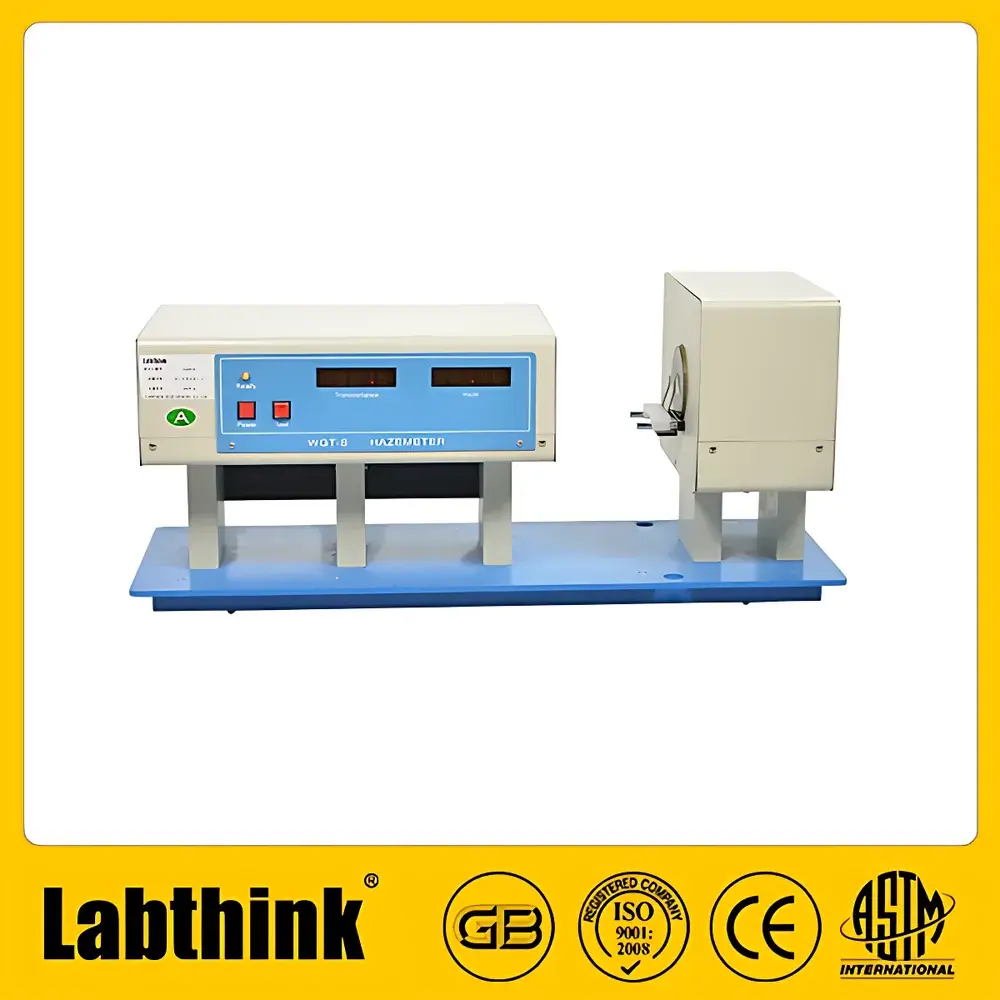
Labthink WGT-S Haze and Transmittance Tester
| Brand | Labthink |
|---|---|
| Model | WGT-S |
| Origin | Shandong, China |
| Manufacturer Type | Direct Manufacturer |
| Product Type | Automatic |
| Haze Range | 0–30.00% |
| Transmittance Range | 0–100.0% |
| Haze Repeatability | ±0.05% (for H ≤ 0.5%) |
| Transmittance Repeatability | ±0.5% |
| Light Source | C-illuminant (12 V DC, 50 W tungsten-halogen lamp + color temperature correction filter) |
| Sample Size | 50 mm × 50 mm (film) |
| Aperture Dimensions | Entrance Ø25 mm, Exit Ø21 mm |
| Detection System | Silicon photodiode with photopic luminosity function (V(λ)) correction |
| Integrating Sphere Geometry | Collimated Illumination / Diffuse Viewing |
| Compliance Standards | GB/T 2410, ASTM D1003–07 (reapproved 2013), JIS K7105–1981 |
| Dimensions | 740 mm (L) × 270 mm (W) × 300 mm (H) |
| Net Weight | 21 kg |
| Power Supply | 220 V, 50 Hz |
Overview
The Labthink WGT-S Haze and Transmittance Tester is a precision optical instrument engineered for the quantitative evaluation of light transmission and scattering behavior in planar transparent and translucent materials. It operates on the fundamental principles defined in ASTM D1003 and ISO 14782:1999—measuring total transmittance as the ratio of total transmitted radiant flux to incident flux, and haze as the ratio of diffusely transmitted flux (scattered at angles greater than 2.5° from the incident beam direction) to total transmitted flux. Designed for rigorous quality control and R&D environments, the WGT-S employs a standardized C-illuminant source (tungsten-halogen lamp with chromaticity correction) and a V(λ)-corrected silicon photodetector housed within an integrating sphere assembly. This configuration ensures spectral response alignment with human photopic vision, enabling metrologically traceable measurements compliant with international photometric conventions. The system supports both solid sheet/film specimens (e.g., PET, PC, PMMA, acrylic sheets) and liquid samples (e.g., pharmaceutical solutions, beverage formulations), delivering stable, operator-independent results under controlled ambient conditions.
Key Features
- Automatic dual-parameter measurement: Simultaneous acquisition and display of transmittance (%) and haze (%) with real-time BCD serial output.
- Microprocessor-controlled calibration routine with auto-zero and auto-gain functions, minimizing drift and manual intervention.
- Integrated C-illuminant optical path: 12 V DC, 50 W tungsten-halogen lamp with calibrated color temperature filter ensures spectral stability per CIE illuminant C requirements.
- V(λ)-matched detection: Silicon photodiode paired with photopic luminosity correction filter guarantees compliance with CIE standard observer functions.
- Collimated illumination geometry with diffuse viewing: Optimized for high signal-to-noise ratio and minimal edge-scatter interference in thin-film applications.
- Standardized sample handling: Precision-machined 50 mm × 50 mm film holder and dedicated 40 mm × 2 mm reference standard included for daily verification.
- Robust mechanical architecture: Cast aluminum housing with EMI-shielded electronics, designed for continuous operation in ISO Class 8 cleanroom-adjacent or QC laboratory settings.
Sample Compatibility & Compliance
The WGT-S accommodates rigid and flexible planar specimens up to 3 mm thickness—including polymer films (BOPP, PET, PE), laminated safety glass interlayers, coated optical substrates, and medical-grade silicone membranes. Liquid samples are measured using optional cuvette adapters compatible with standard 10 mm path-length quartz cells. All measurement protocols adhere strictly to ASTM D1003–07 (Standard Test Method for Haze and Luminous Transmittance of Transparent Plastics), GB/T 2410–2008 (Plastics—Determination of haze and transmittance), and JIS K7105–1981. Instrument validation includes factory-certified traceability to NIM (National Institute of Metrology, China) reference standards. Data integrity meets GLP audit requirements through hardware-based timestamping and non-editable internal storage of calibration logs.
Software & Data Management
While the WGT-S operates as a standalone benchtop unit with LED numeric display, it features RS-232 serial interface (BCD format) for integration into centralized LIMS or MES platforms. Optional Labthink proprietary software enables automated batch reporting, statistical process control (SPC) charting (X̄–R charts), and export to CSV/Excel formats. Audit trail functionality records operator ID, calibration events, environmental parameters (if connected to optional external hygrothermograph), and raw measurement timestamps—supporting compliance with FDA 21 CFR Part 11 when deployed with electronic signature modules. All firmware updates are delivered via secure USB dongle with cryptographic signature verification.
Applications
- Quality assurance of optical films used in LCD backlight units, touch panel overlays, and AR/VR waveguide substrates.
- Regulatory testing of pharmaceutical packaging films (e.g., blister lidding, sachet laminates) per USP <661> and EP 3.1.11.
- Development of anti-fog coatings on polycarbonate automotive glazing and greenhouse panels.
- Stability assessment of colloidal suspensions in biopharmaceutical formulations during accelerated aging studies.
- Material qualification for aerospace transparent enclosures where optical distortion and stray light must remain below MIL-PRF-85778 thresholds.
- Process validation of extrusion and casting lines producing architectural glazing and lighting diffusers.
FAQ
What standards does the WGT-S comply with for regulatory submissions?
The instrument conforms to ASTM D1003–07, GB/T 2410–2008, and JIS K7105–1981. Measurement uncertainty budgets are documented per ISO/IEC 17025:2017 Annex A, supporting inclusion in FDA eCTD Module 3 technical reports.
Can the WGT-S measure curved or non-planar samples?
No. It is strictly configured for flat, parallel-surface specimens. Curved lenses or molded optics require goniophotometric systems per CIE S 023/E:2013.
Is user calibration required before each test series?
A full calibration is recommended before first use and after lamp replacement. Daily verification using the supplied 40 × 2 mm reference standard satisfies ISO 9001:2015 clause 7.1.5.2 requirements.
Does the system support 21 CFR Part 11 compliance out of the box?
Hardware-level audit trails are embedded; Part 11 compliance requires deployment with validated third-party electronic lab notebook (ELN) software and role-based access control infrastructure.
What is the typical warm-up time for photometric stability?
The tungsten-halogen lamp achieves thermal equilibrium within 15 minutes. For highest repeatability, allow 30 minutes prior to critical measurements per ASTM E275–17 section 7.2.