
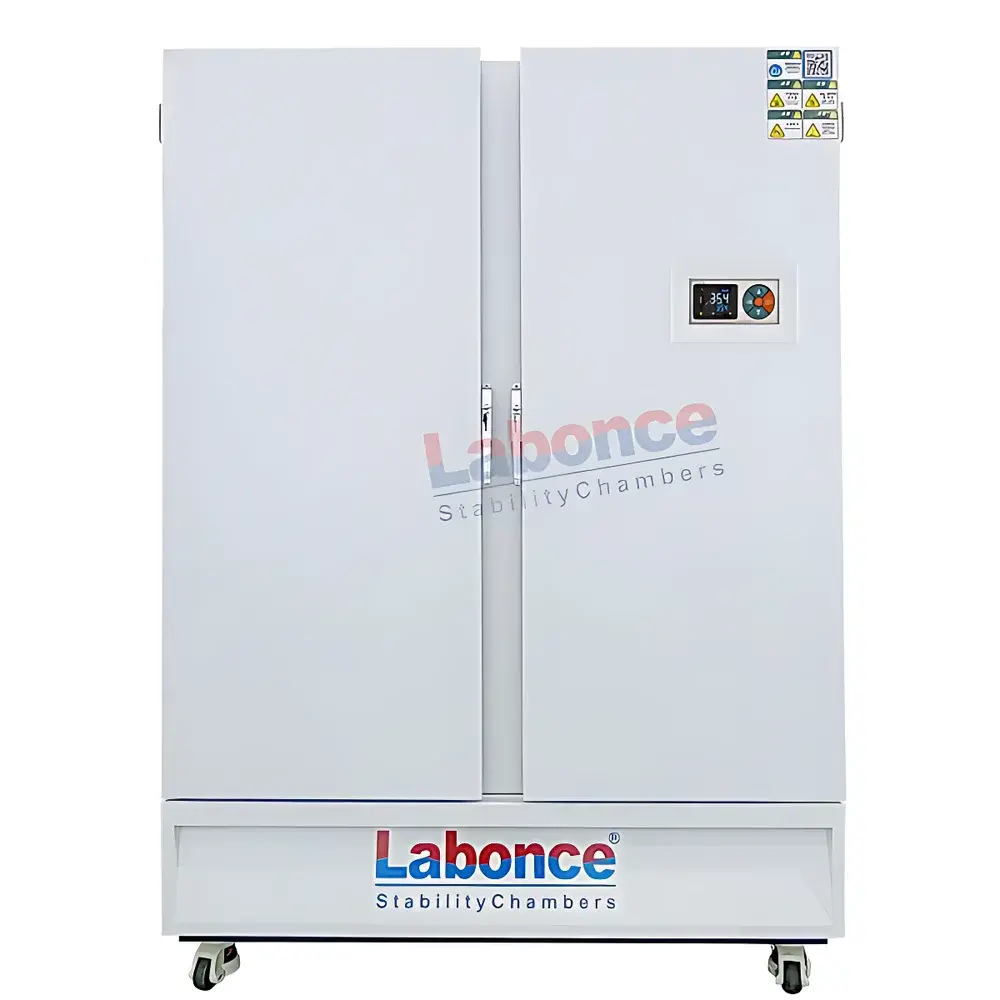
Labonce Labonce-800BI Biochemical Incubator
| Brand | Labonce |
|---|---|
| Model | Labonce-800BI |
| Temperature Range | 0–60°C |
| Chamber Volume | 800 L |
| Internal Dimensions (W×D×H) | 1200×490×1360 mm |
| External Dimensions (W×D×H) | 1385×895×1965 mm |
| Power Consumption | 1.5 kW |
| Temperature Uniformity | ≤2.0°C at 37°C, ≤3.0°C at other setpoints |
| Temperature Fluctuation | ±0.5°C (high temp), ±1.0°C (low temp) |
| Ambient Operating Temperature | +5 to +35°C |
| Power Supply | AC 220 V ±10%, 50 Hz |
| Standard Shelving | 4 adjustable stainless steel shelves |
| Compliance | GB/T 28851-2012 |
Overview
The Labonce Labonce-800BI Biochemical Incubator is an engineered environmental control system designed for precise, stable, and reproducible temperature regulation in life science laboratories. It operates on a forced-air convection principle with an optimized airflow duct system—ensuring uniform thermal distribution across the entire 800 L chamber volume. The incubator maintains setpoint temperatures between 0°C and 60°C, supporting critical workflows in microbial culture, enzyme kinetics, biochemical assay development, and long-term stability testing of biological reagents. Its design adheres strictly to GB/T 28851-2012, China’s national technical specification for biochemical incubators, and incorporates structural and functional features aligned with international expectations for GLP-compliant lab instrumentation—including traceable temperature logging, configurable alarm thresholds, and hardware-level safety redundancies.
Key Features
- Forced-air convection system with redesigned air duct architecture, delivering ≤2.0°C temperature uniformity at 37°C and ≤3.0°C across the full operating range.
- Chamber constructed with mirror-finish AISI 304 stainless steel interior and powder-coated cold-rolled steel exterior—non-porous, corrosion-resistant, and compatible with common laboratory disinfectants.
- High-efficiency hermetic industrial compressor (imported) enabling rapid thermal recovery and low acoustic emission (<55 dB(A) at 1 m).
- LCD-based controller with adjustable fan speed settings, real-time display of chamber temperature, setpoint, and operational status.
- Dual-stage overtemperature protection: independent mechanical thermostat plus electronic limit cutoff; compressor overheat and high-pressure cutout integrated into refrigeration circuitry.
- Standard equipment includes four adjustable stainless steel shelves, internal LED lighting, Ø50 mm external access port, casters with locking mechanism, and audible/visual alarm activation upon deviation or fault condition.
Sample Compatibility & Compliance
The Labonce-800BI accommodates standard microbiological vessels (Petri dishes, flasks, multi-well plates), serum bottles, and custom sample racks up to 1360 mm in height. Its interior geometry supports stacking configurations without compromising airflow integrity. The unit complies with GB/T 28851-2012 for performance verification, including temperature stability, uniformity, and recovery time under defined load conditions. While not certified to ISO 13485 or FDA 21 CFR Part 11 out-of-the-box, its data logging architecture—featuring timestamped internal memory and USB export capability—provides foundational support for audit-ready documentation in regulated environments. Optional UV germicidal irradiation (254 nm) and SMS alert modules further extend suitability for BSL-1/BSL-2 containment workflows.
Software & Data Management
The embedded controller records temperature readings at user-defined intervals (default: 1 minute) into non-volatile memory (≥30 days at default logging rate). Data can be exported via USB flash drive in CSV format for post-acquisition analysis in Excel, MATLAB, or LIMS platforms. The optional BIT-series touchscreen controller (not included with standard Labonce-800BI) adds role-based access control (three-tier permissions), electronic signature support, and 21 CFR Part 11–compliant audit trails—including operator ID, parameter changes, alarm events, and manual overrides. All firmware updates are delivered via secure offline package installation to maintain system integrity in air-gapped facilities.
Applications
- Microbial growth studies requiring extended incubation at mesophilic or psychrotrophic temperatures (e.g., E. coli, Bacillus subtilis, yeast strains).
- Enzyme activity assays where thermal consistency directly impacts kinetic parameter derivation (Vmax, Km).
- Stability testing of diagnostic reagents, vaccines, and monoclonal antibodies per ICH Q5C guidelines.
- Environmental simulation for agricultural research—seed germination, fungal pathogen propagation, and soil microcosm incubation.
- QC/QA validation of media preparation, including nutrient agar, MacConkey, and selective enrichment broths.
- Supporting ISO/IEC 17025-accredited testing labs through documented thermal mapping and periodic calibration verification.
FAQ
What is the maximum ambient temperature for reliable operation?
The Labonce-800BI is rated for continuous use in ambient environments between +5°C and +35°C. Operation above 35°C may impair cooling capacity and extend temperature recovery times.
Can humidity be controlled in this model?
No—standard Labonce-800BI units are temperature-only incubators. Humidity monitoring or control requires the optional humidity sensor add-on, which provides readout only (no active humidification/dehumidification).
Is the internal chamber fully accessible for cleaning and validation?
Yes—the seamless 304 stainless steel interior, absence of internal seams or crevices, and removable shelving facilitate WIP (work-in-process) decontamination and routine thermal mapping probe placement.
Does the unit support remote monitoring via Ethernet or Wi-Fi?
Not natively. Remote connectivity requires integration with third-party building management systems (BMS) via dry-contact alarm outputs or RS-485 Modbus RTU (available on BIT controller variant only).
What calibration standards are recommended for routine verification?
NIST-traceable PT100 probes (Class A tolerance) are recommended for chamber mapping. Verification should follow ISO/IEC 17025 Annex B or ASTM E2874 practices, with minimum 9-point spatial grid assessment at target setpoints (e.g., 25°C, 37°C, 55°C).



