
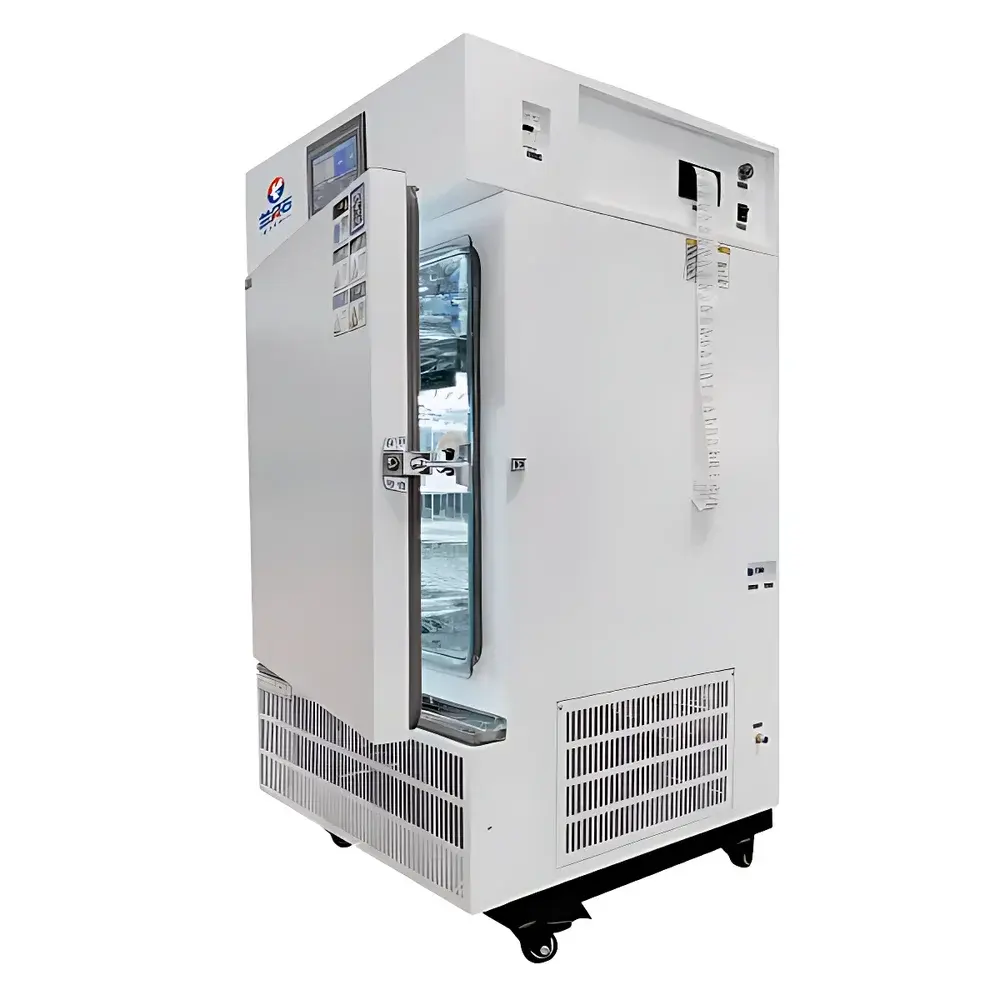
Labonce Labonce-500CGS-FC Pharmaceutical Stability Chamber with Visible Light and Near-Ultraviolet Irradiation
| Brand | Labonce |
|---|---|
| Origin | Beijing, China |
| Manufacturer Type | Direct Manufacturer |
| Country of Origin | China |
| Model | Labonce-500CGS-FC |
| Quotation | Upon Request |
| Temperature Range | 15–65°C |
| Humidity Range | 20–95% RH |
| Chamber Volume | 500 L |
| Internal Dimensions (W×D×H) | 680×680×1080 mm |
| External Dimensions (W×D×H) | 860×1050×1850 mm |
| Power Consumption | 2.2 kW |
| Standard Shelves | 4 pcs (11 total positions) |
| Temperature Uniformity | ≤2.0°C (dark condition) |
| Temperature Fluctuation | <±0.5°C |
| Temperature Deviation | <±1.0°C |
| Humidity Fluctuation | <±2% RH |
| Humidity Deviation | <±3% RH |
| Visible Light Intensity | 100–8000 lux (calibrated at 4500±500 lux) |
| Cumulative Visible Light Dose | ≥1.2×10⁶ lux·hr |
| Near-UV Irradiance | 0.84–5 W/m² (standard operation: 0.84–1.0 W/m²) |
| Cumulative Near-UV Energy | ≥200 W·hr/m² |
| Ambient Operating Temperature | +5 to +35°C |
| Power Supply | AC 220 V ±10%, 50 Hz |
| Refrigeration System | Imported hermetic variable-frequency compressor |
| Humidity Sensor | Imported capacitive humidity sensor |
| Control Interface | ≥7-inch color programmable touchscreen |
| User Access Levels | Three-tier permission system (admin/operator/user) |
| Audit Trail | Time-stamped, tamper-proof operational and alarm logs exportable via USB in read-only format |
| Data Output | Built-in dot-matrix printer + internal electronic storage |
| Safety Protections | Compressor overheat/overpressure protection, water shortage protection, dry-burn prevention, independent overtemperature cutoff, dual-door thermal inertia design |
Overview
The Labonce Labonce-500CGS-FC Pharmaceutical Stability Chamber is an ICH Q1-compliant environmental test system engineered for long-term, GxP-aligned stability studies under controlled temperature, humidity, visible light, and near-ultraviolet (UV-A, 320–400 nm) irradiation conditions. Designed in strict accordance with ICH Harmonised Tripartite Guideline Q1A(R2), Q1B, Q5C, and Chinese Pharmacopoeia 2020 Edition General Chapter , this chamber supports forced degradation testing, photostability assessment per ICH Q5C, and accelerated/scheduled stability protocols required for regulatory submissions to NMPA, FDA, EMA, and PMDA. Its core architecture integrates a high-efficiency variable-frequency refrigeration cycle, precision capacitive humidity sensing, and spectrally characterized optical subsystems—ensuring reproducible, traceable, and auditable environmental exposure across all four critical stress parameters.
Key Features
- Four-parameter environmental control: independent regulation of temperature (15–65°C), relative humidity (20–95% RH), visible light intensity (100–8000 lux), and near-UV irradiance (0.84–5 W/m²), with real-time closed-loop feedback from calibrated sensors.
- GxP-ready control system featuring a 7-inch full-color programmable touchscreen interface displaying real-time variable-frequency compressor output ratio, setpoint deviation, and active alarm status.
- Three-tier user authentication framework supporting role-based access control (RBAC): Administrator (full configuration), Operator (routine run management), and User (view-only mode), each requiring unique username/password credentials.
- FDA 21 CFR Part 11–compatible audit trail functionality: time-stamped, immutable records of all parameter changes, door openings, alarm events, and system logins—exportable via USB in PDF or CSV format with digital signature integrity verification.
- Dual-door thermal inertia design: inner tempered glass door enables non-intrusive sample observation without compromising chamber stability; outer solid insulated door minimizes radiant heat exchange and external light ingress.
- High-density polyurethane foam insulation (≥120 mm thickness) with seamless foaming process ensures thermal and hygric isolation, contributing to ≤2.0°C temperature uniformity (no-light condition) and <±2% RH humidity fluctuation.
- Robust safety architecture including independent overtemperature cutoff, compressor overpressure/overheat protection, water-level monitoring with auto-shutdown, and dry-burn prevention for humidifier elements.
Sample Compatibility & Compliance
The Labonce-500CGS-FC accommodates diverse pharmaceutical dosage forms—including tablets, capsules, injectables in vials, ointments in aluminum tubes, and lyophilized powders—within its 500 L stainless steel 304 interior (electropolished mirror finish, zero leachables). All wetted surfaces comply with USP and ISO 10993-5 biocompatibility requirements. The chamber meets ISO 14644-1 Class 8 (100,000) cleanroom-compatible construction standards and is validated per ASTM E2500-13 and ISPE Good Automated Manufacturing Practice (GAMP® 5) principles. Full IQ/OQ documentation packages are available upon request, supporting qualification under cGMP Annex 15 and EU GMP Annex 15 frameworks.
Software & Data Management
Embedded firmware supports up to 255 programmable test profiles with multi-segment ramp/soak sequences. All environmental data—including temperature, humidity, lux, and UV-W/m² values—are sampled at 10-second intervals and stored internally for ≥12 months (configurable retention). Integrated dot-matrix printer provides immediate hardcopy output of current conditions, alarms, and cumulative dose metrics (lux·hr and W·hr/m²). Electronic data exports include timestamped .CSV files compatible with LIMS integration and statistical process control (SPC) platforms. Audit trail logs conform to ALCOA+ principles (Attributable, Legible, Contemporaneous, Original, Accurate, Complete, Consistent, Enduring, Available) and support GLP/GMP inspection readiness.
Applications
- ICH Q1A(R2) long-term (25°C/60% RH), intermediate (30°C/65% RH), and accelerated (40°C/75% RH) stability testing.
- ICH Q1B photostability studies: Option 1 (forced degradation under UV and visible light), Option 2 (comparison with protected samples), and Option 3 (individual UV/visible exposure).
- Reference standard storage under ICH Q5C-defined conditions for biologics and monoclonal antibodies.
- Excipient compatibility screening under combined thermal-hygrometric-photochemical stress.
- Stability protocol development for novel drug delivery systems (e.g., transdermal patches, inhalers, implants).
- Regulatory filing support for ANDA, NDA, MA, and BLA submissions requiring documented environmental traceability.
FAQ
Does the Labonce-500CGS-FC meet ICH Q1B photostability requirements for Option 1 testing?
Yes—the system delivers ≥1.2×10⁶ lux·hr visible light dose and ≥200 W·hr/m² near-UV energy within defined spectral bands (320–400 nm), fully satisfying ICH Q1B Option 1 irradiation thresholds.
Is the audit trail compliant with FDA 21 CFR Part 11?
Yes—user authentication, electronic signatures, time-stamped immutable logs, and USB-exported read-only files fulfill technical and procedural requirements for Part 11 compliance.
What validation support is provided for GMP environments?
IQ/OQ protocols, factory acceptance tests (FAT), and installation qualification templates aligned with ASTM E2500-13 and EU Annex 15 are included; PQ support is available through certified third-party vendors.
Can humidity be maintained independently at elevated temperatures (e.g., 40°C/75% RH)?
Yes—the variable-frequency refrigeration system and capacitive humidity sensor enable stable RH control across the full operating envelope, including high-temperature/high-humidity conditions.
Is the stainless steel interior electropolished and passivated per ASTM A967?
Yes—the 304 stainless steel chamber interior undergoes electropolishing and nitric acid passivation to eliminate free iron, ensure corrosion resistance, and prevent particulate generation.



