
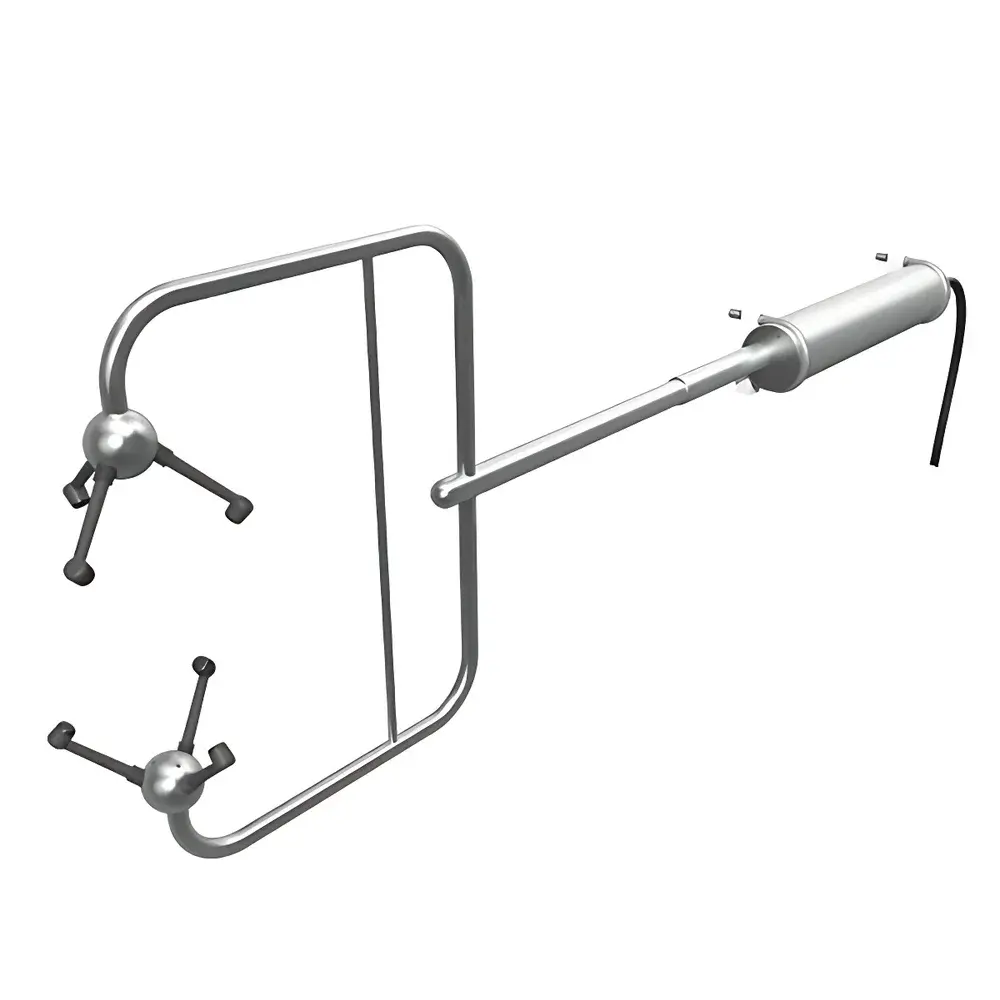
GILL WindMaster HS 3D Horizontal Ultrasonic Anemometer
| Brand | GILL |
|---|---|
| Origin | United Kingdom |
| Model | WindMaster HS |
| Instrument Type | Ultrasonic Anemometer |
| Resolution | 0.01 m/s |
| Measurement Range | 0–45 m/s |
| Accuracy | <1.5% RMS @ 12 m/s |
| Operating Temperature | −40 °C to +70 °C |
| Relative Humidity | 5–100% RH |
| IP Rating | IP65 |
| Output Frequency | Up to 32 Hz |
| Ultrasonic Temperature Range | −40 °C to +70 °C |
| Wind Direction Accuracy | 2° @ 12 m/s (standard), 0.5° @ 12 m/s (customizable) |
| Sonic Temperature Resolution | 0.01 °C |
| Sound Speed Accuracy | < ±0.5% @ 20 °C |
| Sampling Frequency | 20 Hz or 32 Hz (user-selectable) |
| Analog I/O | 4-channel 14-bit ADC (input/output configurable) |
| Digital Interface | RS-232/422/485, ASCII or binary protocol, baud rate 2400–57600 |
| Power Supply | 9–30 VDC, 55 mA @ 12 VDC |
| Dimensions | 956 × 347 × 120 mm |
| Weight | 2.96 kg |
Overview
The GILL WindMaster HS is a high-precision, three-dimensional horizontal ultrasonic anemometer engineered for rigorous atmospheric research and environmental monitoring applications requiring traceable, turbulence-resolving wind vector data. Unlike conventional vertical-axis ultrasonic sensors, the WindMaster HS employs a patented horizontal transducer array architecture—positioning all four ultrasonic transducers in a coplanar, cross-shaped configuration parallel to the ground plane. This design minimizes flow distortion caused by sensor mast interference and significantly reduces wake-induced measurement bias at high angles of attack, making it especially suitable for eddy covariance (EC) flux measurements, boundary layer studies, and offshore wind profiling where aerodynamic fidelity is critical. The instrument operates on the time-of-flight principle: ultrasonic pulses are transmitted and received between opposing transducer pairs along orthogonal X, Y, and Z axes; wind velocity components (U, V, W) are calculated from differential transit times with sub-millisecond timing resolution. Simultaneously, sonic temperature is derived from the mean speed of sound across all paths, providing a fast-response, non-contact thermal metric fully synchronized with wind vector acquisition.
Key Features
- Horizontal transducer geometry optimized to reduce flow shadowing and improve angular response up to ±60° incidence
- High temporal resolution: configurable internal sampling at 20 Hz or 32 Hz, with user-defined output frequencies (1–32 Hz)
- Stainless steel housing rated IP65 for long-term outdoor deployment in harsh coastal, arctic, and industrial environments
- Integrated 14-bit analog I/O subsystem supporting four programmable input/output channels (0–20 mA, 4–20 mA, ±5 V, etc.) for seamless integration with SCADA, data loggers, or control systems
- Simultaneous output of orthogonal wind components (U, V, W), wind speed & direction (polar format), sonic temperature, and sound speed—all time-stamped and phase-aligned
- Low-power operation (55 mA @ 12 VDC) compatible with solar/battery-powered remote stations
- Factory-calibrated traceability to NPL (UK National Physical Laboratory) standards; optional NIST-traceable recalibration services available
Sample Compatibility & Compliance
The WindMaster HS is designed for continuous, unattended operation across diverse environmental regimes—from polar research stations (−40 °C) to desert meteorological towers (+70 °C) and marine platforms exposed to salt-laden humidity (5–100% RH, 300 mm/hr rainfall tolerance). Its mechanical construction complies with BS EN 61000-6-2 (EMC immunity) and BS EN 61000-6-3 (EMC emissions), ensuring stable performance in electrically noisy infrastructure environments. While not intrinsically safe, the unit meets CE marking requirements for environmental instrumentation and supports configuration for GLP-compliant data acquisition when paired with audit-trail-enabled logging systems. It is routinely deployed in networks adhering to WMO Guide to Meteorological Instruments and Methods of Observation (CIMO Guide) and serves as a reference-grade sensor in EC systems validated per AmeriFlux and ICOS protocols.
Software & Data Management
Data output is supported via ASCII or binary serial protocols over RS-232/422/485 interfaces (2-wire point-to-point mode enabled), with configurable baud rates (2400–57600 bps) and framing options. The instrument supports real-time streaming of raw transit times or processed vectors, enabling low-latency ingestion into MATLAB, Python (via PySerial or custom drivers), or commercial platforms including Campbell Scientific LoggerNet, CRBasic, and EddyPro. Firmware updates and parameter configuration are performed via terminal emulation or GILL’s proprietary WindSoft utility (Windows-based). All outputs include embedded timestamps aligned to internal quartz oscillator (±1 ppm stability), and users may define averaging intervals from 0 to 3600 seconds post-acquisition. For regulatory environments, the system can be integrated into 21 CFR Part 11–compliant architectures through external validation of data chain integrity and electronic signature workflows.
Applications
- Eddy covariance flux towers for CO₂, H₂O, CH₄, and energy balance studies (e.g., FLUXNET, NEON, LTER networks)
- Structural health monitoring of bridges, tall buildings, and wind turbine nacelles under dynamic loading conditions
- Offshore meteorological masts and floating LiDAR support buoys requiring minimal mast-induced turbulence error
- Urban boundary layer mapping and dispersion modeling in complex terrain
- Air quality monitoring networks requiring co-located wind vector and temperature for plume trajectory analysis
- Calibration reference for cup-and-vane anemometers and Doppler lidar systems
FAQ
What distinguishes the WindMaster HS from vertically oriented ultrasonic anemometers?
The horizontal transducer layout eliminates vertical support structure interference directly upstream of the sensing volume, reducing flow acceleration artifacts and improving accuracy at elevated pitch/yaw angles—critical for EC applications.
Can the WindMaster HS operate in icing conditions?
While not heated, its IP65-rated enclosure and stainless steel construction resist corrosion and mechanical stress from light rime ice; however, sustained freezing precipitation requires supplemental heating or site-specific mitigation per IEC 61400-12-1 Annex D guidelines.
Is NIST-traceable calibration documentation provided with shipment?
Standard units include UKAS-accredited calibration certificates traceable to NPL; NIST-traceable reports are available upon request with additional lead time and fee.
How is synchronization achieved when integrating with other sensors (e.g., gas analyzers, IRGA)?
The WindMaster HS supports hardware trigger input and PPS (pulse-per-second) output for external clock alignment, ensuring sub-sample temporal coherence across multi-sensor EC systems.
Does the instrument support Modbus RTU or SDI-12 communication protocols?
No—native communication is limited to ASCII/binary serial over RS-232/422/485; Modbus or SDI-12 interoperability requires an external protocol converter or gateway device.
Related Products







