
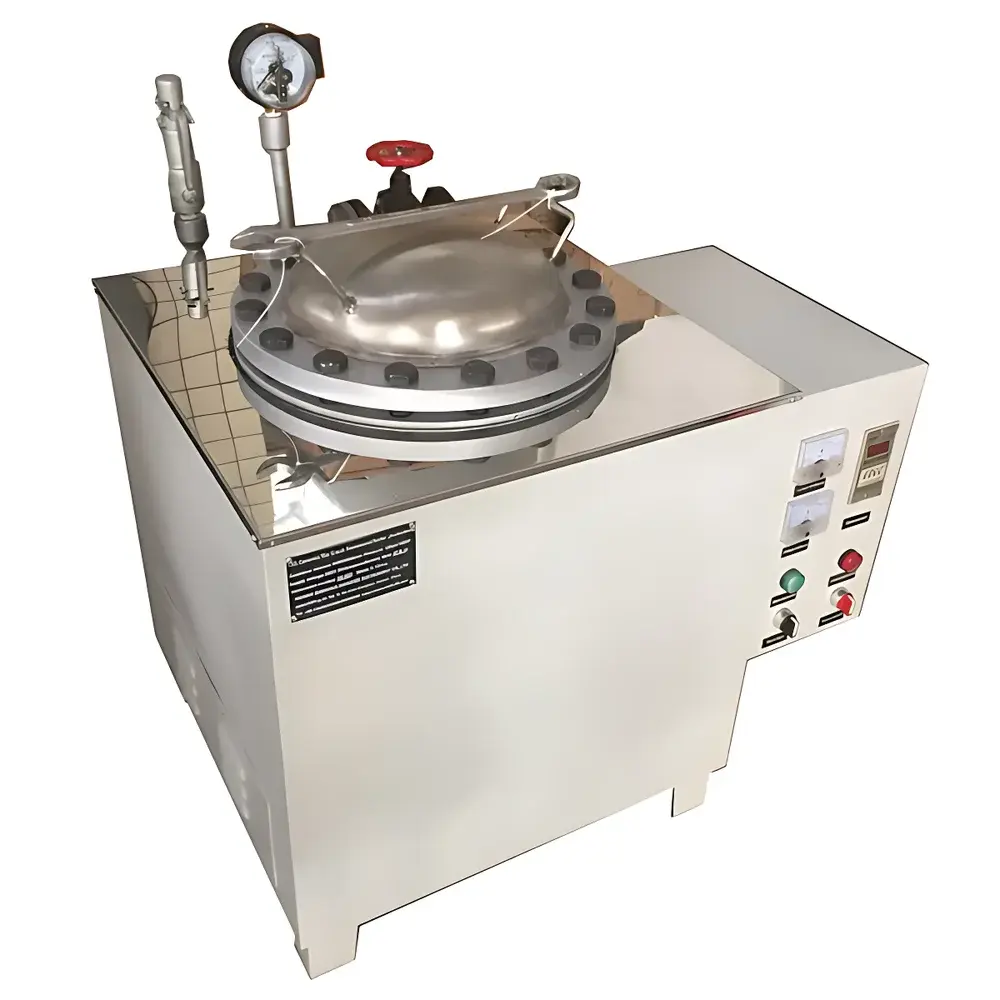
Ceramic Tile Anti-Crazing Test Autoclave (TKL Series)
| Origin | Hunan, China |
|---|---|
| Manufacturer Type | Authorized Distributor |
| Regional Origin | Domestic (China) |
| Model | TKL |
| Voltage | 380 V AC, 2-phase or 3-phase 4-wire |
| Power Rating | 6 kW / 9 kW |
| Chamber Dimensions | Φ300 × 300 mm or Φ500 × 500 mm (custom sizes available) |
| Maximum Rated Pressure | 1 MPa |
| Pressure Control Accuracy | ±20 kPa |
| Control System | Solid-state contactless pressure holding with digital timer setting |
| Compliance | GB/T 3810.11–2006 |
Overview
The TKL Series Ceramic Tile Anti-Crazing Test Autoclave is a precision-engineered pressure testing system designed specifically for evaluating the resistance of glazed ceramic tiles to surface crazing under controlled steam-saturated thermal and mechanical stress. Based on the Couette-type autoclave principle—where saturated steam at elevated temperature and pressure induces differential thermal expansion between glaze and body—the instrument subjects specimens to standardized hydrothermal loading conditions per GB/T 3810.11–2006. This method replicates long-term environmental aging effects in accelerated form, enabling reliable prediction of glaze-body compatibility and structural integrity in real-world applications such as flooring, façades, and wet-area installations. The unit operates within a rigorously defined pressure envelope (0–1 MPa), with thermodynamic stability maintained via electric immersion heating and closed-loop pressure regulation. Its robust stainless-steel pressure vessel architecture ensures long-term dimensional stability and corrosion resistance during repeated sterilization-grade steam cycles.
Key Features
- Two standard chamber configurations: Φ300 × 300 mm and Φ500 × 500 mm—optimized for single-layer tile stacks up to ISO 10545-11 specimen dimensions (200 × 200 mm); custom chambers available for high-throughput lab or QC line integration.
- Electric heating system with dual power options (6 kW or 9 kW) enables rapid steam generation and precise temperature ramp control (typical saturation temperature range: 100–180 °C at corresponding pressures).
- Digital pressure setpoint interface with solid-state zero-contact pressure-holding circuitry eliminates mechanical relay wear and ensures stable dwell conditions over extended test durations (up to 24 h).
- Integrated safety architecture includes ASME-compliant rupture disc, spring-loaded safety valve calibrated to 1.1 MPa, and redundant overpressure cut-off via electro-mechanical pressure switch.
- Front-panel mounted electric contact pressure gauge with analog + digital dual readout provides real-time verification traceable to national metrological standards.
- Industrial-grade PLC-based controller supports programmable multi-step profiles (e.g., ramp-hold-cool sequences), event logging, and manual override for process validation and failure mode analysis.
Sample Compatibility & Compliance
The TKL autoclave accommodates standard ceramic tile specimens conforming to ISO 10545-1 through ISO 10545-13, including both vitrified and semi-vitreous glazed products. Specimen loading follows GB/T 3810.11–2006 requirements: tiles are stacked dry (no interlayer spacers), placed centrally in the chamber, and subjected to uniform radial steam exposure. The system meets mandatory mechanical safety provisions of GB 150.1–2011 (Pressure Vessels) and electrical safety compliance per GB/T 5226.1–2019 (Electrical Equipment of Machines). While primarily certified for Chinese national standards, its operational envelope aligns with equivalent clauses in ASTM C1027 (Standard Test Method for Determining the Resistance of Glazed Ceramic Tiles to Crazing) and EN 1042 (Ceramic Tiles — Determination of Resistance to Thermal Shock and Crazing), supporting international lab accreditation workflows including CNAS and ILAC-MRA.
Software & Data Management
The TKL series includes an optional PC-based data acquisition module compliant with GLP/GMP documentation requirements. This module records time-stamped pressure, temperature, and cycle status events at user-defined intervals (1 s to 60 s resolution), generating CSV- and PDF-formatted audit trails with embedded digital signatures. All logged data include metadata such as operator ID, calibration certificate number, and equipment serial ID—enabling full traceability under FDA 21 CFR Part 11 and ISO/IEC 17025:2017 clause 7.7. The system supports export to LIMS platforms via OPC UA protocol and retains local storage for ≥10,000 test cycles without external memory dependency.
Applications
- Quality assurance testing of glazed ceramic tiles prior to batch release in manufacturing facilities.
- R&D evaluation of new glaze formulations, frit compositions, and firing schedules for improved thermal expansion matching.
- Third-party certification testing for CE marking, CCC certification, and export compliance (e.g., GCC, BIS, SASO).
- Failure analysis of field-reported crazing incidents by replicating suspected service conditions (e.g., freeze-thaw cycling combined with steam exposure).
- Validation of tile adhesion systems under humidified elevated-pressure environments per EN 12004 Annex A.
FAQ
What standards does the TKL autoclave comply with?
It is fully aligned with GB/T 3810.11–2006 and mechanically certified per GB 150.1–2011. Its operating parameters also satisfy functional equivalency with ASTM C1027 and EN 1042.
Can the chamber be customized for non-standard tile sizes?
Yes—custom cylindrical or rectangular pressure vessels can be fabricated upon request, subject to ASME Section VIII Div. 1 design review and hydrostatic test certification.
Is remote monitoring supported?
With the optional DAQ module, real-time pressure/temperature telemetry and alarm notifications are available via Ethernet or RS-485 Modbus RTU.
How often does the pressure sensor require recalibration?
Annual calibration is recommended; the integrated electric contact gauge includes NIST-traceable calibration certificate valid for 12 months from date of commissioning.
Does the system support automated pass/fail reporting?
Yes—the software module generates ISO/IEC 17025-compliant test reports with automatic evaluation against pass thresholds defined in GB/T 3810.11–2006 Annex B.



