
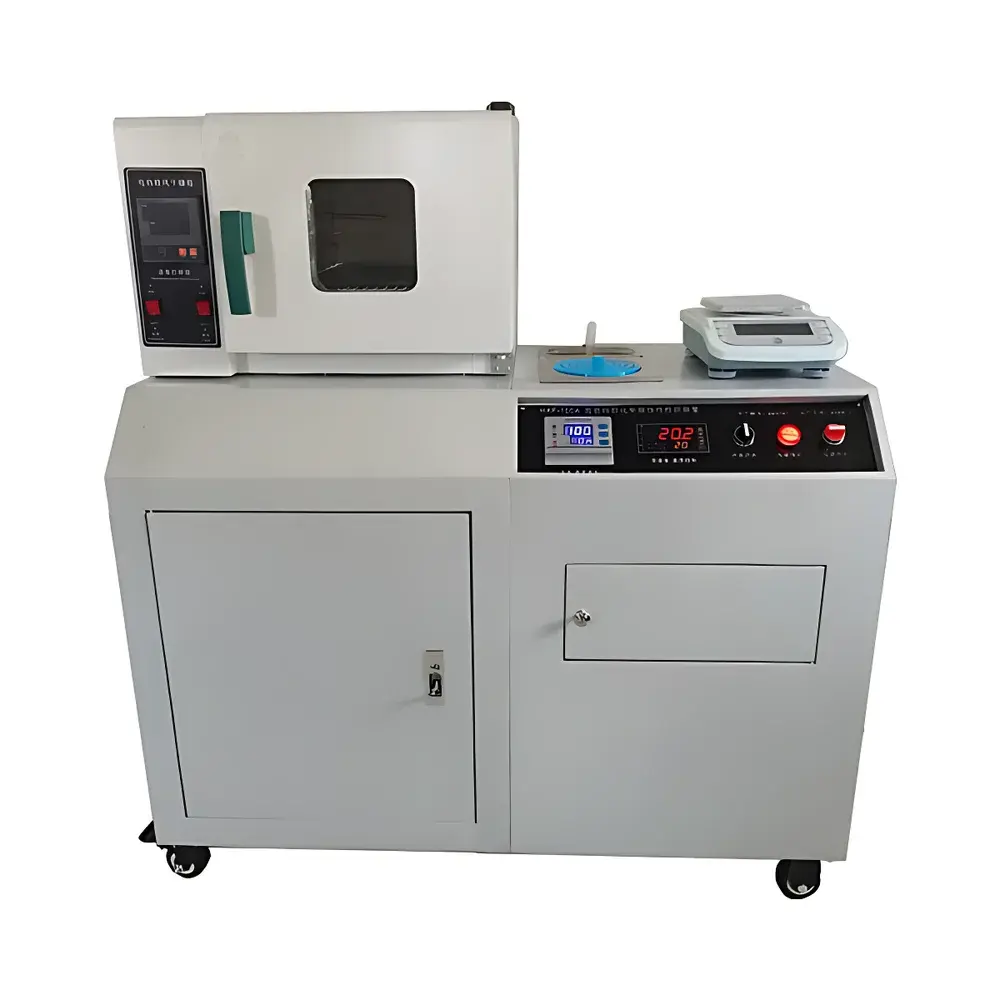
Ceramic Tile Chemical Resistance Testing System HXF-100A
| Origin | Hunan, China |
|---|---|
| Manufacturer Type | Authorized Distributor |
| Origin Category | Domestic (PRC) |
| Model | HXF-100A |
| Price | Upon Request |
| Chemical Reagent | NH₄Cl solution (100 g/L) |
| Reaction Vessel | Borosilicate Glass, 10 L (ISO 3585 compliant) |
| Drying Oven | 350 × 350 × 350 mm stainless steel chamber, 110 °C ± 5 °C |
| Rinse Tank | 10 L capacity, φ16 mm flush valve, municipal water pressure |
| Timer Control | Programmable date-based automation |
| Specimen Size | 50 mm × 50 mm |
| Analytical Balance | 2000 g / 0.01 g resolution |
| Power Supply | 220 V / 50 Hz, <1000 W |
| Illumination Source | 40 W white reflectance lamp |
| Test Duration | 17 days |
| Compliance | GB/T 3810.13, ISO 10545-13 |
| Reporting | Automated grade classification per GB/T 3810.13 Annex A |
Overview
The HXF-100A Ceramic Tile Chemical Resistance Testing System is an engineered platform designed for standardized assessment of ceramic tile surface integrity under prolonged exposure to aggressive chemical environments. It operates on the principle of controlled immersion and cyclic exposure—per ASTM C242 and ISO 10545-13—where specimens undergo static immersion in defined reagent solutions (e.g., 100 g/L ammonium chloride), followed by regulated drying, rinsing, and visual/photometric evaluation. The system replicates real-world service conditions encountered in laboratories, hospitals, food processing facilities, and public infrastructure where acid-, alkali-, or salt-induced glaze degradation may compromise slip resistance, aesthetic stability, or hygienic performance. Unlike generic corrosion test chambers, the HXF-100A integrates purpose-built borosilicate glass reaction vessels (ISO 3585 certified), temperature-stabilized drying ovens, and calibrated illumination for consistent visual grading—ensuring metrological traceability across sequential test cycles.
Key Features
- Borosilicate glass reaction vessel (10 L capacity, ISO 3585-compliant) for inert containment of corrosive media and long-term optical clarity during observation
- Stainless steel drying oven (350 × 350 × 350 mm internal volume) with PID-controlled heating to maintain 110 °C ± 5 °C throughout 17-day test sequences
- Dedicated rinse tank (10 L) with φ16 mm brass flush valve and standardized municipal water pressure delivery for repeatable post-immersion cleaning
- Programmable timer module enabling fully autonomous execution of multi-stage protocols—including immersion duration, drying intervals, and rinse frequency—based on calendar-date scheduling
- Integrated 40 W white reflectance lamp mounted above specimen viewing zone to ensure uniform illumination (≥300 lux at sample plane) per GB/T 3810.13 visual assessment requirements
- Built-in support for 50 mm × 50 mm tile specimens cut to ISO 10545-13 dimensional tolerances, with optional alignment jigs for reproducible positioning
- Compatible with analytical balance (2000 g / 0.01 g resolution) for mass loss quantification—enabling supplementary gravimetric analysis alongside visual rating
Sample Compatibility & Compliance
The HXF-100A accommodates glazed and unglazed ceramic tiles, porcelain stoneware, and vitrified floor/wall tiles conforming to EN 14411, ISO 13006, and GB/T 4100. Specimens must be free of edge chipping, microcracks, or pre-existing surface contamination prior to testing. All operational parameters—including reagent concentration (100 g/L NH₄Cl), temperature setpoints, dwell times, and lighting geometry—strictly adhere to the procedural mandates of ISO 10545-13:2014 and its national adoption GB/T 3810.13–2016. The system supports full audit trails when paired with GLP-compliant laboratory documentation practices and satisfies evidentiary requirements for CE-marking technical files, CCC certification submissions, and third-party verification reports issued under ISO/IEC 17025-accredited laboratories.
Software & Data Management
The HXF-100A operates as a hardware-controlled analog-digital hybrid platform: while core timing and thermal regulation are managed via embedded microcontroller firmware, data capture and reporting rely on external laboratory information management systems (LIMS) or validated spreadsheet templates. Users record initial mass, post-test mass, visual grade (A–E per GB/T 3810.13 Table A.1), and photographic evidence using calibrated digital imaging equipment. The system’s design enables full compliance with FDA 21 CFR Part 11 when integrated with electronic signature-capable LIMS platforms that enforce user authentication, change logging, and version-controlled report generation. No proprietary software is bundled; instead, the device provides standardized I/O interfaces (RS-232, dry-contact relay outputs) for integration into existing QA/QC workflows.
Applications
- Pre-market validation of ceramic tile formulations for healthcare facility flooring subject to frequent disinfectant exposure (e.g., sodium hypochlorite, quaternary ammonium compounds)
- Quality conformance testing of export-grade tiles destined for Middle Eastern or Southeast Asian markets where high ambient humidity accelerates salt efflorescence and glaze leaching
- Root cause analysis of field failures involving discoloration, crazing, or gloss loss in commercial kitchens or pharmaceutical cleanrooms
- Supporting ISO 9001:2015 clause 8.5.1 (control of production and service provision) through documented, repeatable test execution
- Training and inter-laboratory proficiency testing for tile inspection technicians under CNAS accreditation programs
FAQ
What standards does the HXF-100A directly support?
The system is configured to execute test procedures specified in ISO 10545-13:2014 and GB/T 3810.13–2016 without modification.
Can the system accommodate alternative reagents beyond ammonium chloride?
Yes—vessel geometry and material compatibility permit substitution with sulfuric acid (1% v/v), sodium hydroxide (1% w/v), or acetic acid (5% v/v) per ISO 10545-13 Annex B, provided users validate concentration accuracy and temperature stability independently.
Is the drying oven suitable for weight-loss measurements over extended cycles?
The oven’s thermal uniformity (±5 °C) and stainless steel construction meet ISO 10545-13 requirements for mass stabilization; however, final gravimetric readings must be performed in a climate-controlled weighing room per ISO/IEC 17025.
Does the system include calibration certificates for critical components?
Borosilicate glass vessels carry ISO 3585 certification; temperature sensors are supplied with factory calibration data. End-user periodic verification against NIST-traceable references is required per ISO/IEC 17025 Clause 6.5.
How is visual grading objectively enforced during evaluation?
Grading follows the five-tier scale (A–E) defined in GB/T 3810.13 Annex A, supported by standardized viewing distance (500 mm), illumination (>300 lux), and comparison against reference image sets archived per laboratory SOPs.






