
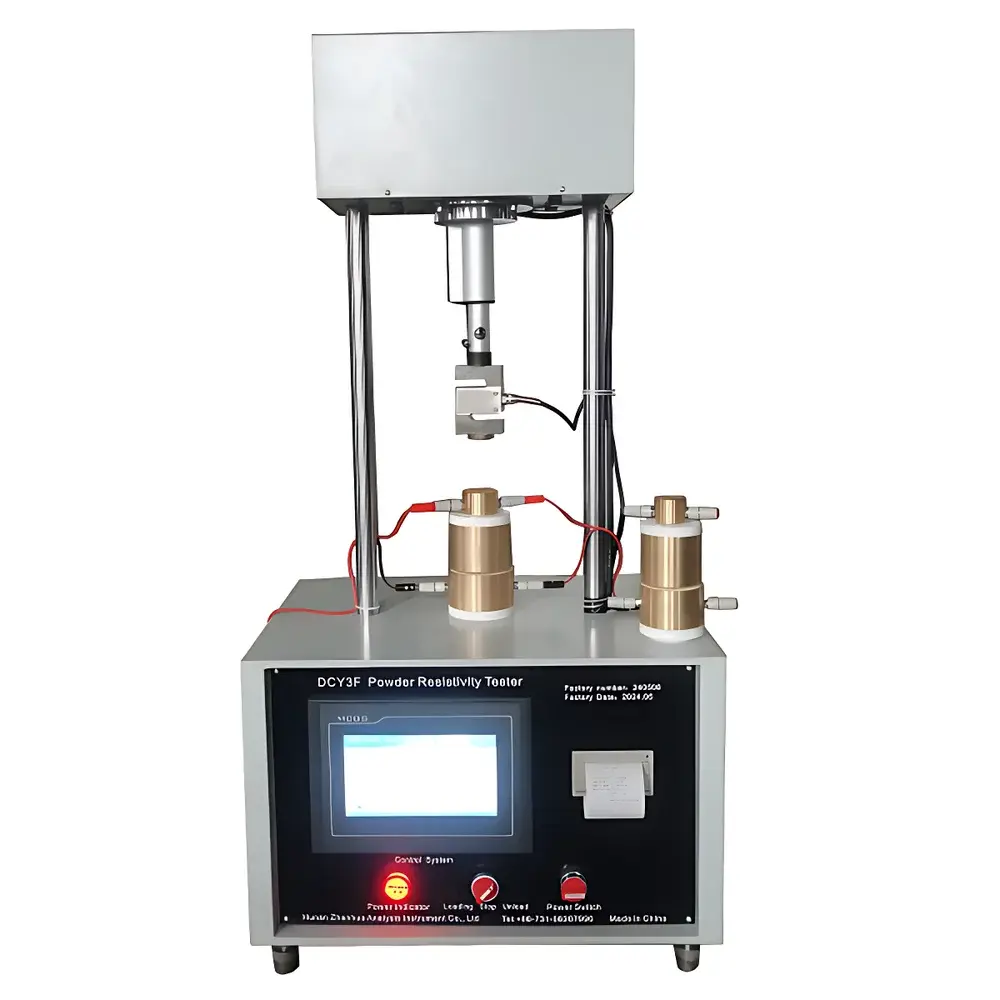
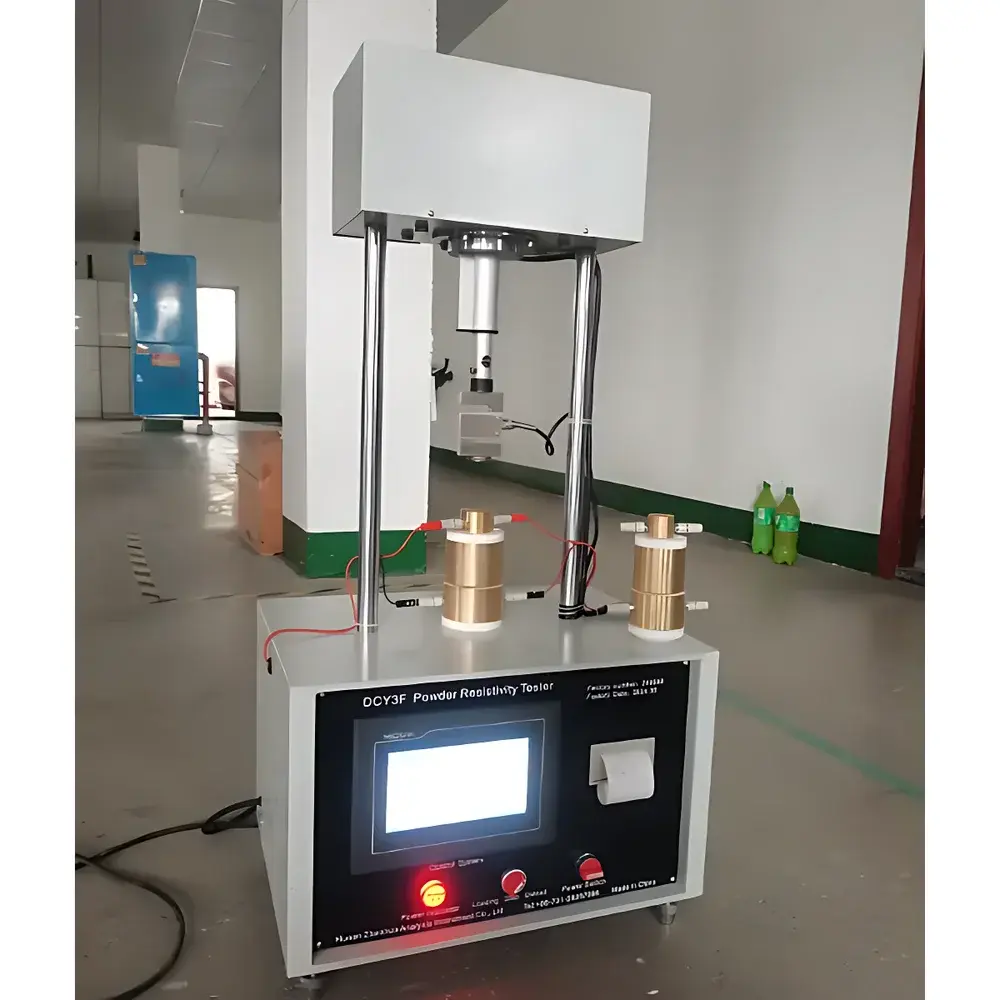
ZHENHUAFENXI DCY3F Powder Resistivity Tester
| Brand | ZHENHUAFENXI |
|---|---|
| Origin | Hunan, China |
| Manufacturer Type | Authorized Distributor |
| Country of Origin | China |
| Model | DCY3F |
| Pricing | Available Upon Request |
| Max. Applied Force | 300 kg |
| Max. Piston Stroke | 100 mm |
| Current Output Range | 0–5 A (±0.01 A) |
| Voltage Measurement Range | 0–200 mV (±0.01 mV) |
| Sample Tube Inner Diameter | ≥20 mm (small), ≥30 mm (large) |
| Cross-sectional Area | ≥314 mm² (small), ≥700 mm² (large) |
| Electrode Spacing | 10 mm (small tube), 20 mm (large tube) |
| Resistivity Measurement Range | 1–1800 µΩ·m |
| Compliance | ISO 10143:1995, YS/T 587.6 |
Overview
The ZHENHUAFENXI DCY3F Powder Resistivity Tester is a precision-engineered instrument designed for the quantitative determination of electrical resistivity in granular and powdered conductive materials—primarily carbon-based compounds such as graphite powders, carbon black, electrode pastes, and metallurgical coke fines. It operates on the four-terminal (Kelvin) measurement principle, eliminating lead resistance and contact potential errors to ensure high reproducibility in bulk resistivity evaluation. The system applies controlled uniaxial compaction via a hydraulic loading mechanism with a maximum force of 300 kg, enabling standardized densification prior to resistivity measurement—a critical requirement for ISO 10143:1995 and YS/T 587.6 compliance. Unlike conventional two-point probes, this tester integrates fixed-spacing voltage sensing electrodes (10 mm or 20 mm apart depending on tube configuration) and current-injection terminals, ensuring consistent geometric factor application across sample batches.
Key Features
- Hydraulic loading system with large transmission ratio for smooth, vibration-free compaction up to 300 kg; eliminates mechanical shock and ensures uniform powder densification.
- High-stability constant-current source (0–5 A, resolution ±0.01 A) paired with low-noise millivolt measurement circuitry (0–200 mV, resolution ±0.01 mV) for accurate voltage drop detection across compacted samples.
- Dual-sample tube configuration: interchangeable small-bore (≥20 mm ID, ≥314 mm² cross-section) and large-bore (≥30 mm ID, ≥700 mm² cross-section) stainless-steel cylinders, supporting wide particle size and density ranges.
- Integrated touch-screen control interface with embedded data acquisition firmware—automates pressure ramping, current application, voltage sampling, resistivity calculation, and result logging.
- Onboard resistivity computation engine referencing standardized geometric factors per tube dimensions; includes quick-reference lookup tables aligned with ISO 10143 Annex B for immediate interpretation without external software.
- Robust mechanical architecture with calibrated load cell feedback and real-time force monitoring, supporting GLP-aligned documentation of compaction history per test cycle.
Sample Compatibility & Compliance
The DCY3F is validated for use with dry, free-flowing, non-fibrous powders exhibiting particle sizes between 1 µm and 1 mm. It accommodates both fine carbon blacks and coarse calcined anthracite fractions, provided material flow characteristics permit homogeneous packing under applied load. All measurements conform to the procedural requirements of ISO 10143:1995 “Carbonaceous materials for the production of aluminium — Determination of the specific electrical resistivity of carbonaceous raw materials” and YS/T 587.6 “Test methods for carbonaceous materials used in aluminium industry — Part 6: Determination of specific electrical resistivity”. The instrument’s mechanical design—including electrode spacing tolerance, cylinder dimensional repeatability, and force calibration traceability—supports audit readiness for internal quality systems aligned with ISO/IEC 17025 and GMP-relevant documentation workflows.
Software & Data Management
Data handling is performed entirely within the embedded ARM-based controller running a deterministic real-time OS. Each test sequence captures timestamped records of applied force, current magnitude, measured voltage, calculated resistivity, and operator ID (if enabled). Results are exportable via USB 2.0 to CSV format for integration into LIMS or statistical process control platforms. While the system does not implement FDA 21 CFR Part 11 electronic signature functionality natively, audit trail logs—including parameter changes, calibration events, and test initiation—can be exported and archived to meet basic GLP record retention requirements (minimum 5 years). Optional RS-485 Modbus RTU interface enables integration into centralized SCADA environments for multi-instrument monitoring.
Applications
- Quality control of carbon anode raw materials in primary aluminium smelting facilities.
- R&D screening of conductive filler dispersion efficiency in battery electrode slurry formulations.
- Batch-to-batch consistency verification of synthetic graphite powders used in lithium-ion battery anodes.
- Process validation of thermal treatment effects on graphitization degree via resistivity correlation.
- Technical specification verification for carbon brushes, furnace electrodes, and EDM graphite grades.
- Teaching laboratories requiring hands-on demonstration of powder compaction physics and transport property relationships.
FAQ
What standards does the DCY3F comply with?
ISO 10143:1995 and YS/T 587.6 are fully supported through hardware geometry, force control accuracy, and measurement methodology.
Can the instrument measure insulating or semi-conductive powders?
No—it is optimized for conductive carbonaceous materials with resistivity ≤1800 µΩ·m; samples exceeding this range fall outside its calibrated operating envelope.
Is calibration traceable to national metrology institutes?
Force transducers and electrical modules are factory-calibrated using NIST-traceable references; users receive calibration certificates with each unit.
How is sample height variation compensated during measurement?
The system uses fixed electrode spacing—no height correction is applied. Consistent sample volume is ensured by controlling mass and compaction force per standard method.
Does the instrument support automated reporting with company branding?
Report templates are fixed-format; custom header/footer branding requires post-export editing in spreadsheet software.



