
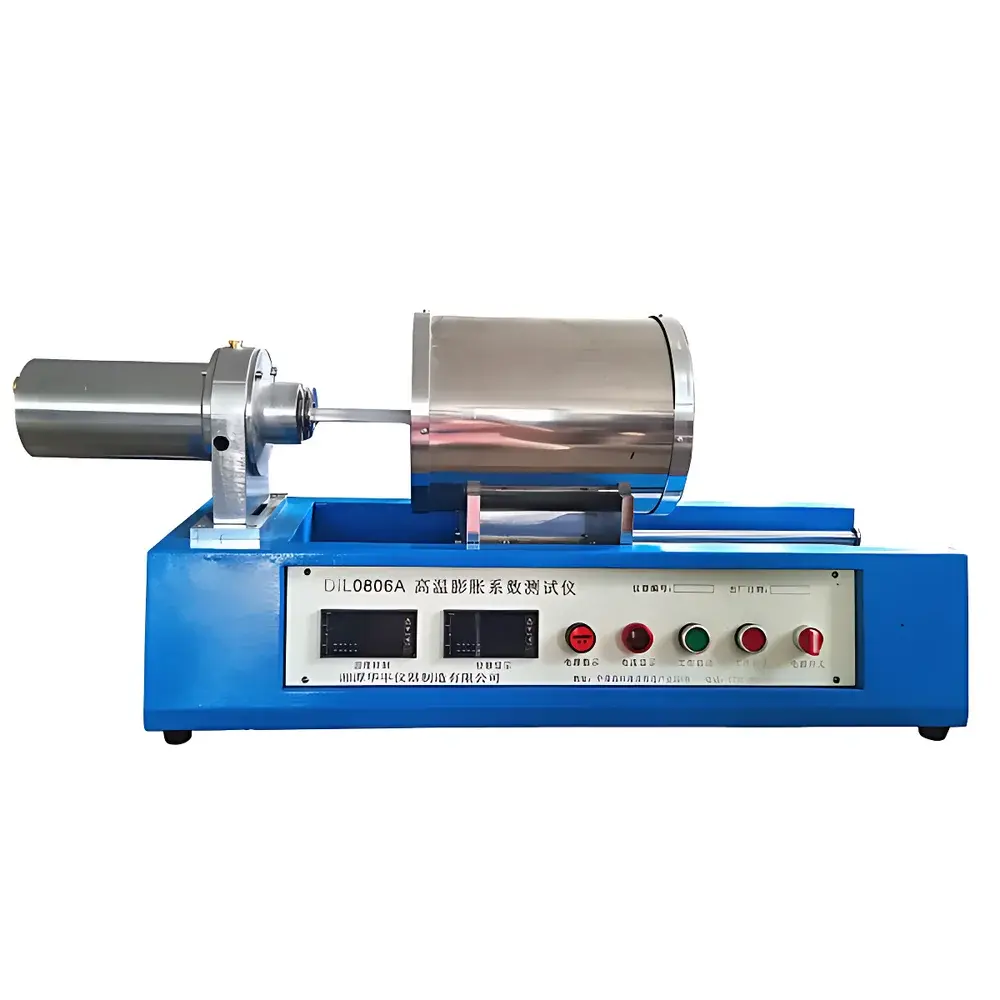
ZHENHUAFENXI DIL0806A High-Temperature Dilatometer
| Brand | ZHENHUAFENXI |
|---|---|
| Origin | Hunan, China |
| Model | DIL0806A |
| Temperature Range | RT–1000 °C |
| Heating Rate | 0–20 °C/min |
| Temperature Accuracy | ±0.1 °C |
| Sample Dimensions | 10 mm × 50 mm |
| Atmosphere Compatibility | Inert, Oxidizing, Reducing Gases |
| Measurement Resolution (ΔL) | 0.1 µm |
| Sample Holder Material | Fused Quartz / Alumina |
| c-DTA® Function | Optional |
| Compliance Standards | ASTM E831, ASTM D696, ASTM D3386, DIN 51045 |
Overview
The ZHENHUAFENXI DIL0806A High-Temperature Dilatometer is a precision horizontal dilatometric system engineered for the quantitative measurement of dimensional changes in solid and semi-solid materials as a function of temperature under near-zero-load conditions. It operates on the principle of contact-based linear displacement sensing—using high-stability linear variable differential transformers (LVDTs) or optical encoders—to detect minute length variations (ΔL) with sub-micrometer resolution. The instrument integrates a programmable high-temperature furnace, thermocouple-based sample proximity temperature monitoring, and optional computational Differential Thermal Analysis (c-DTA®), enabling concurrent acquisition of thermal expansion and enthalpic response data. Designed for rigorous laboratory environments, the DIL0806A supports controlled atmosphere operation—including inert (N₂, Ar), oxidizing (air, O₂), and reducing (H₂/N₂, CO) gas environments—with selectable mass flow control and pressure regulation capabilities. Its horizontal configuration ensures ergonomic sample loading, mechanical stability during thermal cycling, and consistent thermal coupling between thermocouple and specimen.
Key Features
- Horizontal furnace architecture for improved thermal uniformity, ease of sample insertion, and reduced gravitational sag effects during high-temperature testing
- Programmable heating/cooling rates from 0 to 20 °C/min, optimized per selected furnace module (RT–500 °C, RT–1200 °C, RT–1400 °C, or RT–1600 °C)
- High-resolution displacement detection with ≤0.1 µm resolution over a 500 µm or 5000 µm full-scale range
- Direct-contact thermocouple placement adjacent to the sample for enhanced temperature accuracy (±0.1 °C) and repeatability
- Modular sample holder system compatible with fused quartz and alumina crucibles; accommodates specimens up to 50 mm in length and 5–10 mm in diameter
- Optional c-DTA® functionality: derives pseudo-DTA signals from first-order derivatives of expansion curves, supporting temperature calibration and phase transition identification without additional hardware
- Rate-Controlled Sintering (RCS) algorithm embedded in software—dynamically adjusts heating rate in real time to maintain user-defined linear shrinkage velocity during densification processes
Sample Compatibility & Compliance
The DIL0806A accepts a broad spectrum of material forms: dense ceramics, metallic alloys, powder compacts, polymer composites, refractory bricks, thin films on substrates, and glass-ceramic systems. Its design accommodates irregular geometries via custom-machined grooves in tubular sample holders. All operational protocols adhere to internationally recognized thermal analysis standards, including ASTM E831 (linear thermal expansion of plastics), ASTM D696 (coefficient of linear expansion of plastics), ASTM D3386 (thermal expansion of electrical insulating materials), and DIN 51045 (dilatometry of solid materials). The system supports GLP-compliant data recording with timestamped metadata, audit-trail-enabled software logs, and user-access-level management—facilitating regulatory submissions under FDA 21 CFR Part 11 where electronic records are required.
Software & Data Management
Control and analysis are executed via a Windows-based application communicating with the instrument through USB 2.0 interface. The software provides ISO/IEC 17025-aligned workflows: automatic baseline correction, multi-segment heating profile definition, derivative curve generation (dL/dT), coefficient-of-linear-expansion (CTE) calculation across user-specified temperature intervals, and graphical overlay of multiple runs. Raw data export is supported in CSV, ASCII, and universal .tdms formats. Optional modules include RCS process scripting, c-DTA peak deconvolution, and automated report generation compliant with internal QA templates or external accreditation bodies. All measurement sessions retain full traceability—including operator ID, calibration certificate references, furnace serial number, and environmental chamber status.
Applications
This dilatometer serves critical roles in materials development and quality assurance across academia and industry. It quantifies sintering kinetics in ceramic green bodies, determines glass transition (Tg) and softening points in amorphous oxides, evaluates thermal mismatch stresses in metal-ceramic joints, characterizes anisotropic expansion in fiber-reinforced composites, and monitors phase transformation temperatures (e.g., martensitic, perovskite, or spinel transitions) via inflection analysis in dL/dT curves. In metallurgy, it supports heat treatment optimization by mapping dimensional stability during tempering or aging cycles. In battery materials research, it assesses electrode coating integrity under thermal cycling. For refractories and nuclear-grade graphite, it delivers CTE data essential for structural modeling under reactor operating conditions.
FAQ
What temperature ranges are available with the DIL0806A?
Standard configuration includes RT–1000 °C; optional furnace modules extend capability to RT–1400 °C and RT–1600 °C—quoted separately.
Is c-DTA® included as standard equipment?
c-DTA® is an optional firmware and software module; it requires no additional sensors but must be licensed and activated within the control software.
Can the instrument operate under vacuum?
The base system is configured for gas-purged or dynamic-flow atmospheres; vacuum compatibility (≤10⁻² mbar) is achievable with optional vacuum-rated furnace seals and differential pumping accessories.
How is temperature calibration verified?
Calibration is performed using NIST-traceable reference materials (e.g., α-alumina, fused quartz, or Invar), with verification documented per ASTM E831 Annex A2 procedures.
Does the software support automated pass/fail evaluation against specification limits?
Yes—custom tolerance bands can be defined per test segment; the software flags deviations in real time and generates compliance summaries in PDF or Excel format.



