
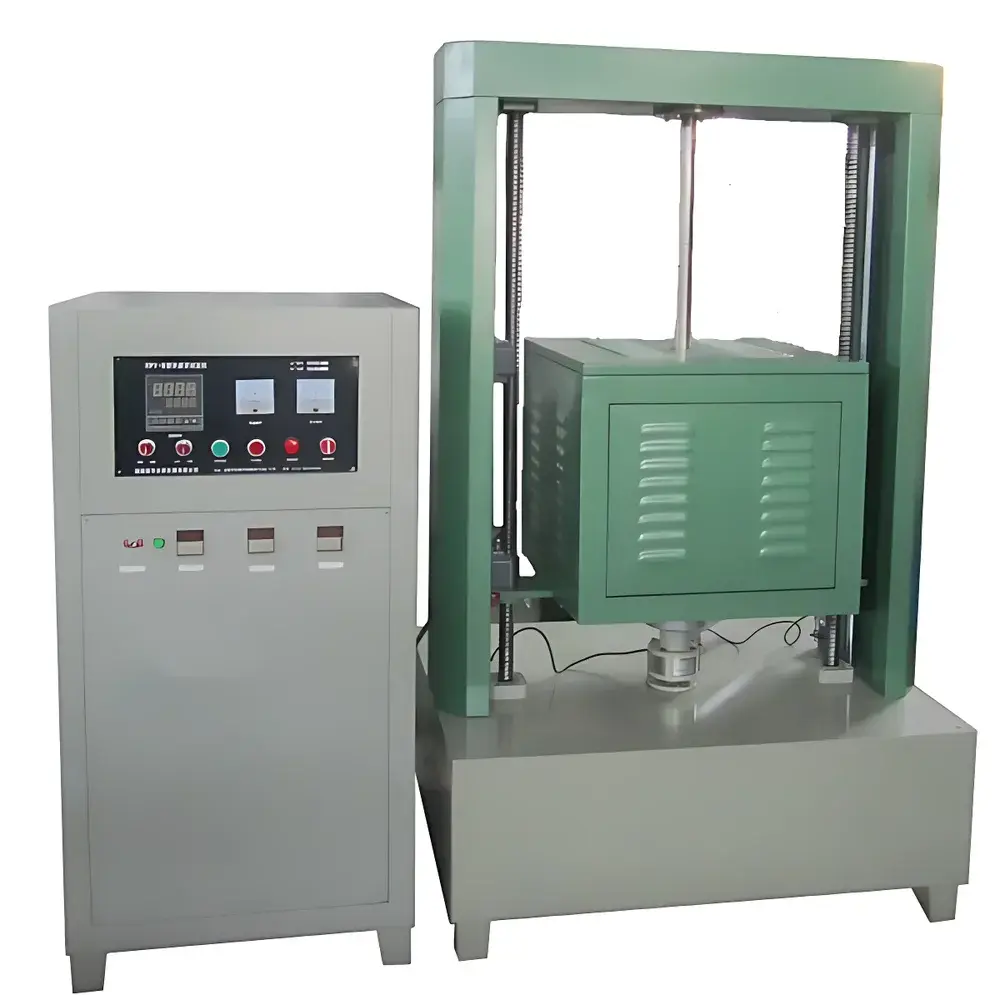
RPY-B Metal Thermal Fatigue Testing Machine
| Origin | Hunan, China |
|---|---|
| Manufacturer Type | Authorized Distributor |
| Origin Category | Domestic (China) |
| Model | RPY-B |
| Quotation | USD 9,800 (FOB) |
| Instrument Type | Thermal-Mechanical Fatigue Tester |
| Maximum Test Load | 1 kN |
| Temperature Range | Ambient to 1100 °C |
| Temperature Uniformity | ±2 °C at setpoint |
| Thermal Cycling Range | Room temperature ↔ 1100 °C |
| Heating Method | Resistance Wire (Ni-Cr Alloy) |
| Specimen Dimensions | Ø36 mm × 50 mm |
| Axial Deformation Measurement Range | 0–10 mm |
| Cooling Time per Cycle | 5–15 min |
| Power Consumption | 12 kW |
| Overall Dimensions (L×W×H) | 1200 × 650 × 1650 mm |
| Net Weight | 160 kg |
Overview
The RPY-B Metal Thermal Fatigue Testing Machine is a purpose-built electromechanical system designed to evaluate the thermomechanical fatigue (TMF) behavior of metallic components under controlled, cyclic thermal and mechanical loading. It operates on the principle of constrained thermal expansion/contraction: when a metal specimen is subjected to repeated heating and cooling cycles—while mechanically restrained or loaded—reversible and irreversible strains accumulate due to mismatched thermal expansion coefficients across microstructural phases or geometric boundaries. This induces time- and temperature-dependent stress states that drive progressive microcrack nucleation, coalescence, and eventual failure. Unlike isothermal mechanical fatigue, TMF involves coupled thermal gradients, viscoplastic deformation, oxidation-assisted crack growth, and potential phase instability—making it critical for validating components in aerospace turbine blades, exhaust manifolds, nuclear fuel cladding, and high-temperature valve bodies. The RPY-B integrates a rigid portal-frame load frame with a high-stability tubular furnace, enabling synchronized application of axial force (up to 1 kN) and precise temperature cycling (ambient to 1100 °C) under programmable ramp rates and dwell times.
Key Features
- Rigid portal-type structural frame engineered for high axial stiffness and minimal thermal drift during prolonged testing
- High-temperature tubular furnace with Ni–Cr resistance heating elements, optimized for uniform radial temperature distribution (±2 °C at 1100 °C)
- Integrated axial load actuation system with closed-loop force control, capable of applying static or cyclic loads up to 1 kN
- Digital displacement transducer with 0–10 mm measurement range and sub-micron resolution for real-time strain tracking
- Modular cooling module supporting forced-air or optional inert-gas quenching, enabling controllable cooling intervals from 5 to 15 minutes per cycle
- Industrial-grade control cabinet with embedded PID temperature controllers, overload protection, and emergency thermal cutoff
- RS-232/USB interface compliant with standard industrial communication protocols for external data acquisition and synchronization
Sample Compatibility & Compliance
The RPY-B accommodates cylindrical metallic specimens measuring Ø36 mm × 50 mm—compatible with common ASTM E1198 (Standard Practice for Thermomechanical Fatigue Testing), ISO 12106 (Metallic Materials — Fatigue Testing — Axial Strain Control Method), and GB/T 21143 (Chinese national standard for thermomechanical fatigue of metals). It supports both in-phase and out-of-phase TMF modes, where thermal and mechanical cycles are aligned or shifted by 90°–180° to simulate service-relevant stress–strain hysteresis. The furnace design conforms to IEC 60519-1 safety requirements for industrial electric heating equipment. All electrical subsystems meet CE low-voltage directive (2014/35/EU) and EMC standards (2014/30/EU). Data traceability supports GLP-compliant workflows via timestamped audit logs and user-access-controlled test profiles.
Software & Data Management
The included Windows-based testing software provides full-cycle automation: defining multi-segment thermal ramps (heating/cooling rates, dwell durations), superimposing mechanical load waveforms (sinusoidal, trapezoidal, block), and synchronizing data acquisition at configurable sampling intervals (1–100 Hz). Real-time plots display temperature vs. time, load vs. displacement, and hysteresis loops. Raw datasets are exported in CSV and HDF5 formats for post-processing in MATLAB, Python (NumPy/Pandas), or commercial FEA platforms. Software enforces role-based access control (operator, engineer, administrator), maintains electronic signatures per test record, and generates PDF reports containing metadata (test ID, operator, calibration dates, environmental conditions) compliant with FDA 21 CFR Part 11 requirements for regulated laboratories.
Applications
- Evaluation of thermal barrier coating (TBC) adhesion and interfacial cracking in Ni-based superalloys
- Qualification of austenitic stainless steels (e.g., 316H, Inconel 718) for Gen IV nuclear reactor components
- Life prediction modeling of automotive turbocharger housings under transient exhaust gas temperature profiles
- Comparative assessment of oxide dispersion strengthened (ODS) alloys versus conventional wrought alloys under thermal shock conditions
- Validation of finite element models incorporating coupled thermo-elasto-viscoplastic constitutive laws
FAQ
What is the maximum allowable thermal ramp rate supported by the RPY-B?
The system supports programmable heating rates up to 20 °C/min and cooling rates up to 15 °C/min under forced-air convection; rates may vary depending on specimen mass and ambient conditions.
Can the RPY-B perform tests under protective atmosphere?
Yes—the tubular furnace accepts optional quartz or alumina tubes with gas inlet/outlet ports, enabling tests under N₂, Ar, or forming gas (5% H₂/95% N₂) to suppress surface oxidation.
Is third-party calibration certification available?
Factory calibration certificates traceable to CNAS-accredited metrology labs are provided; optional UKAS or DAkkS-certified calibration services can be arranged upon order.
Does the software support custom scripting for advanced test sequences?
The API interface supports Python and LabVIEW integration via TCP/IP socket commands, allowing users to embed conditional logic, adaptive control loops, or machine learning–driven termination criteria.
What maintenance is required for long-term operational stability?
Recommended quarterly verification includes thermocouple calibration check, load cell zero-drift validation, furnace insulation integrity inspection, and firmware update review—all documented in the included Maintenance Logbook.
Related Products



