
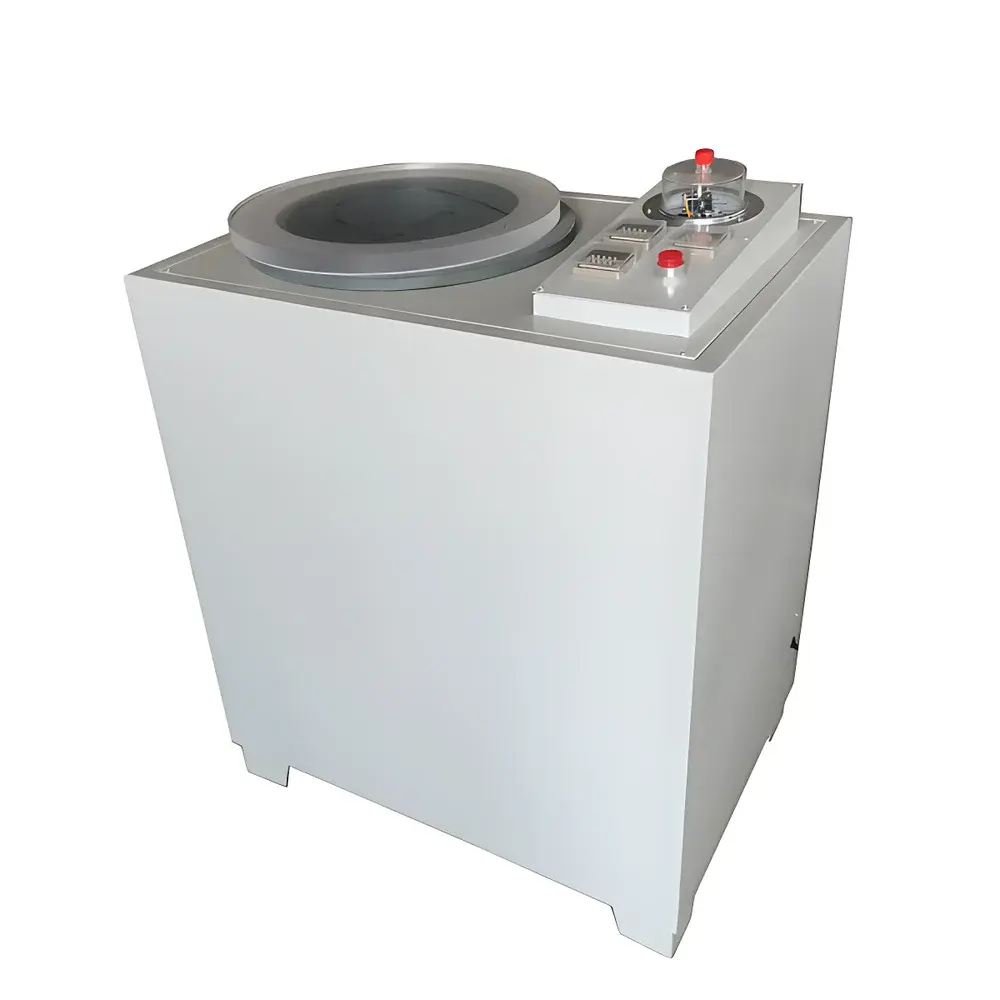
ZHENHUAFENXI TXY Ceramic Water Absorption Tester
| Brand | ZHENHUAFENXI |
|---|---|
| Origin | Hunan, China |
| Manufacturer Type | Authorized Distributor |
| Country of Origin | China |
| Model | TXY |
| Pricing | Available Upon Request |
| Immersion Time Range | 1–120 min (adjustable) |
| Water Filling Time Range | 0–99 min (adjustable) |
| Vacuum Pressure Options | –0.1 MPa (–100 kPa), 20 kPa (abs), or 10 kPa (abs) |
| Repeatability Error | <1% |
| Sample Chamber Dimensions | Ø400 × 300 mm or Ø300 × 300 mm (stainless steel or polypropylene construction |
Overview
The ZHENHUAFENXI TXY Ceramic Water Absorption Tester is a precision-engineered vacuum-based system designed for the quantitative determination of water absorption in ceramic tiles and related inorganic non-metallic materials. It operates in strict accordance with the gravimetric vacuum saturation method specified in GB/T 3810.3–2016 and ISO 10545-3, which define standardized procedures for measuring the ratio of absorbed water mass to dry specimen mass after controlled vacuum impregnation and subsequent surface-drying. The instrument employs a dual-phase process: first, evacuation of air from open pores within the specimen under regulated negative pressure; second, controlled immersion under vacuum to allow capillary-driven water ingress into the microstructure. This methodology ensures thermodynamic equilibrium between pore volume and liquid phase, enabling reproducible quantification of open porosity — a critical quality indicator for frost resistance, mechanical integrity, glaze adhesion, and long-term durability in architectural and industrial ceramics.
Key Features
- Vacuum regulation system offering three selectable absolute pressure setpoints: –100 kPa (full vacuum), 20 kPa, or 10 kPa — enabling method flexibility for low-porosity vitrified bodies versus high-porosity earthenware or refractory bricks.
- Programmable immersion timer (1–120 minutes) and water filling duration (0–99 minutes), supporting ASTM C373-compliant adaptations and internal QC protocols requiring extended saturation cycles.
- High-stability stainless steel or corrosion-resistant polypropylene sample chambers (standard Ø300 × 300 mm or Ø400 × 300 mm), with optional custom dimensions to accommodate oversized test specimens such as large-format porcelain slabs or extruded ceramic profiles.
- Digital vacuum monitoring with real-time pressure feedback and automatic cut-off logic to prevent over-evacuation or chamber overpressure during water introduction.
- Integrated safety interlocks including vacuum leak detection, lid-position sensing, and pressure-relief valve activation — compliant with IEC 61000-6-2/6-4 electromagnetic compatibility requirements for laboratory environments.
Sample Compatibility & Compliance
The TXY tester accommodates flat, irregular, or segmented ceramic specimens up to 5 kg in mass and 100 mm in thickness, provided dimensional constraints of the selected chamber are observed. It supports testing of glazed and unglazed tiles, stoneware, porcelain, refractory bricks, clay-based insulators, and sintered oxide ceramics (e.g., alumina, zirconia). All operational parameters and calibration records are traceable to national metrological standards via documented verification procedures. The instrument satisfies essential requirements for ISO/IEC 17025-accredited laboratories performing routine quality control in tile manufacturing facilities, third-party certification bodies (e.g., CNAS, ICC-ES), and R&D centers engaged in ceramic formulation development. While not inherently 21 CFR Part 11-compliant, its data output format supports integration into validated LIMS or ELN platforms where audit trails and electronic signature workflows are externally managed.
Software & Data Management
The TXY operates via an embedded microcontroller interface with tactile keypad and LCD display. No proprietary software is required for basic operation; however, ASCII-formatted test logs (including timestamp, vacuum setpoint, immersion duration, final wet/dry mass entries, and calculated absorption %) can be exported via RS-232 serial port for import into Excel, LabWare, or custom QA databases. For laboratories implementing GLP/GMP-aligned documentation practices, external weighing systems with RS-232 or USB connectivity may be synchronized using simple terminal emulation scripts to auto-populate mass inputs and minimize manual transcription errors. Calibration certificates for vacuum transducers and timers are issued annually per manufacturer-recommended maintenance intervals.
Applications
- Quality assurance of ceramic floor and wall tiles in compliance with EN 14411, ANSI A137.1, and JIS A 5208.
- Porosity evaluation of technical ceramics used in thermal barrier coatings, filtration membranes, and catalytic substrates.
- Raw material screening for clay-body formulations — correlating absorption behavior with firing shrinkage, density, and thermal expansion coefficients.
- Failure analysis of delaminated or spalled ceramic components where moisture ingress pathways must be quantified prior to SEM-EDS or XRD phase mapping.
- Research into hydrothermal aging mechanisms in heritage conservation science, particularly for historic brick and terra cotta restoration projects.
FAQ
What vacuum levels are supported, and how do they affect test results?
The TXY provides three calibrated vacuum setpoints: –100 kPa (absolute zero reference), 20 kPa, and 10 kPa. Lower absolute pressures enhance pore evacuation efficiency in highly porous bodies (e.g., quarry tiles), while higher residual pressures (e.g., 20 kPa) reduce risk of microcracking in low-porosity vitrified ceramics. Selection must align with the referenced standard or internal method validation protocol.
Can the instrument handle specimens larger than Ø400 mm?
Yes — custom chamber configurations up to Ø600 × 400 mm are available upon engineering review. Structural integrity, vacuum seal performance, and weight capacity (max. 8 kg) are verified prior to delivery.
Is calibration documentation included with shipment?
Each unit ships with a factory calibration report for vacuum sensor linearity (±0.5% FS) and timer accuracy (±0.1 s over 120 min), traceable to CNAS-accredited metrology labs in Hunan Province.
Does the system meet ISO 17025 requirements for accredited testing?
The TXY itself is not certified, but its design, verification procedures, and measurement uncertainty budget support full compliance when operated within a laboratory’s documented quality management system meeting ISO/IEC 17025:2017 Clause 6.4 and 6.5 requirements.
How is repeatability error (<1%) validated?
Repeatability is determined per ISO 5725-2 using ten consecutive measurements on a homogeneous porcelain tile reference sample (certified open porosity = 0.42 ± 0.03%), following identical vacuum and immersion parameters across all trials.



