
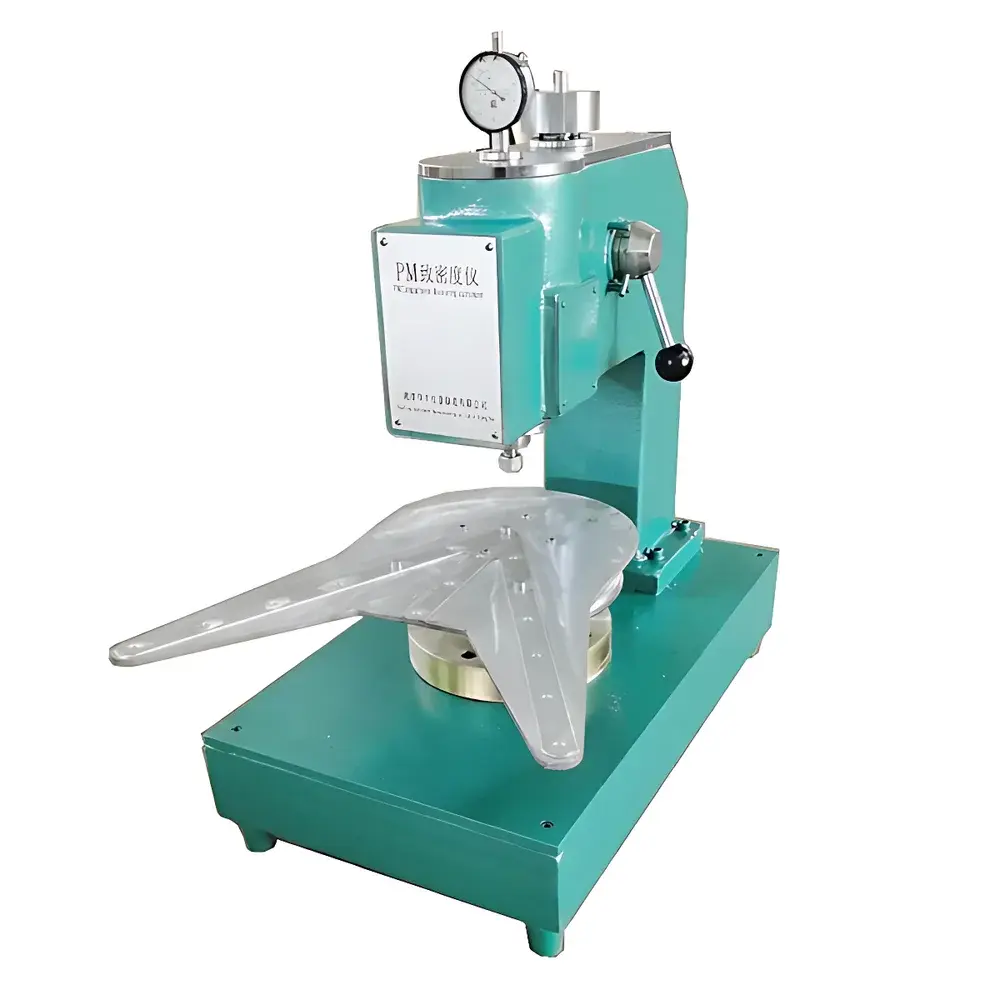
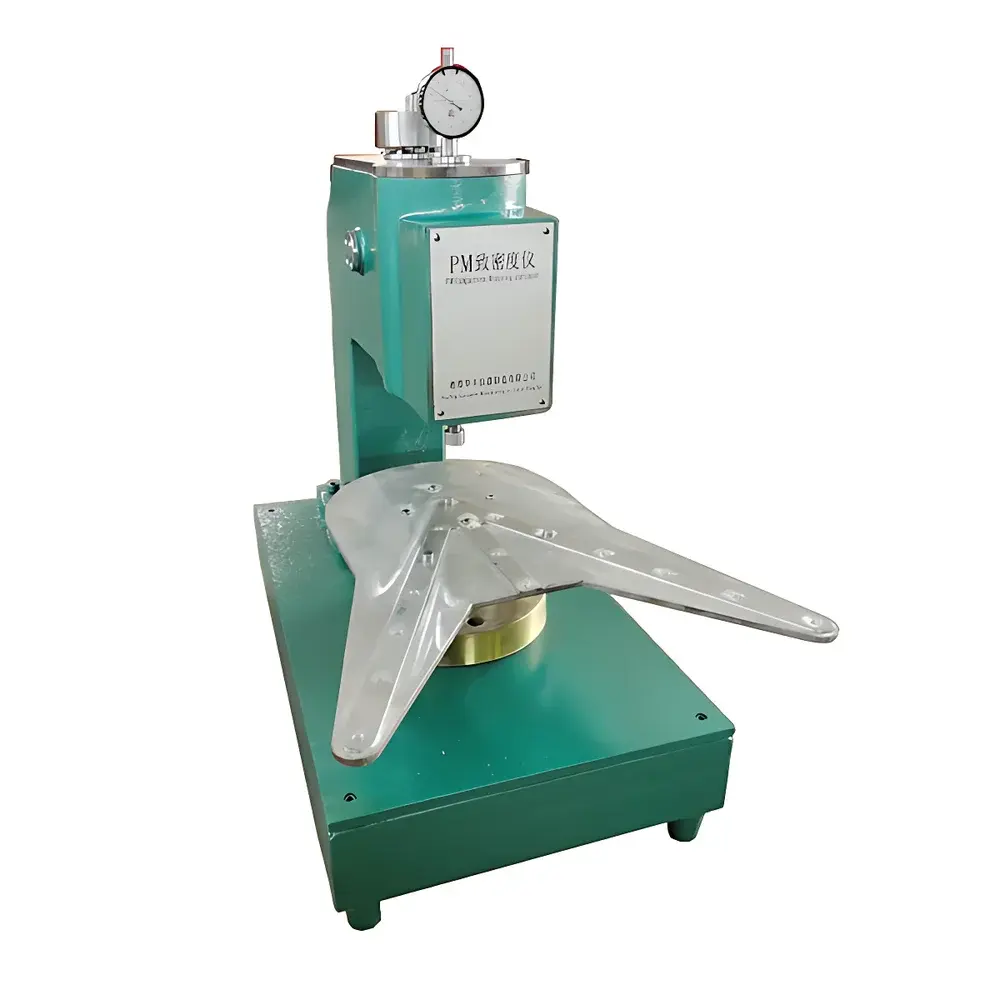
ZHENHUAFENXI PM Penetrometer for Green Density Measurement of Non-Metallic Powder Compacts
| Brand | ZHENHUAFENXI |
|---|---|
| Origin | Hunan, China |
| Model | PM |
| Instrument Type | Portable Green Density Penetrometer |
| Application | Green density evaluation of non-metallic powder compacts (e.g., ceramic, graphite, refractory preforms) |
| Penetrator Tip Diameters | Ø0.5 mm, Ø0.75 mm, Ø1.0 mm (stainless steel) |
| Maximum Penetrator Travel Distance from Worktable | ~100 mm |
| Horizontal Distance from Penetrator Axis to Machine Frame | 210 mm |
| Test Load Options | Selectable dead-weight masses (kg) |
Overview
The ZHENHUAFENXI PM Penetrometer is a purpose-built mechanical instrument engineered for the quantitative assessment of green density — the pre-sintering bulk density — of unfired non-metallic powder compacts. Unlike conventional pycnometric or gas displacement densitometers, this device operates on the principle of controlled quasi-static indentation under defined static loads, correlating penetration depth with compact resistance to deformation — a parameter empirically linked to interparticle bonding strength and relative density in green bodies. It is widely applied in ceramic, advanced refractory, graphite electrode, and technical porcelain manufacturing where precise control over green density directly influences dimensional stability, shrinkage behavior, and final sintered microstructure. The instrument complies with foundational mechanical testing conventions used in ISO 2738 (ceramic green bodies), ASTM C373 (water absorption and apparent porosity), and internal quality protocols aligned with ISO 9001-certified production environments.
Key Features
- Portable, benchtop-compatible architecture with rigid cast-iron base and vertical column assembly ensuring minimal deflection during load application.
- Selectably weighted main load system using calibrated stainless-steel dead weights, enabling precise force application ranging from 0.5 kg to 5 kg (configurable per user specification).
- Interchangeable conical needle penetrators (Ø0.5 mm, Ø0.75 mm, Ø1.0 mm) fabricated from hardened 304 stainless steel, each with standardized tip geometry per ISO 6507-1 guidelines for consistency in contact area definition.
- Manual micrometer-based depth measurement system with 0.01 mm resolution, integrated coaxially with the penetrator shaft to eliminate parallax error.
- Adjustable sample support platform with fine-height vernier adjustment (±1 mm resolution), accommodating specimens up to 100 mm in height and 80 mm in diameter.
- No electrical power requirement — fully mechanical operation ensures intrinsic safety in dusty or solvent-rich production environments and eliminates calibration drift associated with electronic transducers.
Sample Compatibility & Compliance
The PM Penetrometer is validated for use with green-state compacts of non-metallic powders including alumina, zirconia, silicon carbide, fused silica, graphite, and clay-based ceramics. Specimens must be flat-surfaced, free of surface cracks or delamination, and exhibit sufficient mechanical integrity to resist edge chipping during indentation. While not a certified metrology standard instrument, its methodology supports internal process control benchmarks traceable to reference samples calibrated via helium pycnometry (ASTM D5550). Data generated are suitable for GMP-aligned batch release documentation when paired with documented operator qualification, equipment verification logs, and periodic inter-laboratory comparison studies.
Software & Data Management
The PM Penetrometer operates without embedded firmware or proprietary software. All measurements are recorded manually in laboratory notebooks or LIMS-integrated spreadsheets. Users are advised to follow ALCOA+ principles (Attributable, Legible, Contemporaneous, Original, Accurate, Complete, Consistent, Enduring, Available) when documenting penetration depth, applied load, penetrator diameter, and ambient conditions (temperature, humidity). For regulated environments, handwritten records may be scanned and archived with time-stamped digital signatures compliant with FDA 21 CFR Part 11 when integrated into validated document management systems.
Applications
- Quality assurance of green ceramic tiles and sanitaryware prior to kiln loading.
- Process optimization of cold isostatic pressing (CIP) parameters for graphite anode blanks in battery material production.
- Batch-to-batch consistency monitoring of refractory preforms used in metallurgical linings.
- Correlation of green density with subsequent sintered density and open porosity (via ASTM C20).
- Root-cause analysis of warpage or cracking defects traced to non-uniform green density distribution.
- Validation of binder burnout schedules by tracking density gradients across cross-sections.
FAQ
Is the PM Penetrometer suitable for metallic powder compacts?
No — it is specifically designed for low-hardness non-metallic green bodies. Metallic compacts typically require higher test loads and different indenter geometries (e.g., Rockwell or Vickers), and may damage the stainless-steel needle tips or yield non-linear penetration responses.
Can penetration depth be converted directly to absolute density values?
Not without empirical calibration. The instrument provides comparative green density indices; absolute density values require correlation with reference measurements obtained via helium pycnometry or Archimedes’ principle on matched specimens.
What maintenance is required?
Annual verification of penetrator tip geometry using optical profilometry, recalibration of micrometer scale against NIST-traceable gauge blocks, and lubrication of vertical guide rails with silicone-free precision grease.
Does it meet ISO/IEC 17025 requirements?
As a mechanical comparator, it may be included within an ISO/IEC 17025-accredited scope if method validation, uncertainty budgeting, and staff competency assessments are performed per Clause 7.2 and Annex A.3 of ISO/IEC 17025:2017.



