
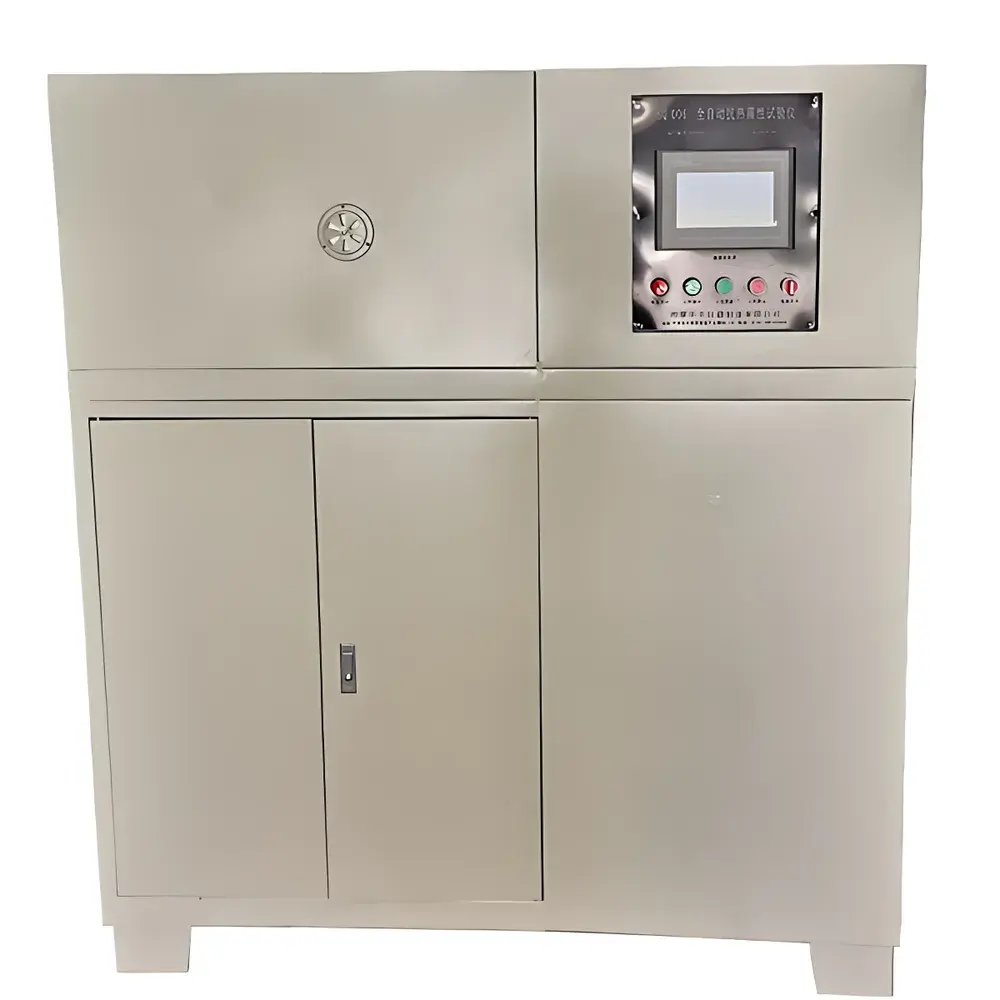
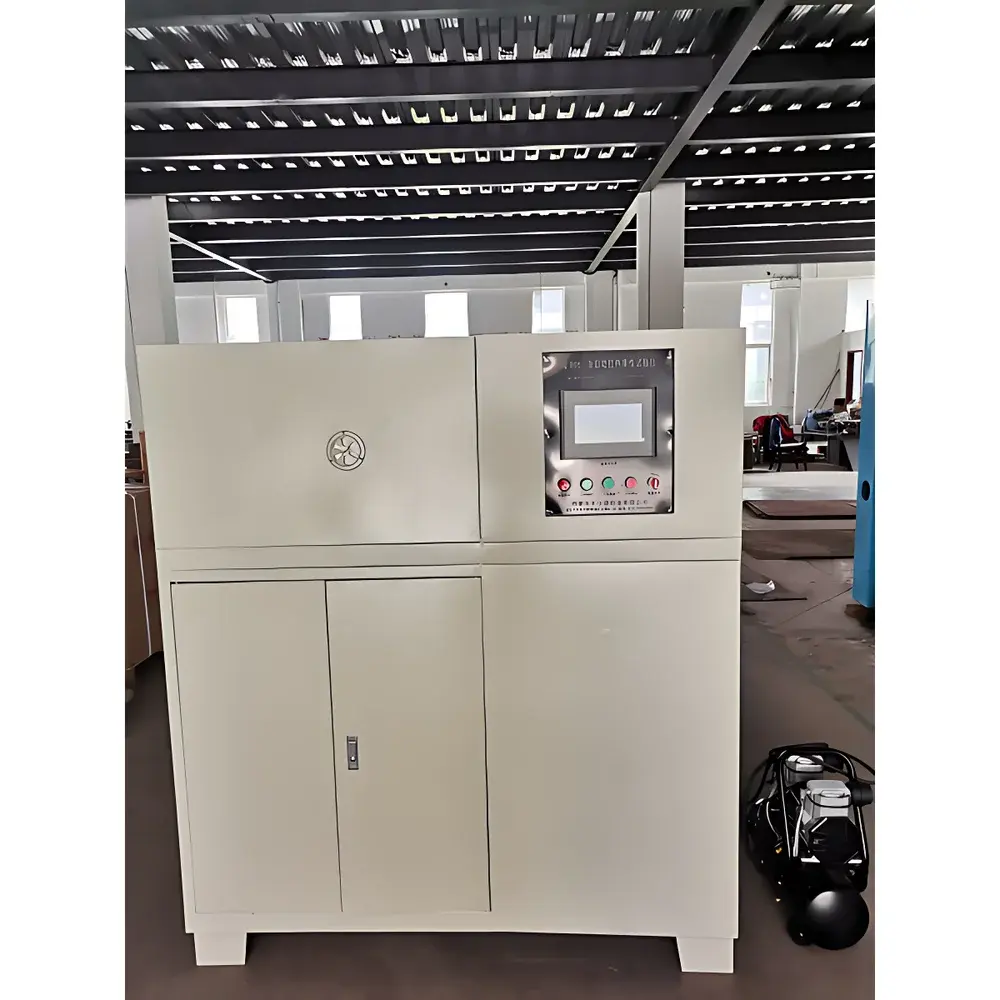
ZHENHUAFENXI SQ006 Fully Automated Thermal Shock Resistance Tester for Honeycomb Ceramics
| Brand | ZHENHUAFENXI |
|---|---|
| Origin | Hunan, China |
| Model | SQ006 |
| Maximum Furnace Temperature | 500 °C |
| Temperature Control Accuracy | ±2 °C at 500 °C |
| Effective Chamber Dimensions | 350 × 350 × 350 mm |
| Cold-to-500 °C Ramp Time | 120 min |
| Heating Power | 5 kW |
| Timer Range | 0–180 min |
| Air Compressor Capacity | 30 L |
| Air Compressor Power | 1 kW |
| Control Interface | 10-inch Industrial Touchscreen HMI with SCADA-based Configuration Software |
| Compliance | GB/T 25994–2010, GB/T 3810.9–2016 |
Overview
The ZHENHUAFENXI SQ006 Fully Automated Thermal Shock Resistance Tester is an engineered solution for evaluating the thermal shock resistance of honeycomb ceramics, refractory products, ceramic tiles, graphite components, silicate-based materials, and other non-metallic structural ceramics. It operates on the principle of controlled cyclic thermal stress induction—alternating rapid heating in a precision-controlled furnace followed by forced convective cooling via compressed air—thereby simulating real-world thermal fatigue conditions encountered during industrial service. The system implements standardized thermal shock protocols defined in GB/T 25994–2010 (Determination of Thermal Shock Resistance for Honeycomb Ceramics) and GB/T 3810.9–2016 (Ceramic Tiles – Part 9: Determination of Resistance to Thermal Shock), supporting both immersion-based and non-immersion test modes depending on specimen water absorption characteristics. Its design prioritizes repeatability, operational safety, and compliance-ready documentation—critical for quality control laboratories operating under GLP-aligned workflows or supplying data for ISO 9001-certified manufacturing processes.
Key Features
- Integrated dual-stage thermal cycle architecture: high-stability resistance furnace (max 500 °C) paired with regulated compressed-air quenching system (30 L reservoir, 1 kW motor)
- Precision temperature control with ±2 °C accuracy maintained at peak operating temperature (500 °C), achieved via PID-regulated heating elements and multi-point thermocouple feedback
- Compact monolithic mechanical layout (350 × 350 × 350 mm effective chamber volume) minimizing laboratory footprint while ensuring uniform thermal distribution
- 10-inch industrial-grade touchscreen HMI running embedded SCADA configuration software, enabling intuitive parameter setup, real-time process visualization, and on-screen data logging
- Automated sequence execution: single-button initiation triggers full thermal cycle—including preheat dwell, ramp-to-target, hold duration, forced-air quench, and post-cycle cooldown—eliminating manual intervention and operator-induced variability
- Compliance-oriented firmware architecture supporting audit-trail generation for critical parameters (temperature setpoints, dwell times, cooling pressure, cycle count), facilitating traceability in regulated environments
Sample Compatibility & Compliance
The SQ006 accommodates standard-format ceramic specimens up to 150 mm in length or diameter, including monolithic honeycomb substrates (e.g., cordierite or silicon carbide automotive catalyst carriers), fired ceramic tiles (ISO 13006), refractory bricks (ASTM C24, ISO 5017), and advanced graphite components used in semiconductor processing equipment. Its dual-mode operation—selectable immersion or dry-air quench—enables conformance with material-specific requirements outlined in GB/T 25994–2010 (optimized for low-porosity honeycombs) and GB/T 3810.9–2016 (applicable to glazed and unglazed ceramic tiles). While not certified to UL/CE standards for standalone CE marking, the instrument’s electrical subsystems comply with IEC 61000-6-3 (EMC emission limits) and IEC 61000-6-2 (immunity requirements), and its thermal enclosure meets EN 60519-1 safety provisions for industrial heating equipment.
Software & Data Management
Control and data acquisition are managed through a deterministic real-time OS running proprietary configuration software. The interface provides graphical representation of temperature vs. time profiles, digital display of instantaneous furnace temperature, compressor pressure, and elapsed cycle time. All experimental parameters—including target temperature, soak duration, number of cycles, and quench delay—are programmable and stored with timestamped metadata. Raw thermal profiles and pass/fail status per cycle are exportable in CSV format for integration into LIMS or statistical process control (SPC) platforms. Audit logs record user login events, parameter modifications, and emergency stop activations—supporting FDA 21 CFR Part 11 readiness when deployed with supplementary access-control policies and electronic signature validation.
Applications
- Quality assurance testing of automotive catalytic converter substrates for OEM Tier-1 suppliers
- R&D evaluation of novel cordierite-alumina composite formulations under accelerated thermal cycling
- Production line verification of ceramic tile batches prior to packaging and shipment
- Thermal stability benchmarking of silicon nitride and mullite-based refractories in metallurgical furnace linings
- Material screening for high-temperature filtration media used in waste incineration and chemical processing
- Academic research on crack propagation kinetics in brittle ceramics subjected to repeated thermal gradients
FAQ
Does the SQ006 support ASTM C1100 or ISO 10545-9 thermal shock protocols?
The SQ006 is configured specifically for Chinese national standards GB/T 25994–2010 and GB/T 3810.9–2016. While its thermal cycling methodology aligns conceptually with ASTM C1100 (thermal shock resistance of refractories) and ISO 10545-9 (ceramic tiles), protocol-specific timing sequences and quench media specifications require manual adaptation; no out-of-the-box templates for these standards are included.
Can the unit be integrated into a centralized lab automation network?
Yes—the device features RS-485 Modbus RTU communication capability, enabling integration with building management systems (BMS) or central SCADA platforms for remote monitoring and alarm notification. Ethernet/IP or OPC UA interfaces are not natively supported but may be added via third-party protocol gateways.
What maintenance intervals are recommended for the air compressor and furnace elements?
The air compressor requires oil-level inspection every 250 operating hours and filter replacement every 1,000 hours. Heating elements are rated for ≥5,000 hours at 500 °C continuous operation; periodic resistance measurement (annually) is advised to detect incipient degradation.
Is calibration certification provided with the instrument?
A factory-assembled NIST-traceable temperature calibration report (covering 100–500 °C range) is supplied with each unit. Users must perform periodic in-house verification using calibrated reference thermocouples per ISO/IEC 17025 guidelines.
How is sample handling safety ensured during high-temperature cycling?
The furnace chamber incorporates dual redundant door interlocks, overtemperature cut-off (set at 520 °C), and surface temperature shielding limiting external housing temperature to <60 °C during operation—meeting EN 60519-1 Class II enclosure requirements for operator protection.



