
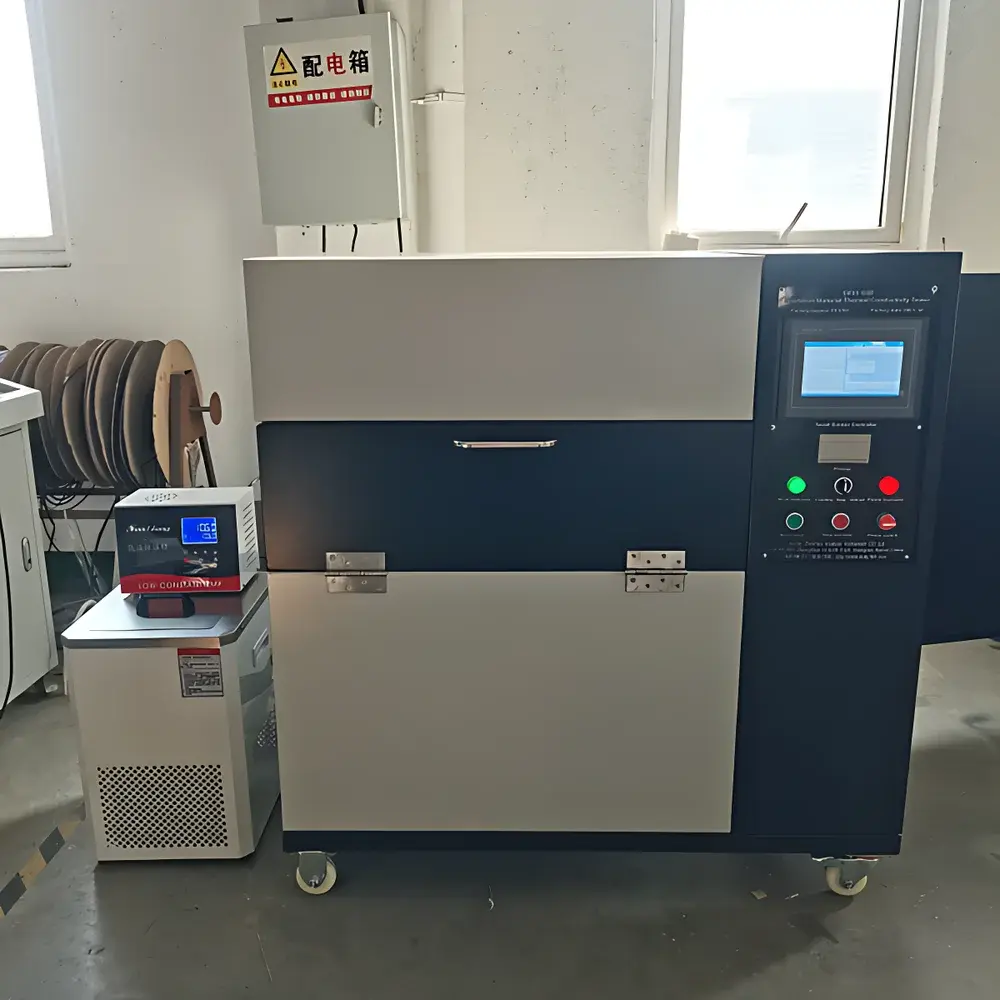
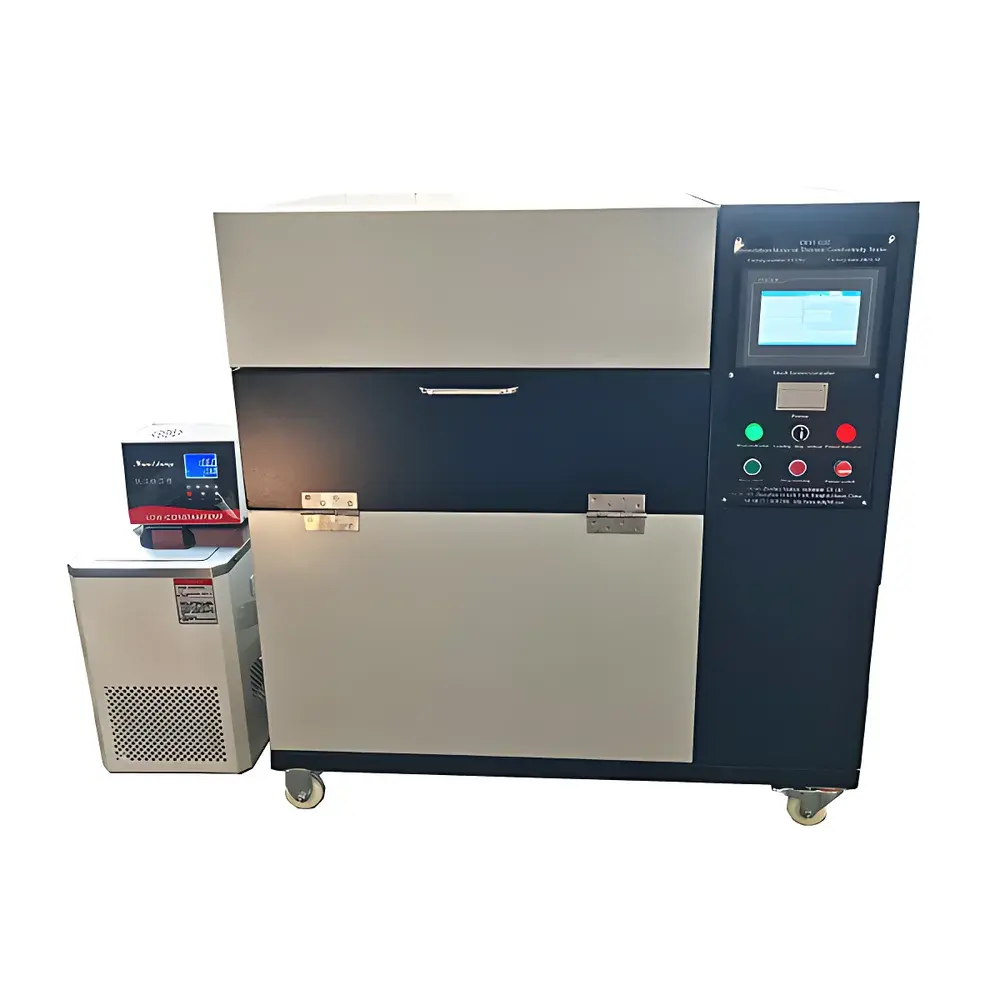
ZHENHUAFENXI DRH-600 Intelligent Guarded Hot Plate Thermal Conductivity Analyzer (600 mm)
| Brand | ZHENHUAFENXI |
|---|---|
| Origin | Hunan, China |
| Manufacturer Type | Authorized Distributor |
| Country of Origin | China |
| Model | DRH-600 |
| Instrument Type | Guarded Hot Plate Method |
| Sample Capacity | Single specimen |
| Test Environment | Ambient pressure |
| Thermal Conductivity Range | 0.0015–3.0 W/m·K |
| Accuracy | ±3% |
| Repeatability | ±1% |
| Temperature Range (Cold Plate) | 0–99.9 °C |
| Temperature Range (Hot Plate) | Ambient to 99.9 °C |
| Specimen Dimensions (Max) | 600 × 600 × 200 mm |
| Specimen Flatness Tolerance | ≤0.5 mm |
| Thickness Measurement Range | 0–200 mm |
| Thickness Resolution | 0.01 mm |
| Applied Pressure Range | 0–1000 N |
| Pressure Resolution | 0.1 N |
| Temperature Resolution | 0.01 °C (Cold Plate), 0.1 °C (Hot Plate) |
| Power Supply | AC 220 V ±5%, 3.0 kW |
Overview
The ZHENHUAFENXI DRH-600 Intelligent Guarded Hot Plate Thermal Conductivity Analyzer is a precision instrument engineered for steady-state thermal conductivity measurement of low-to-moderate conductivity solid materials under ambient pressure conditions. It operates on the guarded hot plate principle—defined in ASTM C518, ISO 8301, and GB/T 10295—as a primary standard method for determining thermal transport properties in insulating and construction-grade solids. The system features a dual-plate configuration: a centrally heated hot plate surrounded by a temperature-controlled guard ring, and a cooled cold plate mounted below the test specimen. Heat flow through the specimen is measured under controlled, one-dimensional, steady-state conditions, with lateral heat loss minimized via active guarding and high-efficiency insulation. Designed for laboratory-based material certification and R&D validation, the DRH-600 delivers traceable, reproducible results essential for compliance with building energy code requirements, fire safety standards, and thermal performance specifications in civil engineering and industrial insulation applications.
Key Features
- Guarded hot plate architecture with integrated PID-controlled guard ring, ensuring minimal edge losses and high spatial uniformity of heat flux.
- Triple-layer thermal shielding and environmental isolation system to suppress ambient thermal drift and convective interference.
- Motorized parallelism adjustment mechanism enabling automatic alignment between specimen surfaces and hot/cold plates—reducing contact resistance uncertainty and minimizing non-uniform compression effects.
- Dual cooling options: electronic Peltier-based cold plate or external recirculating chiller interface (e.g., precision water bath with ±0.01 °C resolution).
- High-resolution thickness gauge (0.01 mm) and real-time load cell (0–1000 N, 0.1 N resolution) for in-situ specimen compression monitoring and thickness-dependent thermal resistance correction.
- Fully automated temperature ramping, stabilization, and data acquisition sequence governed by embedded fuzzy-PID algorithms for hot plate and guard ring thermal tracking.
- Integrated Windows-based control software with GLP-compliant audit trail logging, user access levels, and electronic signature support per FDA 21 CFR Part 11 requirements.
Sample Compatibility & Compliance
The DRH-600 accommodates rigid, semi-rigid, and granular solid specimens up to 600 mm × 600 mm in planar dimension and 200 mm in thickness—including mineral wool, expanded polystyrene (EPS), extruded polystyrene (XPS), phenolic foam, calcium silicate board, autoclaved aerated concrete (AAC), gypsum board, ceramic fiber modules, and loose-fill glass fiber batts. Specimens must exhibit surface flatness ≤0.5 mm to ensure uniform interfacial contact. All measurements comply with the metrological definitions and procedural constraints outlined in ASTM C518–23 (“Standard Test Method for Steady-State Thermal Transmission Properties by Means of the Guarded-Hot-Plate Apparatus”), ISO 8301:2023 (“Thermal insulation — Determination of steady-state thermal resistance and related properties — Guarded hot plate apparatus”), and GB/T 10295–2008 (“Determination of steady-state thermal resistance of thermal insulating materials — Guarded hot plate method”). The instrument’s calibration protocol supports traceability to national metrology institutes via certified reference materials (e.g., NIST SRM 1450c Fibrous Glass Board).
Software & Data Management
The DRH-600 is operated via ZHENHUAFENXI’s proprietary ThermalLab™ v4.2 software suite—a Windows 10/11-compatible application supporting full automation from specimen loading to final report generation. The software implements real-time thermal equilibrium detection using dynamic variance thresholds and multi-point thermocouple validation. All raw sensor data (temperature gradients, applied load, thickness displacement, power input) are time-stamped and stored in encrypted SQLite databases compliant with ISO/IEC 17025 documentation integrity requirements. Reporting modules generate PDF/CSV outputs conforming to ISO 17025 Annex A2 templates, including uncertainty budgets per GUM (JCGM 100:2008). Audit logs record operator ID, timestamp, parameter modifications, calibration events, and result approvals—enabling full retrospective traceability for internal QA audits or regulatory inspections.
Applications
- Quality assurance testing of thermal insulation products in manufacturing facilities (e.g., EPS/XPS board producers, mineral wool fabricators).
- Third-party certification testing for CE marking, UL 723, EN 13162, and ASTM C1289 compliance.
- Research into novel aerogel composites, phase-change material (PCM)-integrated panels, and bio-based insulators at academic and government laboratories.
- Validation of computational heat transfer models (e.g., finite element simulations) requiring experimentally derived k-values at defined mean temperatures (20–70 °C).
- Building envelope performance evaluation per ASHRAE 90.1, ISO 6946, and ISO 10456 standards.
FAQ
What standards does the DRH-600 directly support for compliance reporting?
ASTM C518, ISO 8301, and GB/T 10295—each implemented with full procedural fidelity, including guard ring width ratios, minimum specimen thickness requirements, and equilibrium criteria.
Can the DRH-600 measure anisotropic materials such as layered composites?
Yes—provided the specimen is oriented with its principal thermal axis perpendicular to the plates; directional anisotropy must be reported separately per orientation, following ISO 8302 guidance.
Is external calibration verification required before each test series?
No—built-in auto-calibration routines verify thermal gradient linearity and load-cell zero offset prior to every run; however, annual NIST-traceable verification using SRM 1450c is recommended for accredited labs.
Does the system support unattended overnight testing?
Yes—software-configurable hold times, automatic shutdown upon completion, and thermal runaway protection enable extended-duration tests without operator presence.
What maintenance protocols are specified for long-term accuracy retention?
Biannual inspection of thermocouple junction integrity, annual recalibration of load cell and thickness transducer, and quarterly cleaning of plate contact surfaces with isopropyl alcohol and lint-free cloth.



