
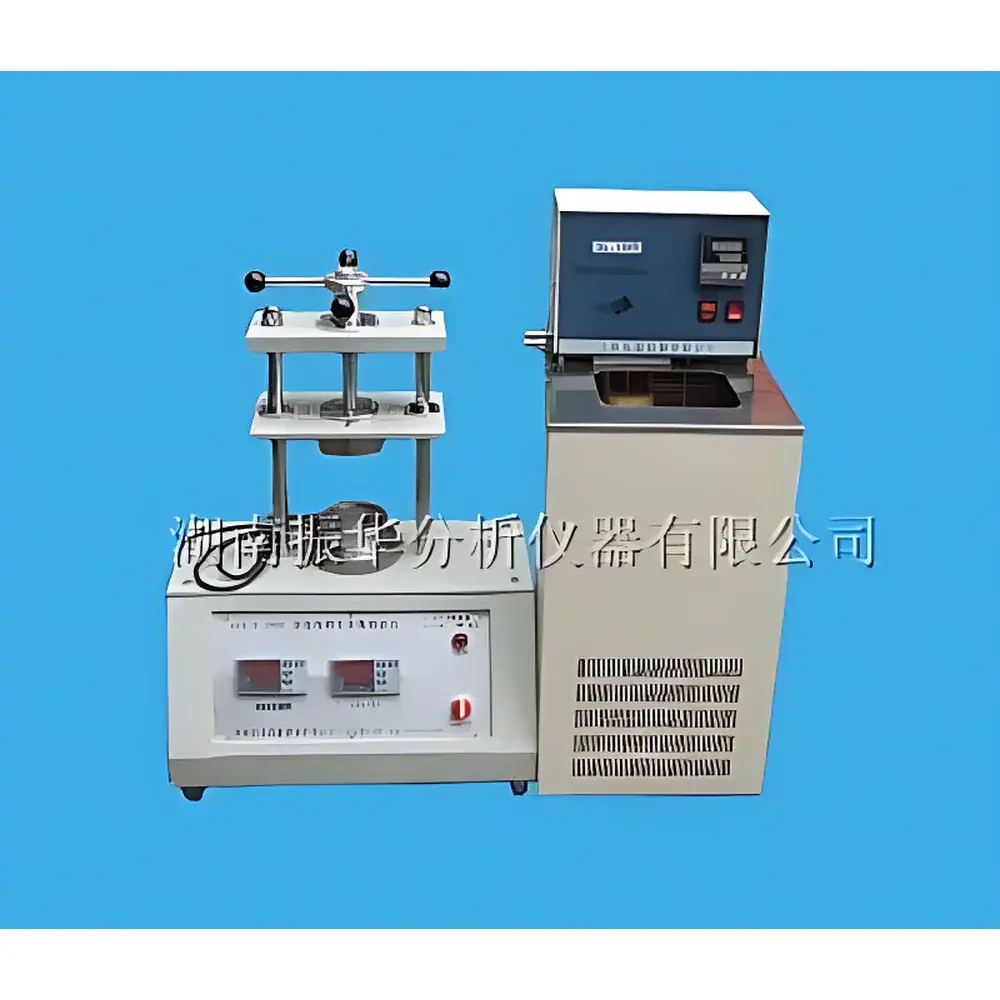
DRX-II-LUX Carbonaceous Material Thermal Conductivity Analyzer
| Origin | Hunan, China |
|---|---|
| Manufacturer Type | Distributor |
| Origin Category | Domestic (China) |
| Model | DRX-II-LUX |
| Price | Upon Request |
| Measurement Principle | Steady-State Guarded Hot Plate (Modified ASTM C177 / ISO 8302 compliant architecture) |
| Heat Plate Diameter | Φ65 mm |
| Heat Plate Temp | 60 ± 0.1 °C (Pt100 controlled) |
| Cold Plate Temp | 20 ± 0.1 °C (water-cooled, Pt100 controlled) |
| Preheater Temp | 40 °C (optional) |
| Coolant Temp Control | 20 ± 0.5 °C |
| Coolant Flow Rate | 40 L/h |
| Temperature Differential Resolution | ±0.1 °C (via differential thermopile or dual Pt100) |
| Sample Dimension | Φ50 × 50 mm |
| Thickness Measurement Accuracy | ±0.01 mm (digital caliper) |
| Test Duration | 5–20 min |
| Contact Pressure | Manual or motorized preloading system |
| Max Power Consumption | ≤1.5 kW |
Overview
The DRX-II-LUX Carbonaceous Material Thermal Conductivity Analyzer is a precision steady-state thermal transport measurement system engineered for the reliable determination of thermal conductivity (λ, W/m·K) in dense, low-porosity carbon-based materials—including graphite electrodes, carbon-carbon composites, silicon carbide-reinforced carbon, and synthetic graphite blocks. It operates on the guarded hot plate principle, adapted to meet the geometric and thermal boundary conditions specified in ISO 12987:2000 (Road vehicles — Carbon materials — Determination of thermal conductivity) and YS/T 63.3–2006 (Non-ferrous metals industry standard for carbon anode materials). Unlike transient methods (e.g., laser flash), this instrument establishes true thermal equilibrium across a representative sample thickness, delivering high reproducibility for quality control and material certification in electrode manufacturing, nuclear graphite qualification, and aerospace component validation.
Key Features
- Dual-plate temperature control architecture: Independent Pt100-sensed hot plate (60 ± 0.1 °C) and water-jacketed cold plate (20 ± 0.1 °C), ensuring stable axial thermal gradient with minimized lateral heat loss.
- Integrated preheater module (40 °C setpoint) minimizes thermal shock during sample loading and reduces measurement stabilization time.
- Automated coolant management system maintains constant 20 ± 0.5 °C inlet temperature and 40 L/h flow rate—critical for long-duration steady-state operation under GLP-compliant environmental monitoring.
- Differential temperature sensing via either calibrated thermopile or matched Pt100 pairs, achieving ±0.1 °C resolution across the sample’s hot/cold interfaces.
- Mechanical preloading system supports both manual and motor-driven contact force application, enabling consistent interfacial pressure (typically 0.1–0.5 MPa) to minimize contact resistance variability per ASTM C177 Annex A3 recommendations.
- Modular design allows field retrofitting of data acquisition upgrades, including 21 CFR Part 11–compliant audit trail modules and automated report generation.
Sample Compatibility & Compliance
The DRX-II-LUX accepts cylindrical specimens of nominal dimensions Φ50 mm × 50 mm (thickness tolerance ±0.1 mm), machined to parallelism < 0.02 mm per face—requirements aligned with ISO 8302 and IEC 60751 for platinum resistance thermometer calibration traceability. Surface flatness and perpendicularity are verified using Class 0 digital calipers (0.01 mm resolution) prior to insertion. The system complies with ISO/IEC 17025 documentation requirements for test method validation, and its operational protocol satisfies the metrological traceability chain for thermal conductivity certification under CNAS-accredited laboratories. While not certified to UL or CE as a standalone unit, its subsystems (e.g., Pt100 sensors, power supplies) conform to IEC 61000-6-3 EMC standards and RoHS Directive 2011/65/EU.
Software & Data Management
The analyzer interfaces with proprietary Windows-based acquisition software supporting real-time thermal gradient trending, automatic equilibrium detection (dΔT/dt < 0.005 °C/min over 5 min), and iterative λ calculation per Fourier’s law (λ = q·δ/ΔT). Raw sensor outputs (voltage, resistance, flow rate) are timestamped at 1 Hz and stored in encrypted .CSV archives with embedded metadata (operator ID, sample ID, ambient RH/T, calibration certificate IDs). Audit logs record all parameter changes, user logins, and report exports—enabling full compliance with FDA 21 CFR Part 11 when configured with electronic signatures and role-based access controls. Export formats include ASTM E1461–compatible XML and ISO 17025–aligned PDF certificates with uncertainty budgets per GUM (JCGM 100:2008).
Applications
- Quality assurance of carbon anodes in aluminum smelting facilities, verifying λ ≥ 120 W/m·K at 100 °C per YS/T 63.3–2006.
- Thermal homogeneity mapping of isotropic graphite used in fusion reactor first-wall components.
- Batch-to-batch consistency testing of pitch-based carbon fibers in thermal interface materials (TIMs).
- Validation of thermal aging effects in nuclear-grade graphite after irradiation simulation cycles.
- Supporting ASTM D7984–19 (Standard Guide for Thermal Conductivity Testing of Carbon-Based Refractories) in refractory R&D labs.
FAQ
What standards does the DRX-II-LUX directly support?
ISO 12987:2000 and YS/T 63.3–2006 are its primary referenced standards; its hardware architecture also aligns with core requirements of ISO 8302 and ASTM C177 for guarded hot plate methodology.
Can the system measure anisotropic carbon materials?
Yes—by rotating the specimen and repeating measurements along orthogonal axes, provided sample geometry permits uniform contact and known orientation relative to fiber or grain direction.
Is calibration traceable to national metrology institutes?
Temperature sensors are supplied with NIST-traceable calibration certificates; thermal conductivity verification is performed using SRM 1470a (graphite reference material) or in-house certified graphite standards with stated k-values and expanded uncertainties (k=2).
What maintenance intervals are recommended?
Cold plate coolant should be replaced every 6 months; Pt100 sensors require annual recalibration; mechanical preload actuators need lubrication every 12 months per OEM service schedule.
Does the system support unattended overnight testing?
Yes—equilibrium detection logic and auto-shutdown on thermal drift > ±0.2 °C ensure safe extended operation; optional UPS integration provides 30-minute backup during grid interruption.



