
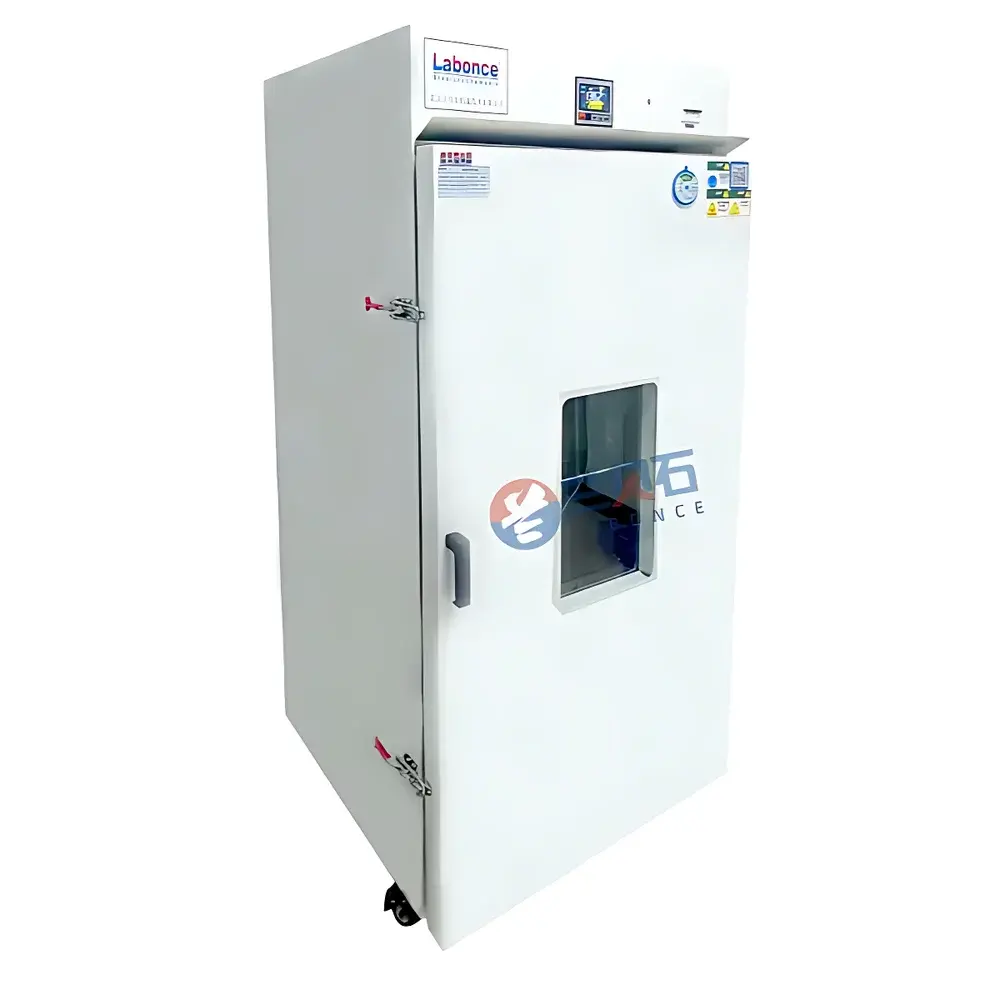
Labonce Labonce-920JM Precision Forced-Air Drying Oven (200 °C)
| Brand | Labonce |
|---|---|
| Model | Labonce-920JM |
| Temperature Range | RT+20 °C to 200 °C |
| Chamber Volume | 1000 L |
| Interior Dimensions (W×D×H) | 1000 mm × 600 mm × 1600 mm |
| Exterior Dimensions (W×D×H) | 1140 mm × 800 mm × 2150 mm |
| Power Rating | 5.2 kW |
| Standard Shelving | 4 stainless steel shelves (adjustable) |
| Temperature Uniformity | ±3.0 °C (at ≤200 °C) |
| Temperature Fluctuation | ±1.0 °C |
| Supply Voltage | AC 220 V ±10% / 50 Hz or AC 380 V ±10% / 50 Hz |
| Construction | External cold-rolled steel with epoxy powder coating |
| Control System | Digital display PID temperature controller |
| Safety | Independent over-temperature protection circuit |
Overview
The Labonce Labonce-920JM Precision Forced-Air Drying Oven is an industrial-grade, convection-heated thermal processing instrument engineered for reproducible, uniform heat treatment of samples in research laboratories, quality control environments, and manufacturing facilities. Operating on the principle of forced-air convection—where a calibrated axial fan circulates heated air across a thermally insulated chamber—the Labonce-920JM ensures rapid thermal equilibration and minimal spatial temperature gradients. Designed for continuous operation within a controlled range of RT+20 °C to 200 °C, it supports standardized drying, curing, baking, sterilization pre-treatment, and moisture content determination protocols per ASTM D2244, ISO 293, and USP . Its 1000 L chamber volume accommodates large-format samples, stacked trays, or multiple test specimens simultaneously—making it suitable for batch processing in electronics component testing, polymer formulation validation, and pharmaceutical excipient stability studies.
Key Features
- Optimized airflow architecture: A rear-mounted, high-efficiency centrifugal blower integrated with a multi-directional baffle system ensures laminar, cross-chamber air circulation—validated to maintain temperature uniformity within ±3.0 °C across the full working volume at 200 °C.
- Dual-layer thermal insulation: 100 mm thick mineral wool insulation combined with a double-wall chamber design minimizes external surface temperature rise and reduces energy consumption during extended dwell cycles.
- Robust chamber construction: Interior lined with 1.2 mm thick AISI 304 stainless steel; exterior finished with electrostatic epoxy powder coating for corrosion resistance and mechanical durability under routine laboratory use.
- PID-based digital temperature controller: High-resolution (0.1 °C) microprocessor-controlled system with programmable ramp/soak profiles, real-time deviation monitoring, and automatic stabilization feedback—compliant with IEC 61000-4 electromagnetic compatibility standards.
- Dedicated safety redundancy: Independent mechanical over-temperature cut-off switch (settable up to 220 °C), door-interlocked heating disable, and grounded chassis wiring meet EN 61010-1 requirements for Class II laboratory equipment.
Sample Compatibility & Compliance
The Labonce-920JM accepts a broad spectrum of sample formats—including Petri dishes, aluminum weighing pans, glass desiccators, ceramic crucibles, PCB assemblies, and coated metal substrates—without risk of warping or oxidation under nominal operating conditions. All internal surfaces are non-reactive and easily decontaminated, supporting GLP-aligned cleaning validation procedures. The oven conforms to key international regulatory frameworks: its temperature control architecture and documentation traceability support FDA 21 CFR Part 11 readiness when paired with optional data logging modules; its thermal performance aligns with ISO/IEC 17025 calibration requirements for accredited testing labs; and its electrical safety certification satisfies CE marking criteria under the Low Voltage Directive (2014/35/EU) and EMC Directive (2014/30/EU).
Software & Data Management
While the standard Labonce-920JM operates via standalone digital controller, optional RS485 communication interface enables integration into centralized lab management systems (LIMS) or SCADA platforms using Modbus RTU protocol. Third-party compliant software packages (e.g., LabVIEW-compatible drivers or custom Python-based acquisition scripts) permit automated data capture of setpoint, actual temperature, elapsed time, and alarm status at user-defined intervals. Audit trail functionality—including operator ID tagging, parameter change logs, and timestamped event records—is available through the optional Labonce DataBridge module, facilitating compliance with GMP Annex 11 and ISO 13485 documentation mandates.
Applications
- Moisture loss quantification in raw materials (e.g., APIs, excipients, food powders) per AOAC 950.46 and ISO 6571.
- Pre-drying of filter membranes and gravimetric sampling media prior to particulate mass analysis.
- Curing of epoxy-coated electronic components and conformal coatings per IPC-CC-830B.
- Accelerated aging studies of elastomers and thermoplastics under controlled thermal stress (ASTM D573).
- Baking of metallized ceramic substrates and printed circuit board laminates prior to solder paste application.
- Stabilization of reference standards and calibration weights in metrology laboratories.
FAQ
What is the maximum recommended continuous operating temperature?
The Labonce-920JM is rated for sustained operation up to 200 °C. For optimal long-term reliability and sensor longevity, Labonce recommends limiting continuous use to ≤190 °C unless validated for specific process requirements.
Can the oven be configured for 380 V three-phase supply?
Yes—the Labonce-920JM supports dual-voltage input (220 V single-phase or 380 V three-phase, 50 Hz) and ships with terminal block wiring pre-configured for either configuration per user specification.
Are shelf positions adjustable?
All four standard stainless steel shelves are vertically adjustable on 25 mm pitch notches, allowing flexible load distribution and optimized airflow clearance around samples.
Does the unit include calibration documentation?
Each unit ships with a factory-issued temperature uniformity verification report (per ISO 17025-accredited methodology) and NIST-traceable sensor calibration certificate for the primary PT100 sensor.
Is remote monitoring supported out-of-the-box?
No—remote monitoring requires the optional RS485 interface module and compatible host software. The base configuration provides local visual readout only.
Related Products



