
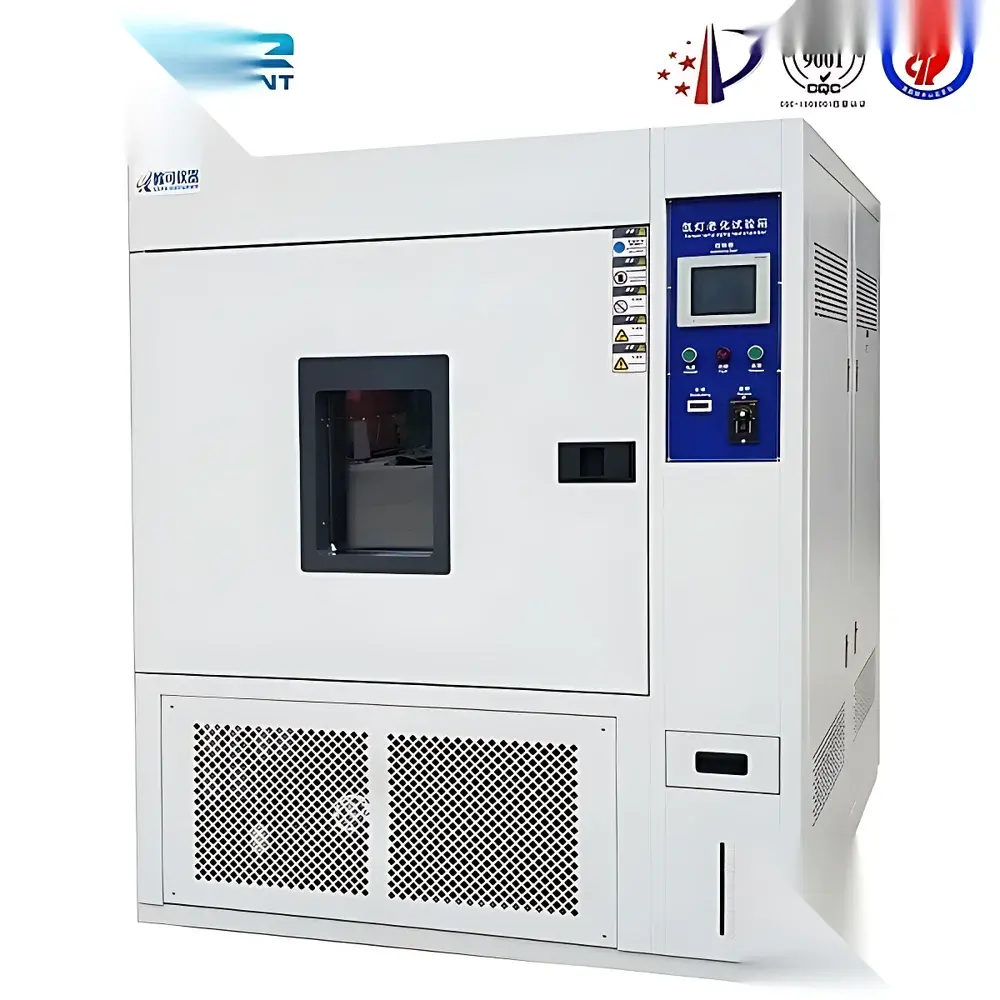
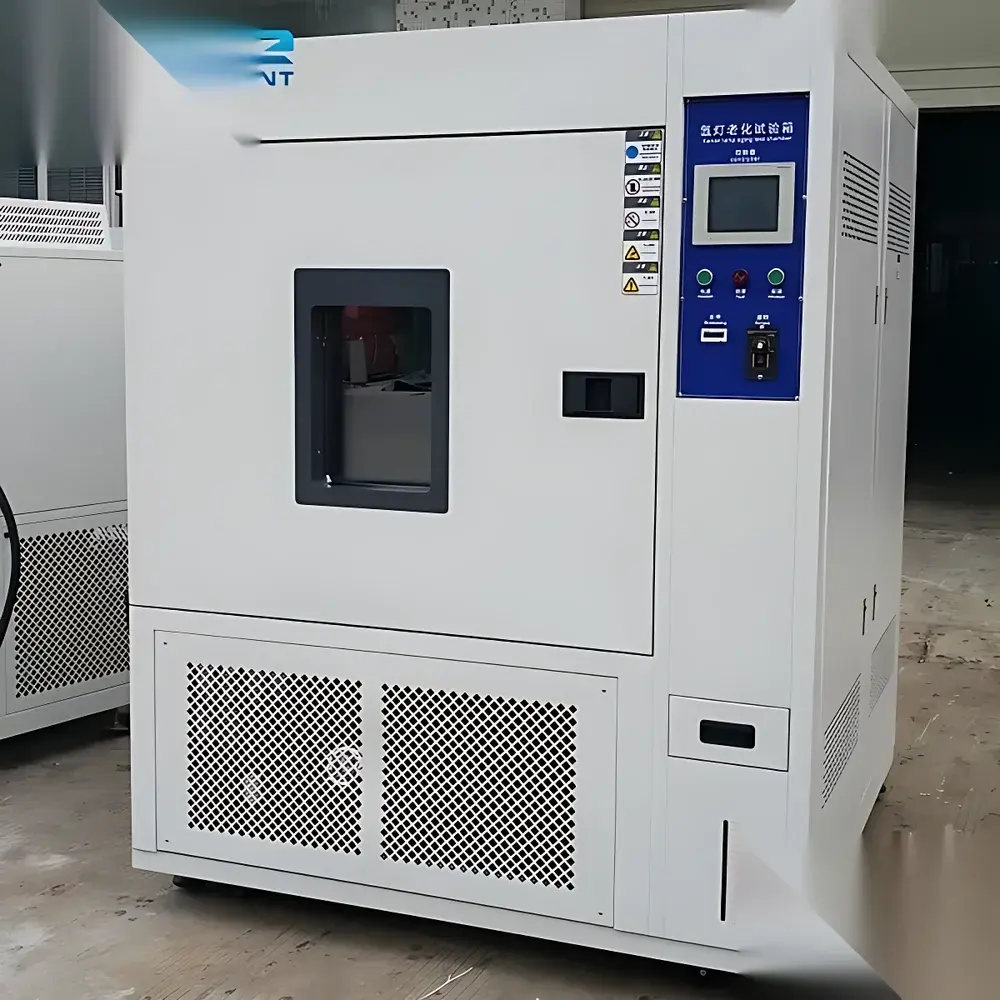
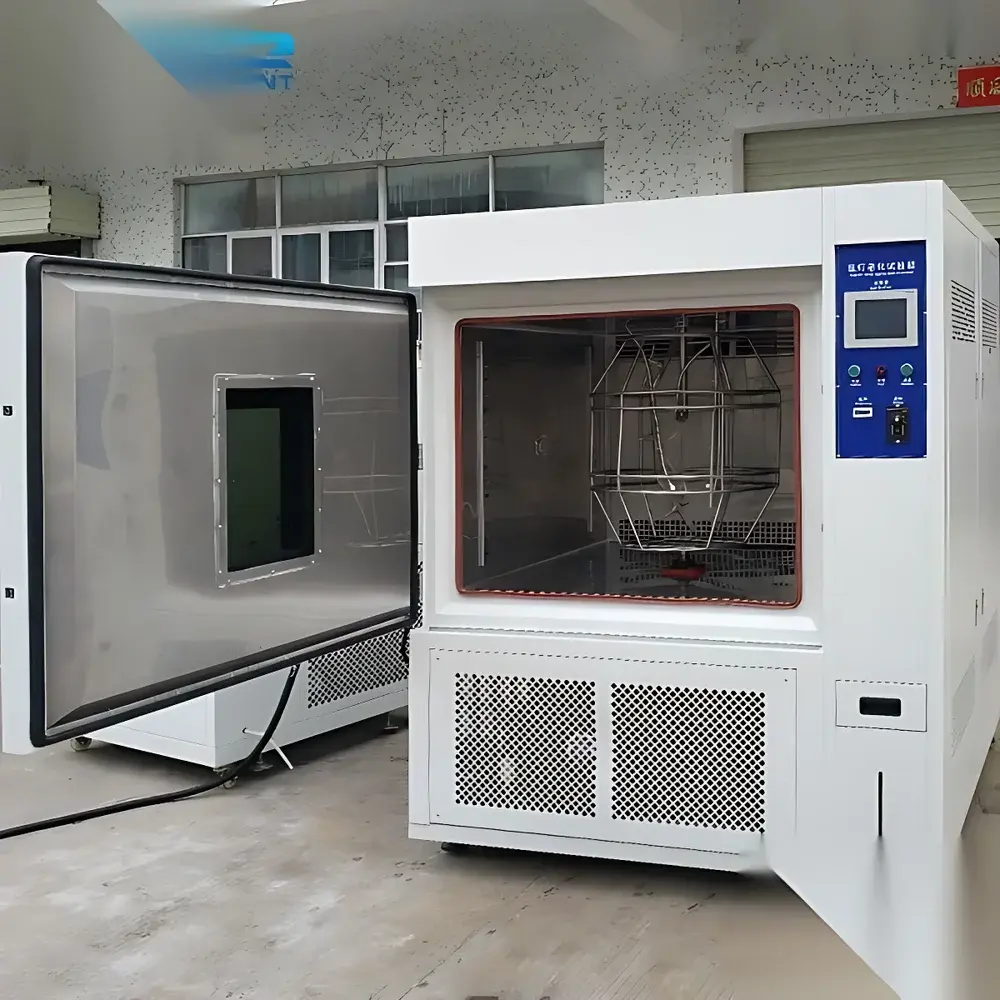
Xenon Arc Weathering Chamber for Epoxy Resins
| Brand | Other Brands |
|---|---|
| Origin | Imported |
| Manufacturer Type | Authorized Distributor |
| Price | USD 5,300 (Reference Only) |
| Power Supply | AC 220 V, 50 Hz, Single-Phase |
| Ground Resistance | ≤4 Ω |
| Lamp Type | Q-Panel OEM Xenon Arc Lamp Tube (UVA-340 or UVB-313) |
| Ballast | Electronic Ignition & Constant-Power Regulated Ballast |
| Protection Systems | Leakage Current Protection, Over-Temperature Alarm, Short-Circuit Protection, Power Failure Safeguard |
| Test Cycle Modes | Light–Heat–Dark–Moisture (Condensation/Spray) |
Overview
The Xenon Arc Weathering Chamber for Epoxy Resins is an engineered environmental simulation system designed to replicate the photochemical, thermal, and hygrothermal stresses induced by natural outdoor exposure. It employs a calibrated xenon arc lamp—traceable to NIST-referenced spectral irradiance standards—to deliver a continuous spectrum closely matching terrestrial sunlight (290–800 nm), including critical UV-B, UV-A, visible, and near-infrared regions. Unlike fluorescent UV or carbon arc sources, xenon arc technology provides spectrally accurate irradiance distribution essential for evaluating polymer degradation mechanisms in epoxy-based systems, such as chain scission, oxidation, and chromophore formation. The chamber integrates precise control of black-standard temperature (BST), relative humidity (RH), and cyclic moisture application (condensation and water spray) to simulate diurnal and seasonal weathering patterns. This enables accelerated aging assessments compliant with internationally recognized test protocols including ISO 4892-2, ASTM G155, SAE J2527, and GB/T 16422.2.
Key Features
- Q-Panel OEM xenon lamp tube with certified spectral output and ≥1,500-hour service life under standard operating conditions
- Microprocessor-controlled irradiance regulation (0.35–0.65 W/m² @ 340 nm, adjustable in 0.05 W/m² increments) with real-time feedback via integrated broadband UV sensor
- Black-standard temperature range: 30–100 °C ±1.0 °C; chamber air temperature: 10–80 °C ±1.5 °C
- Humidity control: 10–95% RH ±3% RH, maintained via steam generator and chilled mirror hygrometer
- Cyclic moisture system: programmable condensation (via cooled specimen holder) and frontal spray (deionized water, 0.5–1.0 L/min, 200–300 kPa)
- Dual-layer insulated stainless-steel chamber with quartz inner filter and outer borosilicate glass envelope for spectral stability and thermal isolation
- Comprehensive safety architecture: Class I protection, earth leakage circuit breaker (30 mA), overtemperature cutoff, emergency stop, and fault logging with timestamped event history
Sample Compatibility & Compliance
This chamber accommodates flat-panel specimens up to 150 mm × 150 mm × 25 mm (W × L × H), with standardized mounting fixtures compatible with ISO 18898-compliant sample carriers. It supports epoxy resin formulations—including amine-cured, anhydride-cured, and UV-curable systems—as well as fiber-reinforced composites, gel coats, and protective coatings. All operational parameters are traceable to internal calibration certificates aligned with ISO/IEC 17025 requirements. The system meets CE marking directives (2014/30/EU EMC, 2014/35/EU LVD), RoHS 2011/65/EU, and conforms to electrical safety standards IEC 61000-6-2 and IEC 61000-6-4. For regulated industries, audit-ready operation logs support GLP and GMP documentation practices per FDA 21 CFR Part 11 when paired with optional electronic signature modules.
Software & Data Management
Equipped with proprietary Windows-based control software (v5.2+), the chamber delivers full-cycle programming, real-time parameter visualization, and automated report generation in PDF/CSV formats. Users define multi-step test profiles—including irradiance ramping, temperature gradients, humidity transitions, and moisture phase sequencing—with up to 99 program steps per cycle. Data acquisition occurs at 1-second intervals and is stored locally on encrypted industrial-grade SSD. Optional Ethernet/IP or Modbus TCP interfaces enable integration into centralized laboratory information management systems (LIMS) and SCADA environments. Audit trail functionality records all operator actions, parameter changes, alarm events, and calibration interventions with user ID, timestamp, and IP address—fully satisfying ALCOA+ data integrity principles.
Applications
This xenon weathering chamber serves as a primary qualification tool for epoxy resin development across aerospace structural adhesives, wind turbine blade matrices, printed circuit board laminates, and automotive under-hood encapsulants. It supports comparative evaluation of photostabilizers (e.g., HALS, UV absorbers), pigment dispersion stability, interfacial adhesion retention in fiber-reinforced systems, and hydrolytic resistance of anhydride-cured networks. In R&D labs, it facilitates DOE-driven formulation optimization; in QC laboratories, it executes pass/fail conformance testing against internal material specifications or customer-facing durability claims (e.g., “10-year exterior color retention”). Correlation studies between xenon exposure hours and field service life are routinely performed using Arrhenius-based acceleration models validated per ASTM D7869.
FAQ
What spectral filters are included with the standard configuration?
Standard configuration includes Daylight-Q/B filter set (equivalent to ISO 4892-2 Option A), delivering broadband irradiance matching global horizontal solar radiation. Optional Extended UV (XUV) and Window Glass (WG) filters are available for automotive interior or building-integrated applications.
Can the chamber operate unattended for extended cycles (e.g., 1,000 hours)?
Yes—designed for continuous operation up to 2,000 hours per lamp life cycle. Integrated lamp hour meter, automatic lamp voltage compensation, and predictive maintenance alerts ensure stable irradiance output without manual intervention.
Is calibration traceable to national metrology institutes?
Irradiance sensors are factory-calibrated against NIST-traceable reference standards; annual recalibration services include certificate of calibration with uncertainty budget per ISO/IEC 17025.
Does the system support custom test protocols beyond ISO/ASTM standards?
Yes—user-defined programs allow arbitrary sequencing of irradiance, temperature, humidity, and moisture phases, enabling proprietary aging models aligned with internal product lifecycle requirements.
What maintenance intervals are recommended for optimal performance?
Lamp replacement every 1,500 hours; quartz filter cleaning weekly; humidity sensor verification quarterly; full system performance validation annually per manufacturer’s PQ protocol.



