
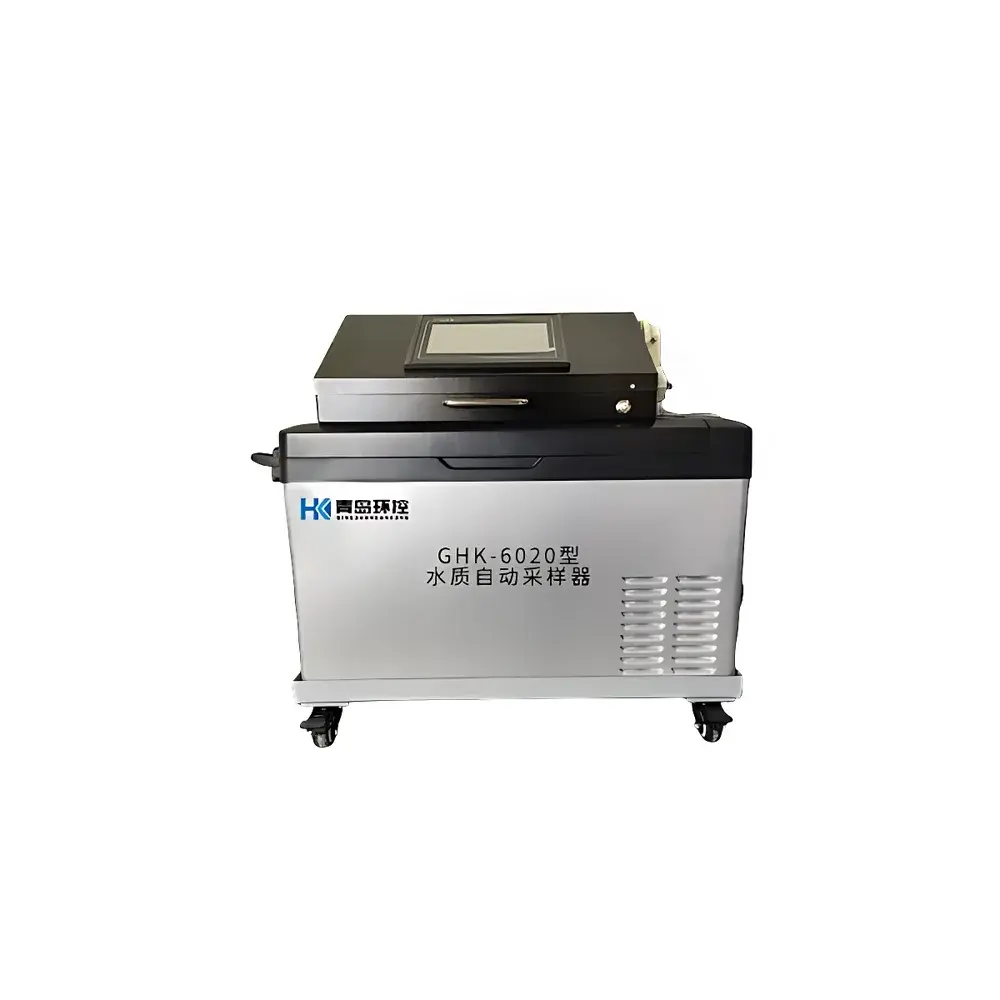
HUANKONG GHK-6020 Portable Automatic Water Sampler
| Brand | HUANKONG |
|---|---|
| Origin | Shandong, China |
| Manufacturer Type | Direct Manufacturer |
| Country of Origin | China |
| Model | GHK-6020 |
| Instrument Category | Automatic Water Sampler |
| Sampling Method | Flow-Proportional & Time-Proportional Sampling |
| Instrument Form Factor | Portable |
| Single Sample Volume Delivery Rate | 12 L/min |
| Compliance | HJ/T 372–2007 (China Environmental Protection Standard) |
| Sample Preservation Temperature | 0–4 °C |
| Bottle Capacity | 1–12 Vials (User-Configurable) |
| Data Storage | Up to 1000 Event Logs (including bottle ID, timestamp, volume, optional COD/NH₃-N values) |
| Interface Options | RS485, Flow Meter Input Signal Port |
| Power Failure Recovery | Auto-Restore Configuration & Operational State |
| Post-Sampling Tube Flush | Automatic Drainage to Prevent Sediment Accumulation |
Overview
The HUANKONG GHK-6020 Portable Automatic Water Sampler is an engineered solution for unattended, programmable, and environmentally controlled water sampling in field-based environmental monitoring applications. Designed in strict accordance with the technical specifications and verification methodology outlined in China’s HJ/T 372–2007 standard—“Technical Requirements and Testing Methods for Automatic Water Samplers”—the GHK-6020 integrates robust mechanical architecture with deterministic sampling logic to ensure representative, traceable, and temperature-stabilized sample acquisition. Its operational principle relies on programmable peristaltic or diaphragm-driven pumping, synchronized with real-time flow or time triggers, enabling precise flow-proportional (e.g., composite sampling proportional to wastewater discharge rate) and time-proportional (e.g., hourly or diurnal composite) collection strategies. The unit is purpose-built for deployment at discrete sampling points including industrial effluent outfalls, municipal wastewater treatment plant influent/effluent channels, river cross-sections, reservoir intakes, and coastal monitoring stations—where portability, power resilience, and cold-chain integrity are critical.
Key Features
- Compact, wheeled portable chassis with integrated carrying handle—designed for rapid transport across uneven terrain and installation in confined or remote locations without fixed infrastructure.
- Configurable multi-bottle autosampler supporting 1 to 12 individual sample vials; vial assignment logic is programmable per event or schedule to support sequential, composite, or triggered sampling protocols.
- Integrated thermoelectric cooling module maintains stored samples continuously within 0–4 °C throughout deployment—meeting preservation requirements for biochemical oxygen demand (BOD), nutrient (NH₃-N, NO₃⁻), and organic contaminant analyses per ISO 5667-3 and EPA Method 1664.
- Multi-mode sampling control: user-defined timer schedules, time-proportional intervals (e.g., every 15 min), flow-proportional triggering (via analog 4–20 mA or pulse input from external flow meter), external TTL/relay signal activation, and RS485 serial command interface (Modbus RTU compatible).
- Non-volatile event logging with timestamped records of bottle position, sampling start/stop time, delivered volume, and optional integration with upstream analyzers for concurrent COD and NH₃-N metadata capture.
- Fail-safe operational continuity: retains all configuration parameters and resumes scheduled operation automatically after power interruption; no manual reinitialization required.
- Post-sampling purge cycle actively evacuates residual water from intake tubing and pump head—minimizing biofilm formation, particulate settling, and cross-sample carryover between events.
Sample Compatibility & Compliance
The GHK-6020 accommodates standard polyethylene (HDPE) or glass sampling bottles (250–2000 mL), compatible with common preservation additives (e.g., sulfuric acid for metals, NaOH for cyanide, HgCl₂ for BOD). It meets the functional and performance validation criteria specified in HJ/T 372–2007, including accuracy of volume delivery (±5% full-scale), timing repeatability (< ±30 s deviation over 72 h), and thermal stability under ambient conditions ranging from –10 °C to +45 °C. While not certified to IEC 61326-1 (EMC) or IP67 by default, its enclosure design supports outdoor use under sheltered conditions. For regulated environments requiring audit readiness, the device supports GLP-aligned data integrity when paired with validated external data loggers or SCADA systems via RS485.
Software & Data Management
Local configuration and status monitoring are performed via a backlit LCD interface with membrane keypad. All sampling programs, bottle mapping, and alarm thresholds (e.g., low battery, clog detection, temperature excursion) are set directly on-device. Event logs—including bottle ID, UTC timestamp (with internal RTC), volume dispensed, and optional auxiliary parameter fields—are stored in non-volatile memory and exportable via USB or RS485 to laboratory information management systems (LIMS) or centralized environmental data platforms. Though no proprietary cloud platform is bundled, the Modbus RTU implementation ensures interoperability with industry-standard SCADA frameworks (e.g., Ignition, Siemens Desigo, or Wonderware) for automated ingestion into compliance reporting workflows aligned with ISO 14001 or national discharge permit requirements.
Applications
- Regulatory compliance monitoring at industrial point sources subject to discharge permits (e.g., textile, pharmaceutical, electroplating facilities).
- Wastewater treatment plant process control—sampling influent, bioreactor zones, secondary clarifiers, and final effluent for QA/QC and regulatory submission (e.g., China’s “Discharge Standards of Pollutants for Municipal Wastewater Treatment Plants” GB 18918–2002).
- River and lake basin assessment campaigns—enabling high-temporal-resolution composite sampling during storm events or seasonal algal bloom periods.
- Source water quality surveillance for drinking water utilities, particularly where grab sampling is logistically impractical or insufficient for capturing diurnal contaminant fluctuations.
- Research-grade field studies conducted by academic institutions and hydrological survey teams requiring reproducible, cold-preserved sample trains under variable site power availability.
FAQ
Does the GHK-6020 support integration with third-party flow meters?
Yes—it provides isolated analog (4–20 mA) and pulse input interfaces compliant with common electromagnetic, ultrasonic, and magnetic flow meter outputs. Calibration coefficients are configurable per channel.
What is the maximum operating duration on battery power?
With optional external 12 V DC battery pack (not included), continuous operation exceeds 72 hours at 2-hour sampling intervals and active refrigeration; runtime scales inversely with sampling frequency and ambient temperature.
Can sample bottle positions be reassigned dynamically during a campaign?
Yes—through the onboard menu or remote Modbus command, users may modify vial mapping, skip positions, or assign duplicate bottles without interrupting the sampling sequence.
Is firmware upgradable in the field?
Firmware updates are supported via USB flash drive using signed binary files; version history and checksum validation are displayed prior to installation to ensure traceability.
How is data integrity ensured during extended deployments?
All logged events include CRC-16 checksums, monotonic timestamps, and write-once memory allocation—preventing overwrites or silent corruption. Critical parameters (e.g., clock, bottle count, temperature setpoint) are stored redundantly across separate EEPROM sectors.







