
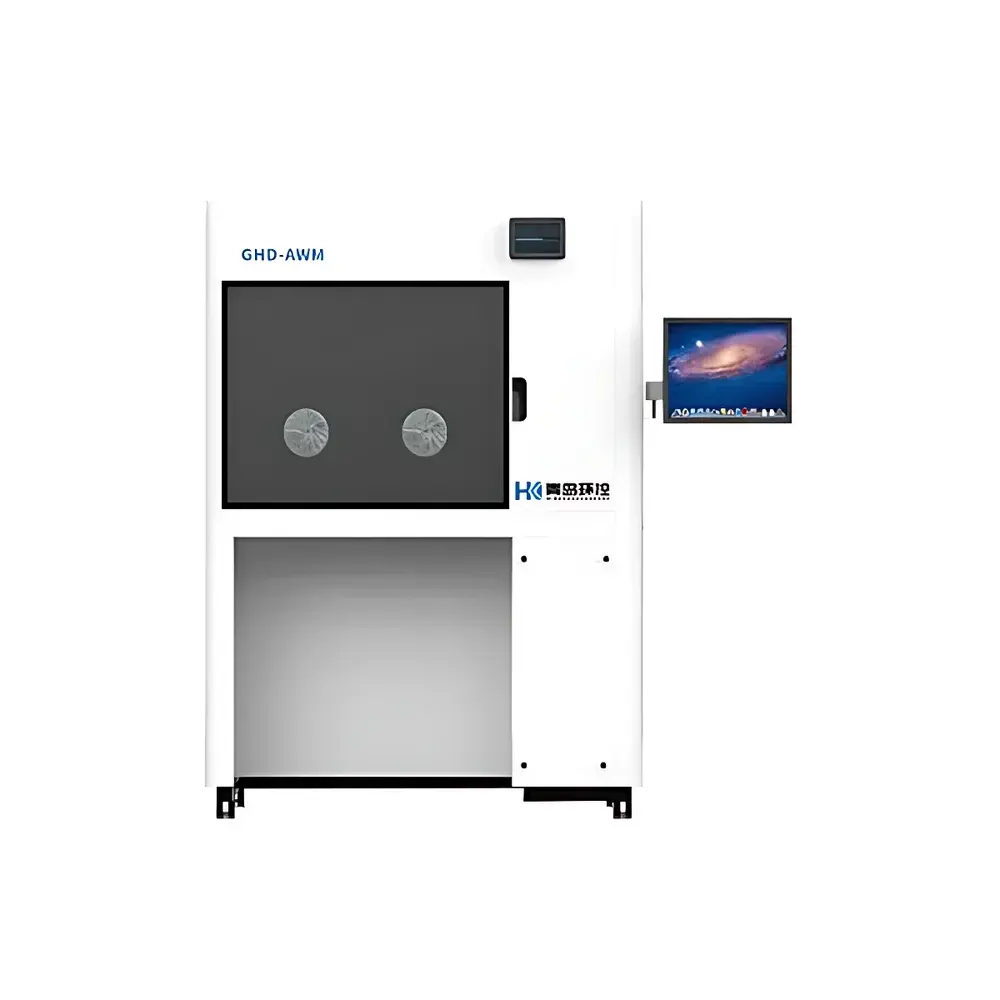
HUANKONG GHD-AWM Manual Filter Weighing Platform
| Brand | HUANKONG |
|---|---|
| Origin | Shandong, China |
| Manufacturer Type | Direct Manufacturer |
| Country of Origin | China |
| Model | GHD-AWM |
| Pricing | Available Upon Request |
| Temperature Control | ±0.5 °C uniformity |
| Humidity Control | 40–60% RH, ±3% RH uniformity |
| Cleanroom Class | ISO 14644-1 Class 5 (equivalent to Federal Standard 209E Class 100) |
| Vibration Isolation | Active pneumatic damping system |
| Weighing Capacity | Up to 220 g |
| Readability | 0.1 µg (10⁻⁷ g) |
| Sample Throughput | 120 × 47 mm filters |
| Electrostatic Neutralization | Bipolar ionizer (±1 kV adjustable output) |
| Data Capture | QR code, barcode & RFID reader integrated |
| Environmental Monitoring | Real-time logging of temperature, humidity, and laminar airflow velocity (0.3–0.5 m/s) with automated report generation |
| Filter Compatibility | Glass fiber, quartz, PTFE, cellulose ester, and mixed ester membranes |
| Sample Types | Solid particulates (PM₂.₅, PM₁₀), powders, lyophilized residues, solvent-free extracts, and non-volatile liquid residues |
Overview
The HUANKONG GHD-AWM Manual Filter Weighing Platform is an engineered environmental metrology workstation designed specifically for gravimetric analysis of airborne particulate matter in regulatory-compliant ambient air and stack emission monitoring. It operates on the principle of high-precision microbalance measurement under strictly controlled thermohygrometric and aerodynamic conditions—ensuring mass stability and minimizing drift induced by thermal expansion, moisture adsorption/desorption, or electrostatic interference. The platform integrates a 0.1 µg readability analytical balance within a Class 5 clean enclosure (ISO 14644-1), maintaining stable temperature (±0.5 °C), relative humidity (40–60% RH, ±3% uniformity), and laminar airflow (0.3–0.5 m/s) throughout the weighing chamber. This architecture directly addresses the core requirements of weight-based particulate quantification as defined in HJ 656–2013, HJ 836–2017, EPA 40 CFR Part 86/1065, EN 12341:1998, EN 14907:2005, and prEN 12341:2012.
Key Features
- Integrated 0.1 µg readability microbalance with internal calibration and automatic drift compensation
- Active temperature and humidity control system with dual-sensor feedback loops and real-time uniformity mapping
- Pneumatic vibration isolation base compliant with ISO 25317 for sub-microgram stability
- Bipolar ionization module (±1 kV adjustable) for electrostatic neutralization of filter substrates and particulate deposits
- Multi-format identification engine supporting QR codes, linear barcodes, and passive RFID tags (ISO 15693/14443A) for unambiguous filter traceability
- Laminar airflow management with HEPA (H14) and ULPA (U15) filtration achieving ≤3,520 particles/m³ ≥0.5 µm (ISO Class 5)
- Automated environmental log generation: temperature homogeneity, humidity distribution, and face velocity profiles exported in CSV/PDF
Sample Compatibility & Compliance
The GHD-AWM accommodates standard 47 mm and 90 mm diameter filters—including glass fiber (GF/F, GF/D), quartz (QMA, QMB), polytetrafluoroethylene (PTFE), cellulose nitrate, and mixed ester membranes—as well as low-concentration PM sampling heads used in isokinetic stack testing. Its chamber geometry and airflow design prevent edge turbulence and particle resuspension during handling. All operational parameters meet the procedural validation criteria outlined in HJ 656–2013 (Section 6.2.3 on balance stability), HJ 836–2017 (Annex A on environmental conditioning), and EPA Method 201A (Section 8.2 on weighing environment controls). The system supports GLP-aligned audit trails when paired with validated LIMS interfaces.
Software & Data Management
The embedded control software provides role-based access, electronic signature support (aligned with FDA 21 CFR Part 11 Annex 11 principles), and timestamped metadata capture for every weighing event—including operator ID, filter ID, environmental logs, balance diagnostics, and manual annotations. Data export complies with ASTM E1447 and ISO/IEC 17025:2017 requirements for raw data integrity. Reports include uncertainty budgeting per GUM (JCGM 100:2008), filter mass change histograms, and chamber performance verification summaries. Optional OPC UA integration enables seamless data routing to enterprise QA/QC systems.
Applications
- Ambient PM₂.₅ and PM₁₀ monitoring networks requiring long-term filter stability and inter-laboratory comparability
- Source testing of industrial stacks per EPA Performance Specification 11 and EN 13284-1
- Reference method validation studies for optical or beta-attenuation monitors
- Filter-based speciation analysis (e.g., water-soluble ions, elemental carbon) where pre- and post-extraction mass differences must be resolved at <1 µg level
- Calibration of cascade impactors and virtual impaction systems using gravimetric reference standards
FAQ
What filter formats does the GHD-AWM support?
It handles 47 mm and 90 mm circular filters, as well as standardized low-concentration PM sampling heads (e.g., EPA Method 5I, ISO 23210 compliant designs).
How is electrostatic interference mitigated during weighing?
A programmable bipolar ionizer generates balanced positive and negative ions to neutralize surface charges on both filter media and deposited particulates prior to each measurement cycle.
Is the system compliant with ISO/IEC 17025 accreditation requirements?
Yes—the platform provides full traceability, environmental logging, balance calibration records, and audit-ready data exports required for laboratory accreditation under ISO/IEC 17025:2017 Clause 7.7 and ILAC-G8:2021.
Can the GHD-AWM be integrated into an existing LIMS?
It supports secure HTTPS API endpoints and configurable CSV/XML export protocols compatible with major LIMS platforms (e.g., LabWare, Thermo Fisher SampleManager, STARLIMS).
What maintenance intervals are recommended for the cleanroom filtration system?
HEPA/UPLA filters require replacement every 12 months or after 7,500 operating hours; ionizer emitter pins should be cleaned quarterly and replaced annually per manufacturer specifications.



