
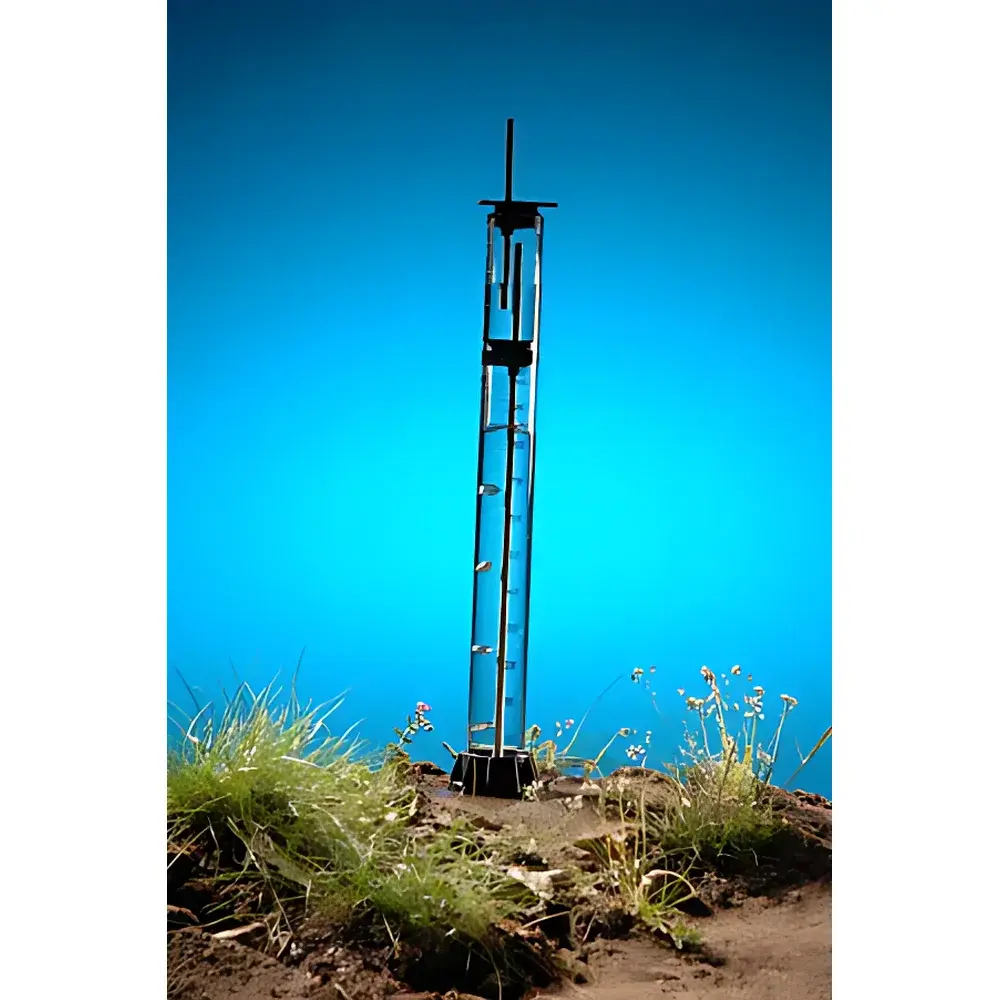
METER Mini Disk Tension Infiltrometer
| Brand | METER |
|---|---|
| Origin | USA |
| Manufacturer Type | Authorized Distributor |
| Product Category | Imported Instrument |
| Model | Mini Disk |
| Instrument Type | Soil Water Potential & Hydraulic Conductivity Analyzer |
| Height | 32.7 cm |
| Diameter (body) | 3.1 cm |
| Sintered Stainless Steel Disc Diameter | 4.5 cm |
| Disc Thickness | 3 mm |
| Upper Chamber Volume | 40.0 mL |
| Lower Chamber Volume | 95.0 mL |
| Adjustable Suction Range | 0.5–7 cm |
| Compliance | ASTM D3385, ISO 28580, USP <1058> (for method validation in environmental hydrology) |
Overview
The METER Mini Disk Tension Infiltrometer is a field-deployable, gravity-fed tension infiltrometer engineered for rapid, reproducible measurement of near-saturated soil hydraulic conductivity (Kfs) under controlled matric potential conditions. Unlike steady-state ponded infiltration methods, the Mini Disk applies a constant, adjustable negative pressure (–0.5 to –7 cm H2O) to the soil surface via a sintered stainless steel disc—enabling quantification of infiltration dynamics in the critical transition zone between unsaturated and saturated flow regimes. Its compact geometry (32.7 cm height, 3.1 cm cylindrical body) and minimal water requirement (<100 mL per test) make it uniquely suited for repeated spatial sampling across heterogeneous field sites, classroom pedagogy, and controlled laboratory column studies. The device operates on the principle of constant-head tension infiltration, where water flux is governed by Darcy’s law modified for unsaturated flow, and measured volumetric depletion in the lower chamber is directly related to the soil’s effective hydraulic conductivity at the applied suction.
Key Features
- Compact, lightweight design (≤1.2 kg) optimized for handheld operation and rapid deployment in remote or topographically constrained locations.
- Sintered 316 stainless steel infiltration disc (4.5 cm diameter, 3 mm thickness) with uniform pore size distribution (mean pore diameter ~20 µm), ensuring stable, bubble-point-controlled suction application and resistance to clogging or corrosion.
- Dual-chamber gravity-driven system: upper “bubble chamber” (40.0 mL) regulates air entry and sets suction level via vertical adjustment of the siphon tube; lower “measurement chamber” (95.0 mL) features calibrated mL-scale graduations for direct volumetric tracking of infiltrated water.
- No external power, pumps, or pressurized gas required—fully passive operation compliant with GLP field protocols and low-infrastructure research environments.
- Interchangeable siphon tubes allow precise suction calibration across the full 0.5–7 cm range, traceable to NIST-traceable manometric standards.
Sample Compatibility & Compliance
The Mini Disk is validated for use on mineral soils ranging from sandy loam to clay loam textures, provided the surface is relatively level (slope 30% OM) or gravels (>2 mm fraction >15%), where lateral flow or preferential pathways compromise measurement integrity. Methodologically, it aligns with ASTM D3385 (“Standard Test Method for Infiltration Rate of Soils in Field Using Double-Ring Infiltrometer”) for comparative context and adheres to the conceptual framework of ISO 28580 (“Soil quality — Determination of saturated hydraulic conductivity — Tension infiltrometer method”). Data collection workflows support audit-ready documentation per FDA 21 CFR Part 11 when integrated with METER’s cloud-connected data loggers and validated software platforms.
Software & Data Management
Volumetric depletion data recorded manually at user-defined time intervals (e.g., every 30 s for sandy soils, 2–5 min for clays) are imported into METER’s freely distributed Mini Disk Analysis Tool—a Microsoft Excel-based macro-enabled workbook. This tool implements the Wooding (1968) analytical solution for transient tension infiltration, automatically computing Kfs (cm/h) and estimating sorptivity (cm·h−0.5) with uncertainty propagation based on measurement repeatability and chamber calibration tolerances (±0.5 mL). Raw data files retain full traceability: timestamp, operator ID, location coordinates (optional GPS integration), suction setting, and soil description metadata. Export formats include CSV, PDF reports, and .xlsx for downstream statistical analysis in R or Python-based hydrological modeling frameworks.
Applications
- Quantifying near-surface hydraulic conductivity gradients for vadose zone contaminant transport modeling (e.g., nitrate leaching, pesticide mobility).
- Evaluating land management impacts—tillage practices, cover cropping, or biochar amendment—on infiltration capacity and soil structural resilience.
- Parameterizing hydrological models (e.g., HYDRUS-1D, SWAP) used in irrigation scheduling, drainage design, and groundwater recharge estimation.
- Field validation of laboratory-measured water retention curves (θ(h)) and hydraulic conductivity functions (K(θ)).
- Undergraduate and graduate hydrology labs: hands-on demonstration of Darcy’s law, capillary drive, and the relationship between matric potential and flux.
FAQ
What soil preparation is required before Mini Disk installation?
The soil surface must be gently scraped to remove litter and debris, then leveled using a straightedge or spirit level. A thin layer of fine sand (~2 mm) may be applied to ensure intimate contact between the disc and soil—especially on crusted or aggregated surfaces.
Can the Mini Disk measure saturated hydraulic conductivity (Ks)?
No—it measures Kfs (field-saturated hydraulic conductivity) at low tensions (–0.5 to –7 cm), which approximates Ks in many structured soils but explicitly excludes gravitational drainage effects inherent in true saturation.
Is calibration required prior to each use?
The siphon tube height defines suction; therefore, physical verification of tube elevation relative to the disc surface is mandatory before each test. Chamber volume calibration is factory-certified and does not require field recalibration.
How many replicates are recommended per site?
Minimum of three spatially independent measurements per treatment or horizon, as per ISO 28580 guidance, to account for microscale heterogeneity and yield statistically robust mean Kfs values with standard error.
Is the Mini Disk compatible with METER’s ZL6 logger or EM50 system?
Not natively—the Mini Disk is a manual, non-electronic instrument. However, its output data integrate seamlessly with METER’s cloud platform (METER Cloud) when entered via the Mini Disk Analysis Tool or third-party IoT sensors measuring concurrent soil water content or temperature.
Related Products







