
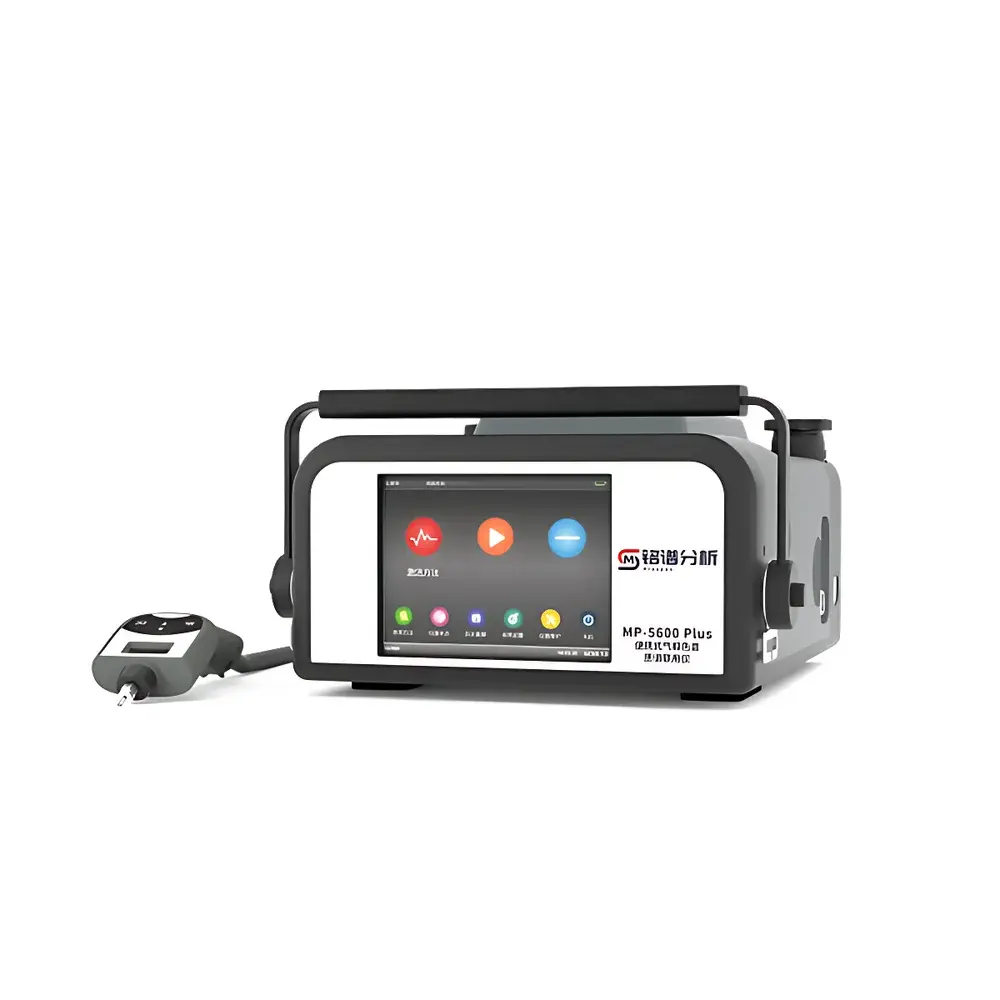
MINSPEC MP-5600Plus Portable Gas Chromatography-Mass Spectrometry System
| Brand | MINSPEC |
|---|---|
| Origin | Shandong, China |
| Manufacturer Type | Authorized Distributor |
| Country of Origin | China |
| Model | MP-5600Plus |
| Instrument Type | Portable GC-MS |
| Mass Range | 15–550 Da |
| Dynamic Range | 7 decades |
| Mass Resolution | Unit Mass Resolution |
| Maximum Scan Rate | 10,000 scans/s |
| Sensitivity | sub-ppt (gas-phase VOCs) |
| Weight | <18 kg |
Overview
The MINSPEC MP-5600Plus Portable Gas Chromatography-Mass Spectrometry (GC-MS) System is an integrated field-deployable analytical platform engineered for rapid, on-site identification and quantification of volatile organic compounds (VOCs) and semi-volatile organic compounds (SVOCs) in environmental matrices. It combines low thermal mass (LTM) fast gas chromatography with a linear ion trap (LIT) mass analyzer to deliver laboratory-grade spectral fidelity under non-laboratory conditions. The system operates on the principle of electron ionization (EI) coupled with full-scan and selected ion monitoring (SIM) acquisition modes, enabling both untargeted screening and targeted quantitation. Designed for regulatory compliance and operational robustness, the MP-5600Plus meets stringent environmental emergency response requirements—including real-time air, water, and soil analysis—without dependency on fixed infrastructure or centralized laboratories.
Key Features
- Low Thermal Mass (LTM) GC module: Enables rapid temperature ramping (up to 120 °C/min), reducing analysis cycle time to under 8 minutes for complex VOC mixtures.
- Linear Ion Trap (LIT) mass analyzer with dual curved surface geometry: Provides extended ion storage capacity, supporting dynamic range across seven orders of magnitude and unit mass resolution (FWHM ≤ 0.7 Da at m/z 502).
- Micro-cryogenic thermal desorption system: Achieves pre-concentration at –5 °C, enhancing sensitivity for low-boiling-point analytes (e.g., vinyl chloride, acetaldehyde) by up to 10× compared to conventional ambient-temperature traps.
- Integrated inertized internal standard delivery system: Delivers precise, reproducible spike volumes via heated, silanized capillary pathways; eliminates carryover and ensures quantitative accuracy across matrix-varied samples.
- High-temperature, isolated EI source: Independent ionization chamber with programmable bake-out up to 300 °C; maintains source cleanliness during high-concentration sample runs and supports GLP-compliant method validation.
- Triple-mode sampling interface: Supports direct gas-phase injection, headspace vial analysis, and solid-phase microextraction (SPME) with thermal desorption—enabling seamless transition between air, aqueous, and solid matrices.
Sample Compatibility & Compliance
The MP-5600Plus is validated for use with EPA TO-14A/TO-15 analogues, ASTM D6728, and ISO 16000-6 methodologies. It complies with Chinese national standards GB/T 32210–2015 (Technical Requirements for Portable GC-MS), HJ 1223–2021 (Emergency Determination of Ambient Air VOCs), and HJ 1227–2021 (Emergency Determination of Water VOCs). Its mechanical architecture satisfies GJB 150.16A–2009 vibration resistance specifications for mobile deployment, while environmental durability is certified per GB/T 11606–2007 (Environmental Testing for Analytical Instruments). All firmware and data handling modules are designed to support audit-ready workflows aligned with ISO/IEC 17025 and FDA 21 CFR Part 11 principles—including electronic signature capability and immutable audit trails.
Software & Data Management
The instrument is operated via MINSPEC’s proprietary GC-MS Navigator™ software, which features embedded NIST-compatible spectral libraries (≥850 compounds), automated deconvolution algorithms (AMDIS-based), and intelligent peak matching with retention index correction. Raw data files (.RAW) adhere to ANDI/NetCDF format for cross-platform compatibility with third-party processing tools (e.g., ChemStation, MassHunter, Compound Discoverer). The software includes built-in calibration curve generation, QC check routines (e.g., surrogate recovery, internal standard drift monitoring), and customizable reporting templates compliant with CNAS and provincial EPB documentation requirements. All data transfers occur over encrypted USB 3.0 or Wi-Fi 5 (802.11ac), with optional cloud synchronization for centralized fleet management.
Applications
- Environmental emergency response: Real-time detection of chemical spills, industrial fugitive emissions, and post-disaster contamination (e.g., benzene, chlorinated solvents, PAHs).
- Field-based regulatory monitoring: Compliance testing for ambient air quality (GB 3095–2012), drinking water (GB 5749–2022), and soil risk screening (HJ 25.3–2019).
- Forensic and homeland security: Rapid identification of illicit narcotics, explosives precursors (e.g., nitroglycerin, TATP), and chemical warfare agent simulants.
- Industrial hygiene: Workplace air monitoring for OSHA-permissible exposure limits (PELs) and ACGIH TLVs® of aromatic hydrocarbons and oxygenates.
- Research field campaigns: Mobile atmospheric chemistry studies, landfill emission profiling, and agricultural pesticide drift assessment.
FAQ
What sample introduction methods does the MP-5600Plus support?
It accepts gas-phase direct injection, static/dynamic headspace analysis, and SPME fiber desorption—each configurable via software-selectable inlet parameters.
Is the system compatible with U.S. EPA Method TO-15?
Yes; the LTM-GC retention time stability (<±0.02 min over 24 h) and LIT mass accuracy (<±0.2 Da) meet TO-15 performance criteria when paired with certified calibration standards.
Can the instrument be operated by non-mass spectrometrists?
Yes—the one-touch “SmartRun” mode automates method selection, tuning, calibration, and report generation based on sample matrix and target analyte class.
How is data integrity ensured during field operation?
All acquisitions include timestamped metadata, operator ID, GPS coordinates (via optional module), and cryptographic hash verification; raw files are write-once/read-many (WORM) enabled.
What maintenance is required between deployments?
Routine checks include EI source cleaning every 50 samples, column trimming every 200 injections, and annual mass calibration using perfluorotributylamine (PFTBA); no vacuum pump oil changes are needed due to sealed turbomolecular pump design.
Related Products




