
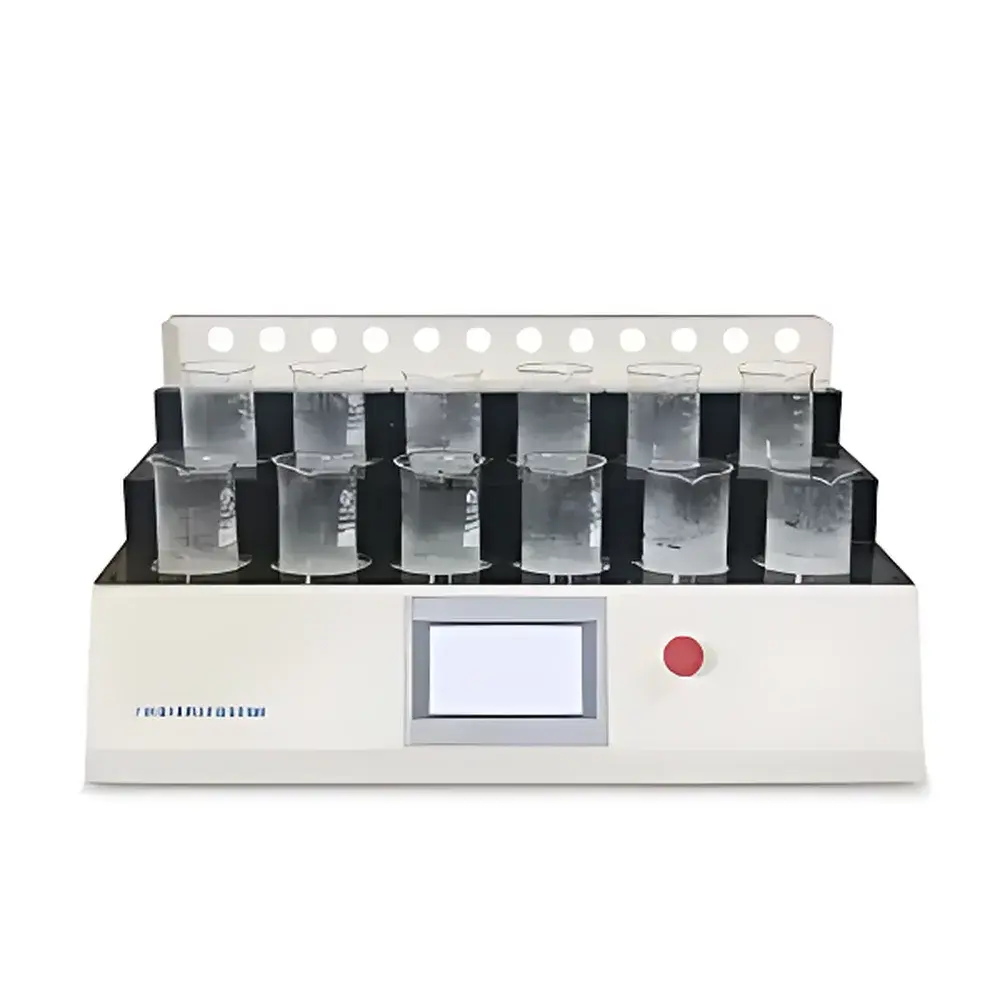
HUANKONG 7100 Automated Large-Volume Aqueous Sample Concentrator
| Brand | HUANKONG |
|---|---|
| Origin | Shandong, China |
| Manufacturer Type | Direct Manufacturer |
| Instrument Type | Automated Quantitative Concentrator |
| Heating Channels | 12 |
| Sample Vessels | Porcelain Crucibles or Glass Beakers |
| Quantitative Accuracy | ±2% (v/v) |
| Power Failure Protection | Data Retention & Auto-Resume |
| Waste Disposal | Automated Acidic Waste Drainage & Rinse Cycle |
| Safety Monitoring | Overflow Detection & Automatic Shutdown |
| Corrosion Resistance | Full PTFE-Coated Chamber + Ceramic-Fiber Heating Elements |
| Compliance | Designed for EPA Method 900.0, ASTM D5673, and ISO 11929 (Radioanalytical Applications) |
Overview
The HUANKONG 7100 Automated Large-Volume Aqueous Sample Concentrator is an engineered solution for unattended, quantitative evaporation and acid digestion of environmental water matrices—specifically developed to meet the operational rigor of radiochemical analysis, regulatory compliance testing, and high-throughput environmental monitoring laboratories. Utilizing controlled infrared-assisted thermal evaporation with ceramic-fiber heating elements, the system applies uniform, non-boil-over heat across all 12 independent channels, enabling reproducible concentration kinetics without sample splashing or analyte loss. Unlike conventional hotplate-based concentrators, the 7100 integrates real-time volume monitoring via calibrated gravimetric or optical endpoint detection (configurable per application), allowing precise termination at user-defined residual volumes—critical for isotopic yield calculations in radionuclide assays (e.g., 90Sr, 137Cs, 238U). Its architecture supports full-cycle automation: from initial sample loading through acid addition, evaporation, charring, ashing, and post-run chamber cleaning—eliminating manual intervention during overnight or multi-day runs.
Key Features
- 12-channel parallel processing with fully independent thermal control and endpoint logic per position—enabling heterogeneous sample batches (e.g., surface water, groundwater, precipitation, and air particulate leachates) to be processed simultaneously under optimized conditions.
- Ceramic-fiber heating modules delivering stable, corrosion-resistant thermal output up to 550 °C; chemically inert surface prevents metal leaching and ensures compatibility with aggressive mineral acids (HNO3, HCl, HF/HNO3 mixtures) used in radiochemical separations.
- Automated reagent handling module for timed, volumetric acid addition (HNO3 or HCl) followed by programmable dry-down and carbonization—supporting standardized salt-out procedures per EPA 900.0 and ISO 11929 Annex B.
- Integrated overflow sensing and dynamic liquid-level feedback loop: optical sensors continuously monitor meniscus height; automatic power modulation or channel suspension occurs if deviation exceeds ±0.5 mL tolerance—preventing cross-contamination and instrument damage.
- Full-system corrosion protection: PTFE-coated internal chamber walls, quartz-viewing windows, acid-resistant waste manifold with integrated neutralization trap, and sealed electronics housing rated IP54 for humid, fume-intensive lab environments.
- Embedded microcontroller with non-volatile memory retains method parameters, run logs, and calibration history—even during extended power outages; auto-resume functionality restores pre-interruption state within 15 seconds of power restoration.
Sample Compatibility & Compliance
The 7100 accommodates standard analytical vessels—including 50–100 mL porcelain crucibles (ASTM C725-compliant) and borosilicate glass beakers—ensuring compatibility with gravimetric residue determination and subsequent gamma/XRF spectroscopy. It is validated for use with EPA Methods 900.0 (Radionuclides in Water), 200.8 (ICP-MS), and ASTM D5673 (Dissolved Metals in Natural Waters), and conforms to GLP documentation requirements through timestamped, operator-locked audit trails. All firmware and control software comply with FDA 21 CFR Part 11 principles: electronic signatures, role-based access control, and immutable data archiving are enforced at the system level. The unit meets CE marking requirements for electromagnetic compatibility (EN 61326-1) and low-voltage safety (EN 61010-1).
Software & Data Management
The HUANKONG Control Suite (v3.2+) provides a browser-based interface accessible via local LAN or secure remote VPN. Users define multi-step methods—including ramp rates, hold times, acid addition volumes/timing, and final dryness thresholds—with version-controlled method libraries and exportable CSV/Excel reports. Each run generates a FAIR-compliant metadata package: instrument ID, calibration status, environmental sensor readings (chamber temp/humidity), raw weight/time series, and digital signatures of all critical actions. Audit logs record every parameter change, user login/logout, and error event—including timestamps traceable to NIST-synchronized network time protocol (NTP). Data export supports LIMS integration via HL7 v2.5 or direct SQL dump to PostgreSQL databases.
Applications
- Radioanalytical laboratories performing gross alpha/beta, 226Ra, 210Po, and transuranic nuclide analyses on drinking water, wastewater, and seawater samples per US NRC and IAEA protocols.
- Environmental monitoring agencies executing national water quality surveys requiring trace metal preconcentration prior to ICP-OES or ICP-MS analysis.
- Research institutions studying atmospheric deposition chemistry—automating evaporation of large-volume (>5 L) air filter leachates and rainwater collectors.
- Regulatory testing labs conducting compliance verification under EU Drinking Water Directive (2020/2184) and China’s GB 5749-2022 standards for inorganic contaminants.
- Geochemical core facilities preparing sediment porewater extracts for anion/cation speciation using ion chromatography and voltammetry.
FAQ
What vessel types are certified for use with the 7100 system?
Porcelain crucibles (ASTM C725 Grade A) and Class A borosilicate glass beakers (ISO 3585) are validated; quartz and PFA vessels may be used with prior thermal stability verification.
Does the system support method validation per ISO/IEC 17025?
Yes—the instrument includes built-in calibration verification routines for volume accuracy, temperature uniformity, and acid delivery precision, with documented uncertainty budgets aligned with ISO/IEC 17025 Clause 6.4.
Can the 7100 integrate with existing LIMS platforms?
It supports HL7 v2.5 messaging, RESTful API endpoints for JSON-based status polling, and scheduled SFTP transfers of completed run reports.
Is remote monitoring supported during unattended overnight operation?
Real-time web dashboard displays live channel status, temperature profiles, weight trends, and alarm history; SMS/email alerts trigger on overflow, power failure, or completion.
What maintenance intervals are recommended for long-term reliability?
Quarterly inspection of PTFE seals and ceramic heater emissivity; annual recalibration of load cells and optical sensors using NIST-traceable standards; no consumables beyond standard labware.



