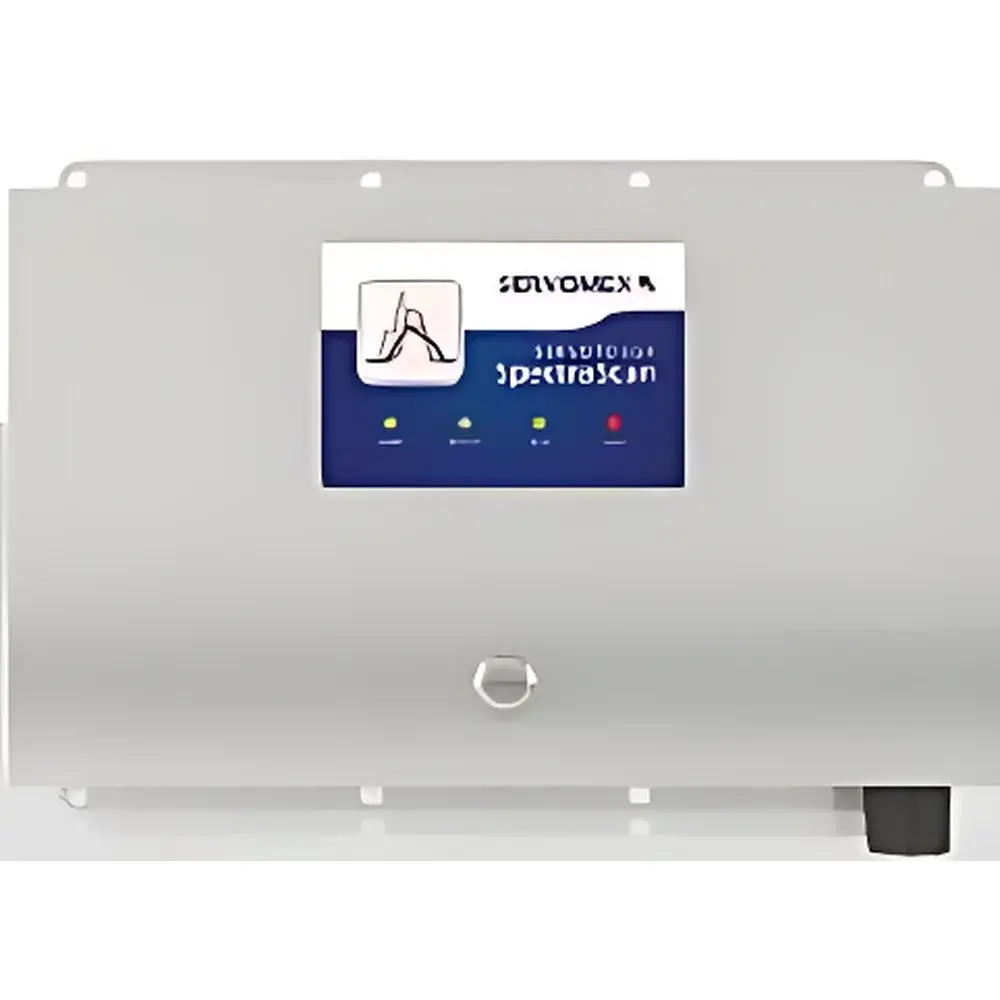
Servomex Servotouch Spectrascan 2400 Light Hydrocarbon Gas Analyzer
| Brand | Servomex |
|---|---|
| Origin | United Kingdom |
| Model | 2400 |
| Measurement Principle | Tunable Filter Infrared (TFIR) Spectroscopy |
| Detection Range | CH₄ 0–100%, C₂H₆ 0–25%, C₃H₈ 0–25%, n-C₄H₁₀ 0–10%, i-C₄H₁₀ 0–10%, C₂H₄ 0–20%, C₂H₂ 0–30%, C₃H₆ 0–20%, C₄H₈ 0–10%, n-C₅H₁₂ 0–5%, i-C₅H₁₂ 0–5%, neo-C₅H₁₂ 0–5% |
| Accuracy | ±1% FS (typical), ±3% FS (higher hydrocarbons, concentration-dependent) |
| Repeatability | ±0.05% FS (5-sec average) |
| Zero Drift | <±0.2% FS/week (no zero gas required) |
| Span Calibration | Factory-performed, permanent optical calibration |
| Response Time | Configurable update rate from 1 s to 5 min |
| Sample Flow | 0.1–10 LPM |
| Sample Pressure | 0–30 psig |
| Optical Cell Volume | 100 mL |
| Sample Temperature | 0–50 °C |
| Enclosure Options | 19″ rack-mount (3U), wall-mount (ATEX Cat 3 Zone 2 / CSA Class I Div 2), IP65-rated |
| Power Supply | 110 VAC 60 Hz / 240 VAC ±24 V |
| Operating Temperature | 0–50 °C |
| Output Interfaces | MODBUS TCP/IP (Ethernet), optional 4–20 mA analog outputs |
| Compliance | ATEX II 3G Ex nA IIC T4 Gc, CSA Class I, Div 2, Groups A/B/C/D, T4 |
Overview
The Servomex Servotouch Spectrascan 2400 is a high-performance, tunable filter infrared (TFIR) gas analyzer engineered for continuous, real-time compositional analysis of light hydrocarbons in industrial process streams. Unlike conventional fixed-filter NDIR or GC-based systems, the Spectrascan 2400 employs a patented wavelength-sweeping interferometric optical architecture that dynamically scans across the mid-infrared spectrum (typically 3–12 µm), enabling selective and simultaneous quantification of C₁–C₅ species—including alkanes (methane, ethane, propane, butanes, pentanes), alkenes (ethylene, propylene, butenes), and alkynes (acetylene)—without chromatographic separation. This TFIR methodology delivers spectroscopic resolution sufficient to resolve overlapping absorption bands, thereby minimizing cross-sensitivity and eliminating the need for carrier gases, combustion fuels, or on-site calibration standards. The analyzer is built upon the field-proven OXS-3100 optical bench platform, ensuring long-term stability and metrological traceability. Its design targets mission-critical applications where second-level responsiveness, multi-component fidelity, and operational autonomy are non-negotiable—such as natural gas custody transfer, LNG quality assurance, fuel blending control, and hydrogen-rich syngas monitoring.
Key Features
- Real-time spectral scanning with configurable update rates from 1 second to 5 minutes—enabling sub-second transient detection when averaged over short intervals
- Simultaneous, interference-compensated measurement of up to 12 hydrocarbon components (C₁–C₅), including structural isomers (e.g., n-butane vs. isobutane; 1-butene vs. isobutylene)
- Zero-gas-free operation: no external zero or span gas required; factory-applied permanent optical calibration remains stable over years under typical process conditions
- Ultra-low cross-sensitivity (<0.1% relative interference between adjacent analytes), validated per ISO 13735 and ASTM D1945 methodologies
- Robust flow-through sampling cell (100 mL volume) compatible with sample pressures up to 30 psig and temperatures from 0 to 50 °C
- Dual-hardware configuration option: single- or dual-analyzer modules housed in identical mechanical enclosures for redundancy or parallel stream monitoring
- Compliance-ready enclosure variants: ATEX Category 3G Zone 2 (II 3G Ex nA IIC T4 Gc) and CSA Class I, Division 2, Groups A/B/C/D, T4
Sample Compatibility & Compliance
The Spectrascan 2400 is validated for use with dry, non-corrosive hydrocarbon streams containing particulate levels <1 µm and dew points at least 10 °C below operating temperature. It accommodates variable flow rates (0.1–10 LPM) and operates without conditioning hardware under most pipeline or refinery off-gas conditions. All configurations meet IEC 61508 SIL 2 functional safety requirements for use in safety instrumented systems (SIS), and firmware supports audit-trail logging compliant with FDA 21 CFR Part 11 for regulated environments. The analyzer’s optical path is sealed and purged internally to prevent contamination, and its calibration integrity is maintained per ISO/IEC 17025-accredited procedures performed at Servomex’s UK manufacturing facility. Documentation includes full Declaration of Conformity (DoC), EC Type Examination Certificate (ATEX), and CSA certification reports.
Software & Data Management
The embedded Servotouch interface provides local HMI with touchscreen navigation, real-time trend visualization, and configurable alarm thresholds. Data export is supported via MODBUS TCP/IP over standard Ethernet, enabling seamless integration into DCS, SCADA, and MES platforms. Optional software packages include SpectraView™ (PC-based configuration and diagnostics) and SpectraLink™ (cloud-enabled remote monitoring with TLS 1.2 encryption and role-based access control). All measurement data include timestamped metadata (sample pressure, temperature, optical signal SNR), and raw spectral logs can be retrieved for retrospective interference analysis. Firmware updates are delivered via signed binary packages with SHA-256 verification, satisfying cybersecurity requirements outlined in ISA/IEC 62443-4-2.
Applications
- Natural gas quality monitoring: Wobbe index, heating value, and hydrocarbon dew point calculation per AGA Report No. 8
- LNG production and custody transfer: composition verification against ISO 6976 and GPA 2145 specifications
- Fuel gas conditioning for gas turbines and reciprocating engines: methane number prediction and knock resistance assessment
- Hydrogen production and purification: detection of hydrocarbon impurities (e.g., CH₄, C₂H₆) in PEM electrolyzer off-gas
- Biomethane and synthetic methane upgrading: real-time tracking of residual siloxanes and higher hydrocarbons pre-odorization
- Chemical feedstock analysis in olefin crackers and steam reformers: rapid feedback for ratio control and catalyst health monitoring
FAQ
Does the Spectrascan 2400 require periodic recalibration?
No. It uses a permanently calibrated optical bench with no consumables or drift-prone electronics. Factory calibration is traceable to NPL standards and remains valid for the instrument’s service life under specified environmental and operational conditions.
Can it measure hydrogen (H₂) concentration?
No. The Spectrascan 2400 is optimized for C₁–C₅ hydrocarbons using mid-IR absorption. For H₂ analysis, Servomex recommends the X-stream or OEM 2000 series thermal conductivity or paramagnetic analyzers.
Is MODBUS TCP/IP the only digital interface available?
MODBUS TCP/IP is standard. Optional 4–20 mA analog outputs (up to 12 channels) are configurable per component, with HART 7.5 support available on request.
What maintenance is required?
Annual visual inspection of optical windows and sample inlet filters is recommended. No routine alignment, lamp replacement, or gas cylinder management is necessary.
How is interference from water vapor or CO₂ handled?
The TFIR engine performs real-time spectral subtraction using reference channels and multivariate algorithms trained on >200 representative gas matrices, effectively suppressing common interferents without requiring external scrubbers or dryers.