
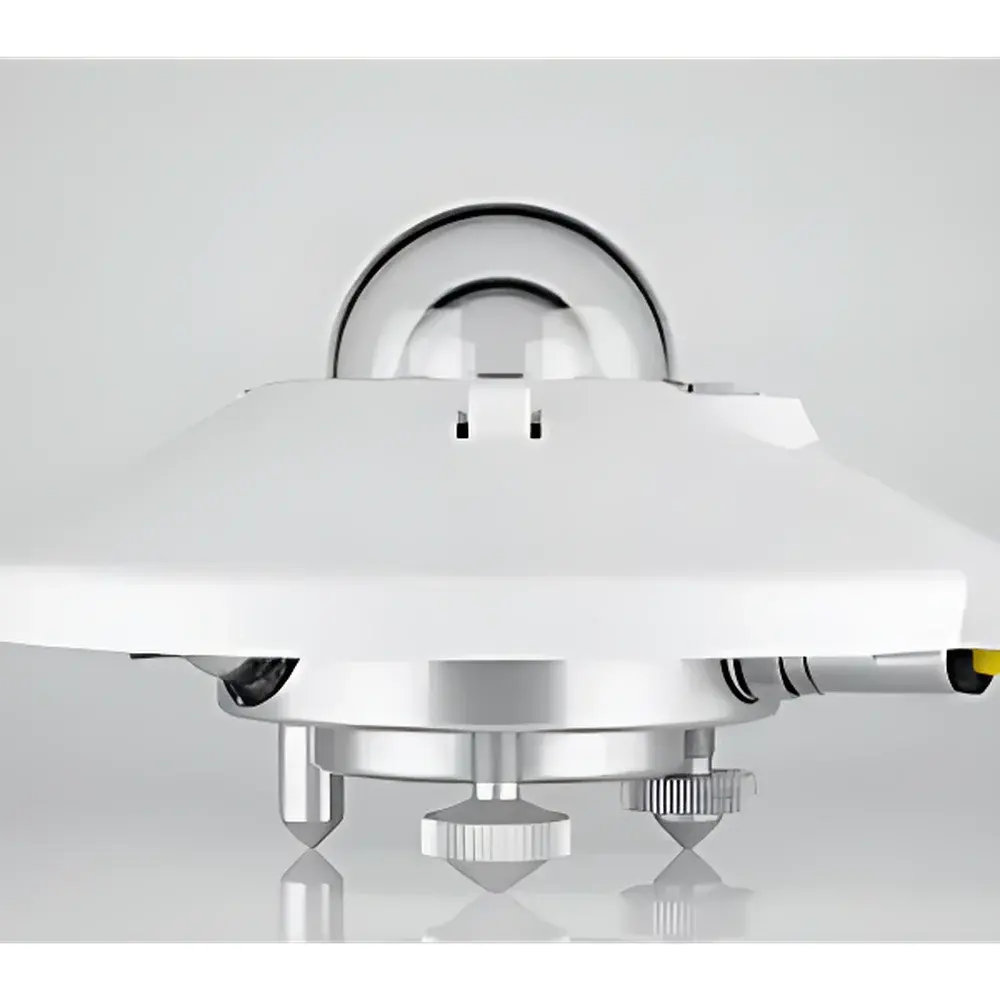
Kipp & Zonen CMP11 Pyranometer
| Key | Brand: Kipp & Zonen |
|---|---|
| Origin | Netherlands |
| Model | CMP11 |
| Spectral Range | 285–2800 nm |
| Sensitivity | 7–14 µV/W/m² |
| Response Time (63%) | < 1.66 s |
| Zero Offset A | < 7 W/m² |
| Zero Offset B | < 2 W/m² |
| Directional Error (up to 80°, 1000 W/m² beam) | < 10 W/m² |
| Temperature Dependence of Sensitivity (−10 °C to +40 °C) | < 1 % |
| Operating Temperature Range | −40 °C to +80 °C |
| Maximum Irradiance | 4000 W/m² |
| Field of View | 180° |
| Output Signal | 0–20 mV (passive, no power required) |
Overview
The Kipp & Zonen CMP11 is a thermopile-based pyranometer engineered for high-stability solar irradiance measurement in professional meteorological networks and solar energy monitoring applications. It operates on the principle of thermal detection: incident solar radiation heats a blackened thermopile sensor, generating a proportional millivolt output via the Seebeck effect—requiring no external power supply. Designed as an evolution of the legacy CMP6, the CMP11 integrates temperature-compensated detector technology first validated in the CMP22 platform, significantly reducing thermal drift and improving long-term calibration stability. Its 180° field of view ensures full-hemispherical capture of global horizontal irradiance (GHI), conforming to ISO 9060:2018 classification as a Secondary Standard pyranometer. The instrument meets IEC 61724-1 requirements for photovoltaic system performance monitoring and is widely deployed in national weather services, research-grade solar resource assessment campaigns, and utility-scale PV plant SCADA integration.
Key Features
- Passive thermopile sensor with integrated temperature compensation—eliminates need for active electronics or power supply
- Optimized response time of <1.66 s (63% step response), enabling accurate capture of rapid irradiance transients under partly cloudy conditions
- Dual zero-offset correction capability: low thermal offset A (<7 W/m²) and minimized offset B (<2 W/m²) for enhanced nighttime and low-irradiance fidelity
- Robust mechanical architecture: stainless-steel housing with anodized aluminum dome, IP67-rated waterproof connector, and gold-plated contacts for corrosion resistance and repeatable calibration exchange
- Redesigned snap-fit shading ring allows unobstructed viewing of the integrated bubble level without removal—improving installation efficiency and tilt verification integrity
- Screw-in desiccant cartridge with included replacement silica gel ensures long-term internal dryness and prevents dome fogging or condensation-related measurement drift
- Yellow signal cable with pre-terminated waterproof socket; multiple standard lengths available for flexible site deployment
Sample Compatibility & Compliance
The CMP11 is compatible with all standard data loggers accepting millivolt-level analog inputs (e.g., Campbell Scientific CR series, Delta-T DL6, Onset HOBO UX120). It requires no signal conditioning for basic GHI logging; however, for industrial control systems demanding 4–20 mA current loops or amplified voltage outputs, Kipp & Zonen’s AMPBOX signal conditioner is recommended. The instrument complies with ISO 9060:2018 (Secondary Standard class), IEC 61724-1 (Photovoltaic system monitoring), and WMO Guide to Meteorological Instruments and Methods of Observation (CIMO Guide, Chapter 7). Its spectral response (285–2800 nm) covers >95% of terrestrial solar irradiance at sea level, and its directional error profile (<10 W/m² up to 80° zenith angle) satisfies stringent network intercomparison protocols such as BSRN (Baseline Surface Radiation Network).
Software & Data Management
While the CMP11 itself is a passive analog sensor, its output integrates seamlessly into Kipp & Zonen’s SOLARLOG family of data acquisition platforms and third-party environmental monitoring software (e.g., PVsyst, Meteodyn WT, SolarAnywhere). When paired with compliant dataloggers supporting audit-trail functionality, raw mV readings can be timestamped, linearized using factory-provided calibration coefficients (traceable to PMOD/WRC), and stored with metadata including instrument serial number, calibration date, and tilt/orientation parameters. For GLP/GMP-aligned solar monitoring programs, users may configure data validation rules (e.g., physical limits checks, rate-of-change thresholds) and export calibrated W/m² values in CSV or NetCDF formats compliant with ISO/IEC 17025 reporting requirements.
Applications
- Long-term solar resource assessment for utility-scale photovoltaic and concentrated solar power (CSP) site selection
- Real-time GHI input for solar forecasting models and grid dispatch optimization
- Calibration reference for lower-tier pyranometers and pyrheliometers within regional monitoring networks
- Climate research stations requiring traceable, maintenance-light irradiance records over multi-decadal timescales
- Performance ratio (PR) and yield analysis in operational PV plants per IEC 61724-1 Annex A
- Educational laboratories demonstrating radiometric principles, atmospheric transmission effects, and sensor metrology fundamentals
FAQ
Does the CMP11 require external power?
No. It is a passive thermopile device generating 0–20 mV output directly from absorbed irradiance.
What is the recommended recalibration interval?
Kipp & Zonen recommends laboratory recalibration every two years for critical applications; annual visual inspection and cleaning are advised.
Can the CMP11 be used indoors or under artificial lighting?
It is designed for natural solar spectrum measurement. Artificial sources with non-solar spectral distributions (e.g., LEDs, halogen) will yield non-representative irradiance values due to spectral mismatch.
Is the CMP11 suitable for tilted-plane irradiance measurement?
Yes—when mounted on a fixed or sun-tracking plane, it measures plane-of-array (POA) irradiance; proper leveling and cosine correction must be applied in post-processing per ISO 9060 guidelines.
How is thermal offset corrected in data processing?
Zero-offset A (thermal emittance) and B (thermal gradient) terms are provided in the calibration certificate and applied using the formula: Ecorr = (Vout − α·Tcase − β·ΔT)/S, where S is sensitivity, Tcase is body temperature, and ΔT is dome-to-body temperature difference.
Related Products







